
WHMCS AI chatbot
WHMCS AI Chatbot: Ready-Made Module, n8n Workflow or Custom Build
A WHMCS AI chatbot answers client questions from your knowledge base, drafts ticket replies for staff and reads the logged-in client's own services and invoices. I build these for hosting companies. This page compares that custom route with a ready-made module and an automation workflow, so you can pick the cheapest one that fits.
Free scoping call of about 30 minutes · written quote within one business day · two weeks of support after delivery
By Shahid Malla, WHMCS developer and hosting infrastructure engineer · Updated
What can a WHMCS AI chatbot or helpdesk assistant do?
A WHMCS AI chatbot can do four jobs well: answer from your knowledge base, draft ticket replies, look up the logged-in client's own services and invoices, and hand off to staff.
- Answer from the knowledge base. For each question it searches your articles and policies, replies from the passages it found and links the article. When nothing matches, it says so.
- Draft ticket replies. A new ticket gets a suggested answer that an agent edits and sends. This is the WHMCS AI helpdesk job, and it is the safest place to begin.
- Look up account facts. "Why is my site down?" is often an overdue invoice and a suspended service. The assistant reads both and says so, for that client only.
- Hand off. It opens a ticket with a summary of the chat, so the agent does not start from "how can I help?".
If you only need the first and last jobs, a general AI chatbot is enough. If you want it to change things in WHMCS, that is an AI agent; chatbot vs agent explains the line.
Should I buy a module, use n8n or commission a custom build?
Buy a ready-made module if it covers your case, use an automation tool for staff-side drafts, and commission a custom build only when you need control that the other two cannot give.
| Point | Ready-made WHMCS module | Automation tool (such as an n8n workflow) | Custom build |
|---|---|---|---|
| Setup effort | Lowest. Install, activate and configure. | Medium. Someone wires the steps, prompts and error handling. | Highest. Scope, build and a test on your own tickets. |
| Control over data | Set by the vendor. Ask whether requests go straight to the model provider or through the vendor's servers. If the code is ionCube-encoded you cannot read what it sends. | High if you self-host the tool. On a hosted plan, ticket text also passes through that service. | Highest. You approve the list of fields that may leave your server. |
| What it can access | Whatever the vendor chose. It runs inside WHMCS, where it can use the client session and API roles do not apply. | Whatever the API role allows. It sits outside WHMCS and has no client session. | Only the actions written into the scope. |
| Running cost type | License fee to the vendor. Model usage is on your own provider account or included, depending on the product. | Hosting or a subscription for the tool, plus model usage and upkeep of the workflow. | Model usage, hosting for the search index, and paid changes later. |
| Fits when | Your support process is ordinary and the module's rules suit you. | You want ticket drafts for staff and already run automations. | You have unusual products, strict data rules or several systems to read. |
Which WHMCS API actions does an AI assistant need?
It needs about six, and half of them only read. These are action names from the WHMCS API reference at developers.whmcs.com.
| API action | Used for | Type |
|---|---|---|
GetClientsProducts | Product name, domain, status and next due date. | Read |
GetInvoices | Unpaid and overdue invoices. | Read |
GetTickets | Earlier tickets, for context and for the hand-off summary. | Read |
AddTicketNote | Saving a draft as a note that only staff see. | Write, internal |
OpenTicket | Turning a chat into a ticket at hand-off. | Write, low risk |
AddTicketReply | Sending an answer to the client. | Write, client-facing; added last, if at all |
The credential should start read-only and be restricted by an API role, because ticket text is written by strangers and a model can be talked into attempting things. The limit has to sit in WHMCS, where no prompt can move it. A WHMCS API credential is an identifier and a secret that take their permissions from a role, which is a list of ticked actions. I create a role with the three read actions, then add each write action when you approve it. Actions such as ModuleSuspend, ModuleTerminate and AddCredit are never ticked, so WHMCS refuses them whatever the model writes. The caller's address also goes into the API IP access restriction setting.
A role cannot limit whose data is read. That check lives in code: the client ID comes from the client-area session and is never chosen by the model. WHMCS API integration and automation covers credentials in more depth.
What data goes to the model provider, and how do I limit it?
Three things are sent: the client's message, the knowledge base passages found for it, and whatever a lookup returned. A GetClientsProducts response holds much more than a status, including the service username, so each tool passes on a short allow-list of fields and drops the rest.
- Passwords, card details and API keys are never placed in a prompt.
- Anything code can answer, such as "is this invoice overdue?", is answered in code and sent as one plain sentence.
- Logs are kept for a period you set and are readable by named staff only.
- Read the provider's current data terms for your plan, and tell clients they are talking to an AI.
Why run in draft mode before auto-reply?
Draft mode shows you how often the assistant is right on your own tickets before a client ever reads its words. In a custom build, a hook on TicketOpen or TicketUserReply triggers the draft, and the agent sees it as a private note. You then count how many drafts were sent unchanged, edited or thrown away, by question type. Auto-reply is a decision you make later with those counts in hand, one category at a time.
How do I build a WHMCS AI chatbot?
I build it in six steps, on a staging copy, and the test on past tickets comes before any client sees it.
- Scope. Departments, question types and permitted actions, in writing.
- Knowledge base clean-up. Two articles that disagree produce two different answers, so each fact gets one source.
- Retrieval. Articles are split at headings and indexed. Below a set match score the assistant does not answer.
- Tools. One small function per API action, with its arguments validated.
- Test on past tickets. Closed tickets are replayed and the drafts are compared with what staff wrote.
- Pilot on one department. Draft mode, with staff approving each reply, then a decision to widen or stop.
What will a WHMCS AI support assistant not do?
It will not make money or access decisions, and it will sometimes be wrong.
- No automatic refunds, credits, suspensions, terminations or cancellations.
- No promised resolution or deflection rate. Those depend on your articles and your clients, so I measure them on your tickets.
- No pretending to be a person. A client can always ask for staff.
- It will give wrong answers at times. Sources, testing and draft mode reduce that; nothing removes it.
Is this comparison neutral?
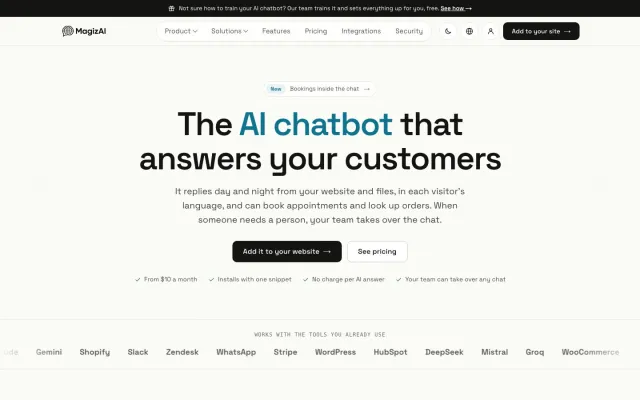
No. I own two of the ready-made options: MagizAI, an AI live chat with a free WHMCS module, which I describe on its own page, MagizAI for hosting providers, and WHMCSPilot.com, which sells WHMCS modules. I also sell custom builds, so I have a commercial interest in every route in the table above. The comparison itself names no product, so that you can apply it to any vendor. A ready-made module, from any vendor, can be the cheaper answer, and if your needs are ordinary I will say so on the call. What a WHMCS-aware chatbot needs to do gives you criteria for judging any product.
What does a custom WHMCS AI chatbot cost?
The build is a fixed quote for a written scope, or $55-$65 per hour, and the model provider bills usage to your own account. The quote grows with the number of tools, departments and languages, and with the state of your knowledge base. After the two weeks of post-delivery support, prompt changes and WHMCS upgrade checks can go under WHMCS support and maintenance.
Who this is for
- Hosting companies whose ticket queue repeats questions the knowledge base already answers
- Support managers who want reply drafts for agents before any bot talks to clients alone
- WHMCS owners weighing a ready-made AI module against an n8n workflow or a custom build
- Teams that must know exactly which client fields leave their server
What is included
- A written scope: which departments, question types and API actions are in, and which are out
- A knowledge base review listing the outdated and conflicting articles to fix first
- Retrieval over your articles, with the source article linked in every answer
- A dedicated WHMCS API role and credential limited to the agreed actions
- Lookup tools for services, invoices and tickets, locked in code to the logged-in client
- Draft mode, with suggested replies saved as staff-only ticket notes
- A test run on your past tickets, with every wrong answer reported to you
- Written handover documentation and two weeks of support after delivery
How the work runs
-
1
Scope
On a free call of about 30 minutes we pick the departments, the question types and the WHMCS actions the assistant may use. The quote follows within one business day.
-
2
Clean the knowledge base
I list articles that are outdated or contradict each other. You decide which version is true, because the assistant repeats whatever it finds.
-
3
Build retrieval
I split the cleaned articles at their headings and index them, so that each question pulls the few passages that answer it and the reply can link its source.
-
4
Add the WHMCS tools
On a staging copy I write one narrow tool per API action, each bound to the dedicated API role and to the client who is logged in.
-
5
Test on past tickets
Closed tickets are replayed through the assistant and its drafts are compared with what your staff sent. You see the failures as well as the passes.
-
6
Pilot on one department
It goes live in draft mode for one department. Staff approve or edit each reply, and we read the results together before deciding to widen it.

Guides on this topic
All guides →-
What a WHMCS-Aware AI Chatbot Needs to Do
I founded WHMCSPilot.com. Here is what an AI chatbot for WHMCS support needs to do: use account context, take only safe actions and hand off to a person.
-
AI Chatbot vs AI Agent: Which Does Your Business Need?
A chatbot answers from your content. An agent calls tools and takes actions. This guide covers what each needs, the risks, a decision table and how to add one safe action at a time.
-
WHMCS Live Chat Integration: The Upgrade-Safe Method
How to add a live chat widget to WHMCS with a hook that survives updates, identify logged-in clients safely, connect chats to tickets, and avoid the usual breakages.
Frequently asked questions
Is there an AI chatbot for WHMCS?
Yes, and there are three ways to get one. Several vendors sell ready-made WHMCS modules. Automation tools such as n8n can connect a language model to the WHMCS API. A developer can also build one to your own rules. The right route depends on how much control you need over data and behavior, and on whether your support process is ordinary enough for an off-the-shelf product.
Can a WHMCS AI chatbot reply to tickets automatically?
Technically yes, through the AddTicketReply API action. I do not start there. The first version saves each suggested answer as a staff-only note, and an agent approves or edits it. After a few weeks you can see which question types the drafts get right nearly every time, and switch on auto-reply for those alone. Everything else stays with staff.
Can the chatbot show one client another client's invoices?
Not if it is built correctly. The WHMCS API itself does not know who is chatting, and a read credential can read every client. So the client ID is fixed by server-side code from the client-area session, and the model cannot change it. Typing someone else's email address or invoice number into the chat returns nothing. I test this case before launch.
Will the assistant issue refunds or suspend services?
No. Refunds, credits, suspensions, terminations and cancellations stay with your staff. The API role I create does not include those actions, so WHMCS rejects the call even if the model is tricked into attempting one. The assistant can explain your refund policy from the knowledge base and open a ticket for the billing department with a summary.
Is an n8n workflow enough for WHMCS AI support?
For staff-side jobs, often yes. A workflow that reads a new ticket, asks a model for a draft and saves it as a note is a reasonable n8n project. It is weaker for a chat with logged-in clients, because the workflow sits outside WHMCS and has no client session, so identity checks have to be built separately. Someone also has to maintain the workflow.
What does a WHMCS AI chatbot cost?
A ready-made module costs a license fee set by its vendor. A custom build from me is a fixed quote for a written scope, or $55-$65 per hour. On top of a custom build, the model provider bills usage to your own account, and that amount depends on ticket volume and the model chosen. I add a daily spend cap and an alert so that the bill stays predictable.
What do you need from me to start?
An export of your knowledge base, a sample of closed tickets with personal details removed where you can, and a staging copy of WHMCS or permission to build one from a backup. I also need an admin who can create the API role and credential, and one person who decides which answers are correct when two articles disagree.
Related services
-
AI Chatbot Developer for Websites, Support and WHMCS
I'm an AI chatbot developer. I build custom chatbots that answer from your own documents, are built to say 'I...
-
AI Agent Development: Hire an AI Agent Developer
AI agent development for hosting and SaaS teams: agents that answer tickets from your knowledge base, update W...
-
WHMCS API Integration and Automation
I connect WHMCS to your CRM, Slack or Telegram, SMS, accounting and control panels with the API, localAPI() an...
-
WHMCS Support and Maintenance
Ongoing WHMCS care, hourly or monthly: staged upgrades, PHP changes, cron and backup checks, module updates an...
Ready to talk about your project?
Send the details and I reply within one business day with questions, an estimate and a plan.