
AI Mode website development
AI Mode Website Development: Websites That Start With a Question
I am Shahid Malla, a freelance developer who builds AI Mode websites: sites that open on one question, recommend options from your own catalog and, once the visitor confirms, create the account, place the order and send the payment link. Your normal pages stay for browsing and search engines. It suits shops, hosting companies and service businesses.
Free scoping call of about 30 minutes · written quote within one business day · two weeks of support after delivery
By Shahid Malla, Freelance WHMCS developer and web developer · Updated
What is an AI Mode website?
An AI Mode website opens on a conversation instead of a menu: the visitor reads one question, "What are you looking for?", and answers in their own words. Here "AI Mode" names a style of website, and it has no connection to Google's AI Mode search feature apart from the shared idea of asking instead of clicking.
Behind the question sits an assistant that asks what a good salesperson would ask, suggests two or three options from your catalog, then fills in the order, opens the account and sends a link to pay. The visitor makes every choice; the site does the typing. Your pages stay, with a "Browse the site" switch always on screen.
What is included in AI Mode website development?
AI Mode website development covers five parts, and the AI model is the smallest of them.
- The front door. The opening question, starting points in your customers' words, and a text box that works on a phone, by keyboard and with a screen reader (replies go to an
aria-liveregion). - An assistant that knows only your business. It answers from your pages, catalog and policies. Prices and stock are read live from your system, never from the model's memory.
- A connection to your order system. The assistant calls your store or billing API through a credential of its own, limited to the actions it needs. On WHMCS that is an API role under Configuration > System Settings > Manage API Credentials; on WooCommerce, a REST API key with only the access level required; on Shopify, a cart built with the Storefront API's
cartCreatemutation. - The browse switch. One click back to the normal site, remembered for the next visit.
- The hand-off. No answer, or a request for a person, sends your team the conversation and the cart.
The answering part overlaps with AI chatbot development; AI Mode adds a real order at the end. Google and OpenAI now let people buy inside their own assistants, which is called agentic commerce. An AI Mode website does it on your domain, with your catalog, prices and payment rules.
Which businesses suit a conversational website, and which do not?
A conversational website suits businesses whose customers know their problem but not the product name. It does little for buyers who already know what to buy.
| Business | Fit | Why |
|---|---|---|
| Hosting, domains and email | Good | Visitors describe a goal, such as a shop for their bakery, not a plan name. |
| Shops with a large catalog | Good | A few questions narrow hundreds of products to three. One order holds several items. |
| Cleaning, repairs, home services | Good | A quote needs size, address and date. The assistant collects them and books the slot. |
| Clinics | Booking only | It finds a time and a practitioner. It never asks about symptoms. |
| Travel, stays, schools, courses | Good | Dates, group size, level and budget decide the offer. |
| Web design and custom work | Fair | It can scope the job and book a call; a firm price needs a person. |
| Buyers who land on an exact product page | Poor | They have already chosen, so a conversation adds a step. |
| Sales that need meetings and a contract | Poor | It can qualify a lead; the deal happens between people. |
Can I add AI to my existing website, or do I need a new one?
You can add AI Mode to an existing WordPress, WooCommerce, Shopify, WHMCS or custom site without a rebuild, as long as your catalog and orders live in a system with an API.
- Teach it the business: pages, catalog, prices, policies and the answers staff give daily, with outdated pages removed.
- Connect the order system, so accounts, orders and invoices are real records, not a form someone retypes.
- Agree what it may do: what it does alone, what waits for the customer's yes, and what always goes to a person, written down before any code.
- Add the front door and the browse switch, then test with real questions on a staging copy, never on the live site.
On a new site I use AI-first website design: each page answers a question customers ask, so one text serves reader, search engine and assistant (see web design and development). Start with the most-asked questions and the one purchase that matters most; the platform steps are in my guide on how to add AI Mode to your website.
Will an AI Mode website hurt my search rankings?
It should not, because crawlers and visitors get the same HTML pages as before, and the conversation is a layer on top. Search engines read pages; they do not talk to your assistant.
- Pages stay server-rendered HTML. The chat script loads on top of a complete page, and the page still works if the script fails.
- Links stay real links. Navigation remains
<a href>elements, and the home page HTML keeps its headings, text and links to every main section. - The sitemap and schema stay.
sitemap.xmllists the same URLs, and the JSON-LD for products, services and the organization stays on its pages. - Conversations never become pages. Transcripts are private records, not URLs.
What safety rules does every AI Mode site I build follow?
Seven rules apply to every build.
- Grounded answers. When your pages and price list are silent, it says "I don't know, let me get someone".
- Confirm before charge. The visitor sees a summary built from your system's data, with items, total and renewal terms, and presses a button. A typed "ok" does not count.
- Payment off the chat. Payment happens on your checkout, invoice or provider's page. A card number typed by mistake is masked before it is stored or sent to the model.
- A person within reach. Complaints and refunds go to your team with the conversation attached.
- AI disclosure. In the EU, Article 50 of the AI Act makes this a legal duty from 2 August 2026. I am not a lawyer; check with yours.
- Accessibility. Keyboard, screen reader, small screens, and the visitor's language where your content allows.
- Cost caps. The AI provider bills every reply, so conversations, visitors and daily spend each have a limit, with an alert.
What will I not build?
- A chat that replaces the pages or hides them from visitors or search engines.
- A checkout that collects card numbers in the conversation, or charges without confirmation.
- An assistant that pretends to be a person, invents scarcity your stock data does not show, or keeps upselling after a no.
- Symptom checking, diagnosis or legal advice.
- A project sold on a promised conversion rate. I measure results with you and promise none.
If you only need answers, a chatbot costs less; see AI chatbot vs AI agent. Assistants that act in your back office are AI agent development.
What should I ask any AI Mode website builder?
Put these seven questions to me or anyone else, and compare the written answers.
- Where do the answers come from, and what does the assistant say when it does not know?
- Does it create real orders, accounts and invoices, or only collect requests that staff retype?
- Where does the customer type card details, and what stops a charge they did not approve?
- Can visitors switch to the normal site, and will every page stay in HTML and in my sitemap?
- How does a conversation reach my team, and how soon?
- What will AI usage cost each month at my traffic, and where is the cap?
- Can I try a live site you built and see how its conversations are logged?
My live example is ElySpace Ask AI, under recent work. Disclosure: I built it as CTO of ElySpace, my employer, not an independent client. I also founded MagizAI, an AI chatbot and live chat product.
Who this is for
- Hosting companies and domain sellers whose visitors do not know which plan they need
- Online shops with a catalog too large to browse comfortably on a phone
- Service businesses that quote or book after a few questions: cleaning, repairs, clinics, travel, courses
- Owners who want to add AI to an existing website without a rebuild or a loss of search traffic
What is included
- A list of real customer questions, used to design the conversation and to test it
- The AI Mode front door: an opening question, starting points and a remembered browse switch
- An assistant that answers from your own content and says when it does not know
- A connection to your store or billing API through a credential limited to the actions it needs
- An order summary the customer confirms, and payment on your provider's page
- Hand-off to your team with the conversation and the cart attached
- Conversation logs, per-conversation limits, a daily spend cap and alerts
- Written handover documentation and two weeks of support after delivery
How the work runs
-
1
Collect questions and pick one purchase
I gather the questions customers really ask, from tickets, chats and sales emails, and we choose the one purchase the first version must handle well.
-
2
Teach and connect
On a staging copy I load your pages, catalog and policies, and connect the order system with test payments only.
-
3
Write the rules
We list what the assistant does alone, what waits for the customer's yes and what always goes to a person.
-
4
Build the front door
The opening question, starting points, browse switch, hand-off and accessibility, on phone and desktop.
-
5
Test with real questions
Your collected questions run through the site. I send you every wrong answer, fix the cause and rerun the set.
-
6
Launch and read conversations
It goes live with logging and spending caps. In the first weeks we read real conversations together and fill the gaps.
Recent work
All case studies →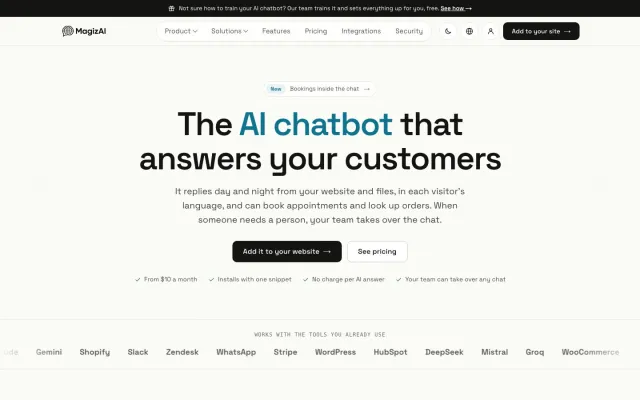

Guides on this topic
All guides →-
How to Add AI Mode to Your Website Without Losing Your Pages
A practical build guide for WooCommerce, Shopify, WHMCS and custom sites: where the assistant's knowledge comes from, how it calls your API, how payment hand-off works, and how to test, measure and cap costs.
-
AI Chatbot vs AI Agent: Which Does Your Business Need?
A chatbot answers from your content and an agent calls tools that change things. How tool calls work per the provider docs, the workflow option between them, how each is billed, and a decision table.
-
What a WHMCS-Aware AI Chatbot Needs to Do
The requirements any WHMCS AI chatbot should meet, checked against the WHMCS developer docs: identity from the session, which fields to drop, API role limits, safe actions, hand-off, and ten tests to run before launch.
Frequently asked questions
Is an AI Mode website the same as Google's AI Mode?
No. Google's AI Mode is a feature of Google Search that answers questions in an AI conversation. An AI Mode website is your own site, built to open on a conversation with an assistant that knows only your business and can place orders in your own system. The two share one idea, asking instead of clicking, and nothing else. Your site does not use Google's feature, and Google's feature does not run on your site.
Will visitors be forced to use the chat?
No. A "Browse the site" switch is visible from the first screen, and the choice is remembered on the next visit, so people who prefer menus and product pages get the normal site. Every page also stays reachable through ordinary links and from search results. The conversation is an entrance, not a gate, and I do not build versions where it becomes one.
Can the assistant take payment inside the conversation?
It sends the customer to pay; it never takes card details itself. After the customer confirms an order summary, the assistant hands over a payment link: your store's checkout, your billing system's invoice or your payment provider's page. A saved card is charged only when the customer confirms it there. Nothing is charged until that step is done, and the assistant has no permission to mark an order as paid.
How much does AI Mode website development cost?
Building it is a fixed quote per scope, sent within one business day of a free scoping call of about 30 minutes, or $55-$65 per hour if you prefer. Running it is a separate cost: the AI provider bills model usage to your own account, and it grows with traffic. I set a per-conversation limit, a daily spend cap and alerts, and report the real cost per conversation from the first weeks of logs.
Can you add AI Mode to my WordPress, Shopify or WHMCS site?
Yes, usually without a rebuild. WooCommerce has a REST API for products and orders, Shopify's Storefront API builds carts that end on Shopify's own checkout, and WHMCS has an API for clients, orders and invoices. A custom site needs an API of its own, or a small one I add. I check your platform, plugins and hosting on the scoping call before I quote.
What happens when the assistant does not know the answer?
It says so and offers a person. The assistant answers only from your pages, catalog, prices and policies; when those do not cover a question, it does not guess. It tells the visitor it will get someone, sends your team the conversation and anything already in the cart, and states your normal reply time outside working hours. The unanswered questions also show which pages you should write next.
Related services
-
AI Chatbot Developer for Websites, Support and WHMCS
I'm an AI chatbot developer. I build custom chatbots that answer from your own documents, are built to say 'I...
-
AI Agent Development: Hire an AI Agent Developer
AI agent development for hosting and SaaS teams: agents that answer tickets from your knowledge base, update W...
-
Freelance Web Designer and Developer for Business Websites
Freelance web designer and developer, 13+ years. Company websites, online stores and booking sites, designed a...
-
MagizAI: AI Live Chat for Hosting Providers That Reads WHMCS
MagizAI answers plan, DNS and billing questions from your WHMCS at any hour. Free WHMCS module, plans from $10...
Ready to talk about your project?
Send the details and I reply within one business day with questions, an estimate and a plan.