ChatGPT SEO is mostly crawler access plus ordinary SEO. OpenAI, Perplexity and Anthropic each document a search crawler (OAI-SearchBot, PerplexityBot and Claude-SearchBot) that you should allow in robots.txt and through your firewall, and Microsoft says Copilot runs on the Bing index. After that, clear, current and verifiable pages do the work. No vendor promises a citation.
ChatGPT SEO, also called generative engine optimization (GEO), is the work of making a website easy for AI search tools to crawl, understand and cite as a source in their answers. Bing's own guidelines define GEO as work that "focuses on content eligibility for grounding and reference in AI responses". The job is the same for ChatGPT search, Perplexity, Microsoft Copilot and Claude; the crawler names differ.
This guide covers the non-Google engines. For Google's AI Overviews and AI Mode, see my Google AI Mode SEO guide.
What do OpenAI, Perplexity, Microsoft and Anthropic say a site needs?
All four say, in their own documentation, that they must be able to crawl your site, and the three AI labs keep search crawling separate from AI training. I read each page below on 23 October 2026: OpenAI's crawler overview, Perplexity's crawler page, the Bing Webmaster Guidelines and Anthropic's crawler help article.
| AI search | Search crawler to allow | Training crawler | User-triggered fetcher | What the vendor says |
|---|---|---|---|---|
| ChatGPT search | OAI-SearchBot | GPTBot | ChatGPT-User | "Sites that are opted out of OAI-SearchBot will not be shown in ChatGPT search answers, though can still appear as navigational links." |
| Perplexity | PerplexityBot | None listed; PerplexityBot "is not used to crawl content for AI foundation models" | Perplexity-User | "To ensure your site appears in search results, we recommend allowing PerplexityBot" |
| Microsoft Copilot | Bingbot (the Bing index) | Not named | Not named | "Bing and Copilot search experiences rely on the same core crawling, indexing, and ranking foundation as traditional search." |
| Claude | Claude-SearchBot | ClaudeBot | Claude-User | Disabling Claude-SearchBot "may reduce your site's visibility and accuracy in user search results." |
The split matters. OpenAI says "Each setting is independent of the others": a webmaster "can allow OAI-SearchBot in order to appear in search results while disallowing GPTBot". Anthropic separates ClaudeBot (training) from Claude-SearchBot (search) the same way. You can stay out of training data and still be eligible for AI search.
User-triggered fetchers visit a page when a person asks about it. OpenAI says ChatGPT-User "is not used to determine whether content may appear in Search", and Perplexity says its user fetcher "generally ignores robots.txt rules". Anthropic says its bots honor robots.txt.
Cited pages are linked: Perplexity says "Each answer includes numbered citations linking to the original sources" (How does Perplexity work?), and Claude's web search help says "Every response includes citations".
Which robots.txt rules let ChatGPT, Perplexity and Claude find your site?
Allow the search crawlers by name, or do not block them. If your robots.txt has no group for these bots and no blanket Disallow: /, they are already allowed. This example allows search and keeps training crawlers out:
# AI search crawlers: allowed
User-agent: OAI-SearchBot
User-agent: PerplexityBot
User-agent: Claude-SearchBot
User-agent: bingbot
Allow: /

# Training crawlers: a separate business choice
User-agent: GPTBot
User-agent: ClaudeBot
Disallow: /
Blocking training is a business choice, not an SEO requirement; on my own site robots.txt allows every crawler, training included.
Changes are not instant. OpenAI says "it can take ~24 hours from a site's robots.txt update for our systems to adjust", and Perplexity says it "may take up to 24 hours".
robots.txt is only half of access. OpenAI recommends "allowing requests from our published IP ranges" (listed at openai.com/searchbot.json). Perplexity says that behind a web application firewall "you may need to explicitly whitelist Perplexity's bots", with rules for Cloudflare and AWS WAF that "combine both User-Agent string matching and IP address verification". So check bot protection at the CDN and the host as well as robots.txt; on my own site, Cloudflare's AI-bot blocking is off.
Can AI search engines find and cite this page?
Work through five checks in order; the first "no" is your next fix.
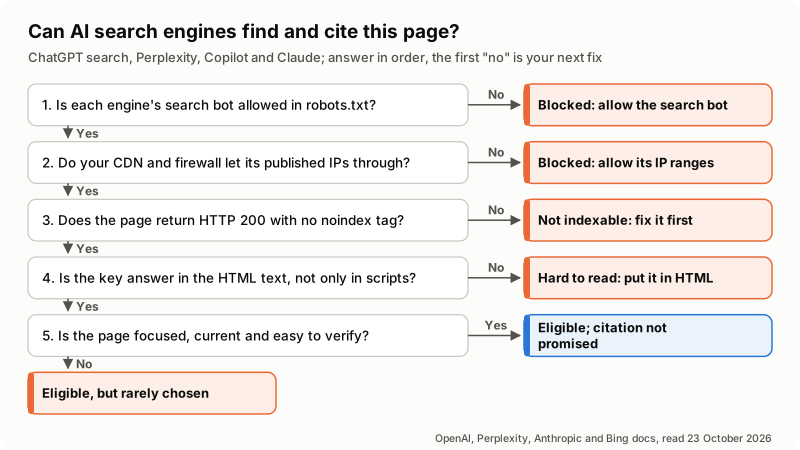
- Is each engine's search bot allowed in robots.txt? If not, allow OAI-SearchBot, PerplexityBot, Claude-SearchBot and bingbot.
- Do your CDN and firewall let its published IPs through? If not, add allow rules that match both the user agent and the vendor's IP list.
- Does the page return HTTP 200 with no noindex tag? Bing says to "Use NOINDEX when a URL should NOT appear in Bing search, Copilot experiences, or grounding API results." The other vendors' pages I read do not discuss noindex; treat a stray one as a stop sign everywhere.
- Is the key answer in the HTML text, not only in scripts? Bing lists "Hiding critical content behind client-side rendering" under things to avoid and warns that "Content that cannot be reliably rendered may not be indexed or selected for grounding results."
- Is the page focused, current and easy to verify? If yes, the page is eligible, but nobody promises a citation. If no, it is eligible but rarely chosen.
How is Copilot SEO different from ChatGPT SEO?
Copilot SEO is Bing SEO. A Microsoft post on AI search answers says experiences like Microsoft Copilot are "Powered by Bing's search index". The Bing guidelines name four discovery signals: "IndexNow URL submission", "XML sitemaps", "Crawlable internal links" and "External links from relevant websites".
Freshness is where Bing differs most. It asks for IndexNow pings when URLs are added, updated or removed, because "Timely notifications help Bing refresh the index and reduce outdated or incorrect URL references in Copilot responses and grounding results." IndexNow is a ping protocol that "has support from Microsoft Bing, Naver, Seznam.cz, Yandex, Yep." On my own site, every publish sends an IndexNow ping.
Bing also documents how meta directives affect Copilot:
| Directive | Effect in Bing and Copilot, per Bing's guidelines |
|---|---|
robots.txt Disallow | "robots.txt controls crawl access, not indexing." |
noindex | Keeps a URL out of "Bing search, Copilot experiences, or grounding API results". |
nosnippet and data-nosnippet | "prevent Bing from displaying captions and may limit Copilot citation quality." |
noarchive | "prevents content from being used in Copilot responses and grounding results." |
nocache | "limits Copilot to using only the URL, title, and snippet, reducing citation depth and answer quality." |
Check the noarchive row first on older sites: a tag added years ago to stop cached copies now keeps the page out of Copilot answers. Local businesses can also register with Bing Places for Business, which Microsoft's AI Performance announcement says keeps address, hours and contact details "eligible for inclusion in AI-generated responses."
What content do AI search vendors say gets cited?
Of the pages I could read today, only Microsoft's give detailed content guidance; the OpenAI, Perplexity and Anthropic pages cover crawlers. Bing asks for pages where:
- "Facts and definitions are explicit" and "Important information is visible on the URL itself".
- The page has one subject: "URLs focused on a primary topic are more likely to be selected for grounding results."
- The answer comes first: "Place essential information near the top of the URL".
- The content stays current: "Update content when facts or guidance change."
Microsoft's post adds that "Assistants like Copilot break content down, a process called parsing, into smaller, structured pieces", and that question-and-answer pairs can be lifted "word for word into AI-generated responses." It warns against hiding answers in tabs, since "AI systems may not render hidden content", or putting key facts only in images or PDFs.
In practice: one question per heading, the answer in the first sentence under it, sourced facts and a visible review date.
Which ChatGPT SEO tactics are myths?
Several tactics sold as "AI SEO" are not in any vendor's documentation, and some appear on Bing's list of abuse.
| Commonly recommended | What the vendors' own pages say |
|---|---|
| You need llms.txt to appear in AI search | llms.txt is "A proposal to standardize on using an /llms.txt file to provide information to help agents use a website." None of the OpenAI, Perplexity, Anthropic or Bing pages above lists it. Google says "You don't need to create new machine readable files, AI text files, or markup" (AI features). |
| Special AI schema gets you cited | Bing: "Structured data may support clearer grounding but does not guarantee visibility or grounding traffic. Markup must accurately reflect visible content." |
| Buy links, mentions or list placements | Bing lists "link buying, link spamming, private networks, and artificial social promotion schemes that simulate popularity" as abuse. |
| Hide instructions for AI in the page | "Attempts to add content designed to manipulate or interfere with language models used by Bing or Copilot may result in reduced visibility or removal from search experiences." |
| Repeat question phrases to trigger citations | "Content should be created for users, not to manipulate ranking systems or trigger citations or AI responses." |
| Mass-produce AI pages for every query | Bing says content generated at scale without editorial review "may be excluded from indexing". |
| Blocking GPTBot hides you from ChatGPT search | OpenAI: "Each setting is independent of the others". |
On my own site I publish llms.txt and llms-full.txt anyway; they cost little and may help agents, but none of the search documentation above mentions them, so I do not count them as a search lever.
How do you measure traffic from ChatGPT, Perplexity and Copilot?
No single report covers every assistant, so use three.
| Where | What it shows | What it does not show |
|---|---|---|
| GA4 "AI Assistant" channel | Visits referred by AI assistants | Visits that arrive with no referrer; Google's AI Overviews and AI Mode |
| Bing Webmaster Tools AI Performance | Citations in Copilot, AI summaries in Bing and select partners | Clicks or traffic |
| Server logs | Whether OAI-SearchBot, PerplexityBot, Claude-SearchBot and bingbot crawl your pages | Whether a crawl led to a citation |
Google's default channel group page says: "AI Assistant is the channel by which users arrive at your site from sources like ChatGPT, Gemini, Deepseek, Copilot, or Grok. It excludes Google's AI Overviews and AI Mode." It applies only "if the referrer matches a list of AI Assistants", and Perplexity and Claude are not named, so also check the Referral channel.
For Copilot, the AI Performance report in Bing Webmaster Tools shows Total Citations, cited pages and "grounding queries", which "are not full user questions or prompts." Bing's caveats: citations do not "represent traffic, clicks, or user engagement", and the data "represents a sample of overall citation activity."
In server logs, verify a bot by user agent and IP, using lists such as perplexitybot.json. A crawl is not a citation, but no crawl means no chance. Once a month, also ask the assistants the questions your buyers ask and note which sources they cite; that is a small sample, not a ranking report.
What is the technical checklist for ChatGPT search, Perplexity and Copilot?
- Allow OAI-SearchBot, PerplexityBot, Claude-SearchBot and bingbot in robots.txt on every subdomain.
- Allow the vendors' published IP ranges at the CDN, firewall and host.
- Verify the site in Bing Webmaster Tools, submit an XML sitemap and send IndexNow pings on changes.
- Remove stray
noindex,noarchiveandnocachetags from pages you want cited. - Serve the main text in the HTML; do not hide answers in tabs, images or PDFs.
- Keep structured data matched to the visible page.
- Put one topic per URL, the answer first and a review date on the page.
- Watch the GA4 AI Assistant channel and Bing's AI Performance report monthly.
What can nobody promise about AI search citations?
Nobody can promise that ChatGPT, Perplexity, Copilot or Claude will cite your page. Bing says so directly: "SEO does not guarantee rankings or traffic, and GEO does not guarantee grounding or citations in AI experiences."
A developer controls crawler access, status codes, rendering, freshness signals and accuracy. Which questions people ask, which model answers and which sources it picks are the vendors' decisions. Bing's AI Performance help says citation trends "cannot be attributed to a specific cause or event". Be wary of anyone who sells a promised AI placement.
These checks belong in the build of any new site, not in a later add-on; if you want them handled, I build sites as a freelance web designer and developer.
What else do people ask about ChatGPT SEO?
How do I get my website to show up in ChatGPT search?
Allow OAI-SearchBot in robots.txt and let OpenAI's published IP ranges through your firewall, as OpenAI recommends. Then make sure the page returns HTTP 200 and carries its answer in plain HTML. OpenAI gives no timeline for inclusion, only about 24 hours for a robots.txt change to register.
Does ChatGPT search use Bing?
OpenAI's crawler page, the only OpenAI page I could read on 23 October 2026, does not say which search providers ChatGPT uses; it documents OAI-SearchBot. Being in Bing is still worth it, because Copilot depends on it.
Does blocking GPTBot remove my site from ChatGPT?
Not from ChatGPT search. OpenAI says GPTBot (training) and OAI-SearchBot (search) are independent settings; blocking OAI-SearchBot is what keeps pages out of ChatGPT search answers.
How do I rank in Perplexity?
Perplexity publishes no ranking factors on the pages I read. Its crawler page says to allow PerplexityBot and its published IP ranges. Beyond access, the content advice in this guide comes from Microsoft, not Perplexity.
Can I pay to appear in ChatGPT answers?
ChatGPT has ads: OpenAI's crawler page describes OAI-AdsBot, which is "used to validate the safety of web pages submitted as ads on ChatGPT." That is advertising. Buying links or mentions to sway organic answers is what Bing's guidelines list as abuse.
If you also want your own website to answer visitors the way these assistants answer questions, that is a separate build: see AI Mode website development, or read how to add AI Mode to your website and AI chatbot for your website first.
Disclosure: I am a freelance developer who builds websites and AI chat features, so I am not neutral. I am not affiliated with OpenAI, Perplexity, Microsoft, Anthropic or Google. I am CTO at ElySpace, a freelance developer for Marmaids LLC, and founder of WHMCSPilot and MagizAI. Quotes come from the vendors' pages as I read them on 23 October 2026; OpenAI's help center blocked automated reading that day, so nothing here is quoted from it.
Last reviewed 23 October 2026.