Hire an AI chatbot development company when the bot needs several people at once, someone on call around the clock, a supplier your procurement rules accept, or many systems launched together. Hire a freelance developer when one person can build, test and maintain one well-scoped chatbot and you want to deal with that person directly. I am an independent developer, so I am not neutral.
An AI chatbot development company is a firm whose staff, usually developers, testers and a project manager, build and often run chatbots on large language models under a company contract. A freelance chatbot developer is one independent person who does the same build work under their own name. The software is the same kind either way; what differs is who is accountable, who covers for whom and what the paperwork looks like.
This guide compares only who builds the bot. If you have not decided whether you need a custom build at all, read ready-made tool or custom build first, because a monthly product often beats both options.
How does an AI chatbot development company compare with a freelancer?
They differ in capacity, cover and paperwork, not in the model or the code. The table covers the points specific to chatbot work.
| Point | AI chatbot development company | Freelance developer |
|---|---|---|
| Who does the work | A team for retrieval and prompts, the widget and testing, with a manager in between. Ask who is assigned. | One person does all of it. Ask whether any part is passed on. |
| Testing the answers | A tester can run the question set apart from the builder. | The builder tests their own work, so ask to see the question set and every failed answer. |
| Hand-offs after launch | Can staff an inbox or an on-call rota, if you pay for one. | One person's hours in one time zone. Your staff answer hand-offs. |
| Model changes | The team reruns tests when a provider retires a model, under a support contract. | The same person, if available; otherwise whoever inherits the handover notes. |
| Several channels at once | Website, WhatsApp, voice and a CRM link built in parallel. | One after another. |
| Contracts | Master agreement, statements of work, a data processing agreement, often insurance and security questionnaires. | A shorter agreement or a marketplace contract. May not meet a large company's supplier terms. |
| Smallest job | Many list a minimum project size, shown below. | Usually none: hours or a fixed quote. |
Hourly rate is missing on purpose. On Clutch's own data it does not split neatly into company and freelancer, as the next section shows.
What does an AI chatbot development company charge per hour?
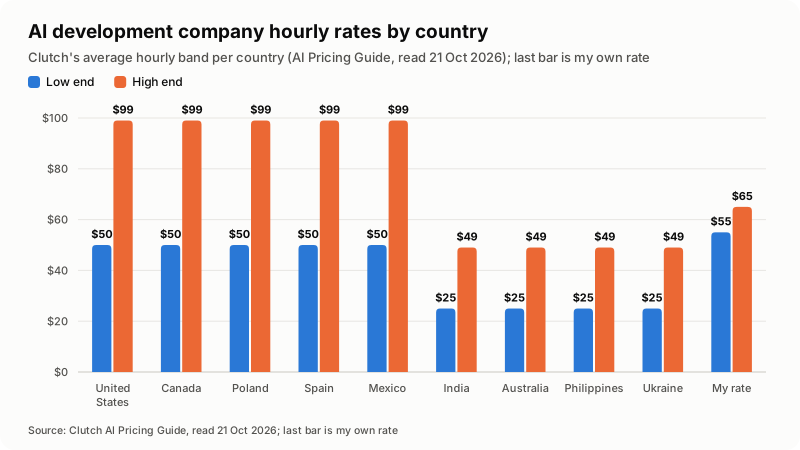
Most AI development companies listed on Clutch charge $25 to $49 an hour, according to Clutch's AI pricing guide as I read it on 21 October 2026, and it gives the same band for chatbots. The band depends more on where the company is than on its being a company.
| Where the company is | Average hourly cost on Clutch |
|---|---|
| United States, Canada, Poland, Spain, Mexico | $50 to $99 |
| India, Australia, Philippines, Ukraine | $25 to $49 |
| United Kingdom | Shown as unknown |
| Shahid Malla, freelance (my own rate, not Clutch data) | $55 to $65 |
My rate sits inside the band for US, Canadian and Polish companies, and above the band for companies in India, where I live. So a freelancer is not automatically cheaper per hour. Clutch says the figures come from reviews by verified clients but gives no review count.
The same guide puts the average AI project reviewed on Clutch at $120,594.55, about $11,553.45 a month, with 10 months as the typical timeline. Those averages cover all kinds of AI work, not only chatbots, so they are not a chatbot price. By my planning estimate, a chatbot that answers from your documents is 35 to 70 hours, or $1,925 to $4,550 at my rate; the breakdown is in what an AI chatbot or agent costs to build. Compare the total for one written scope, never the rate alone.
Will an AI chatbot development company take a small project?
Often not, because many list a minimum project size above what one document-answering chatbot costs. On 21 October 2026, 23 of the first 24 listings in Clutch's Top Artificial Intelligence Companies directory showed a minimum. All 23 set it at $5,000 or more, and 21 at $10,000 or more.
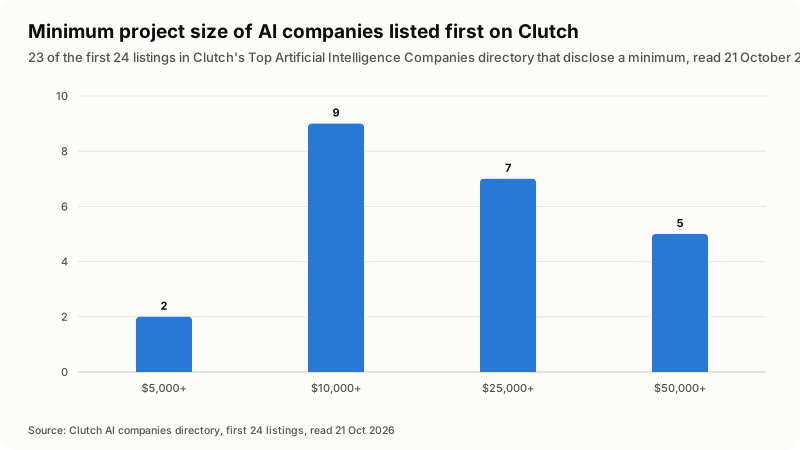
| Minimum project size shown | Companies |
|---|---|
| $5,000+ | 2 |
| $10,000+ | 9 |
| $25,000+ | 7 |
| $50,000+ | 5 |
| Not disclosed | 1 |
Clutch labels the top of the list "Sponsored" and says "We may earn a fee for some placements", so these are the companies a buyer sees first, not a sample of the 32,080 the directory reports. A minimum is a floor, not a price, and a company may fold a small bot into a paid discovery phase. But one bot on one site can fall below these floors, and then a freelancer or a ready-made tool is the realistic route.
When is an AI chatbot development company the better choice?
A company is the better choice when the work or the risk needs more than one person. If two of these describe your project, I would tell you to hire a company.
- Hand-offs around the clock. If a chat that escalates at 3 a.m. must reach a named person within minutes, you need a rota. One freelancer cannot be a rota.
- Regulated data. Health, finance or legal work where your compliance team requires audited supplier controls and security questionnaires. Ask every supplier for what your team needs on day one; if a freelancer cannot provide it, that settles it.
- Procurement rules. Approved supplier lists, purchase orders, insurance certificates and terms a one-person business may not be able to sign.
- Large integrations at once. A bot that reads a CRM, an order system and a helpdesk, answers a phone line and launches on one date.
- Many languages, brands or business units, each with its own content owners.
- No technical owner on your side. A company on a support contract becomes that owner.
When is a freelance chatbot developer the better choice?
A freelancer is the better choice when one person can hold the whole bot in their head: one knowledge base, one or two channels, one owner on your side.
- One chatbot that answers from your documents, with hand-offs to staff you already have.
- A proof of concept to test whether your content can support a bot before a long contract with anyone.
- A budget below company minimums.
- Direct accountability. The person who wrote the retrieval and rules answers when a reply goes wrong.
- An in-house developer will take over and needs code written for handover.
Vet a freelancer with live work you can open and a small paid test task. My guide on how to hire a Claude Code developer sets out that test task, and it works for chatbot developers too.
Which is faster, a company or a freelancer?
A freelancer usually starts sooner; a company can finish a large scope sooner. My own start is a free scoping call of about 30 minutes and a written quote within one business day, while a company's onboarding can add a master agreement, a statement of work and your security review. For one chatbot, calendar time depends mostly on how fast your questions and documents arrive, not on headcount. For several channels at once, parallel people finish sooner. Either way, ask for work in a staging copy and regular updates; my routine is on how I work.
What happens to your chatbot if the builder disappears?
It keeps working only while its accounts are paid and its content stays current, so continuity depends on what you hold, not on who built it. A chatbot runs on a live model account and an index of your documents, and someone must retest it whenever a provider retires a model. Company staff leave too; with a freelancer the risk sits in one person. The fix is the same: hold these in your own name.
| What to hold | Why it matters |
|---|---|
| The AI provider account and API keys | The provider's contract is with the account holder. |
| The vector database or search index | It holds your indexed documents; without it the bot cannot answer. |
| The hosting account and widget code | Where the bot runs and how it appears on your site. |
| The system prompt, rules and hand-off triggers | The bot's behavior, hard to rebuild from memory. |
| The evaluation question set and last results | The only way the next developer can prove nothing broke. |
| The scripts that index your documents | They rebuild the index when content changes. |
Who owns the chatbot's code, outputs and data?
You should, and with a chatbot that includes the AI provider account. Anthropic's Commercial Terms of Service, effective 17 June 2025 and read on 21 October 2026, are "an agreement between Anthropic and you or the organization, company, or other entity that you represent". The customer "(a) retains all rights to its Inputs, and (b) owns its Outputs", and "Anthropic may not train models on Customer Content from Services."
So if the builder opens the account under their own business, those rights sit with them. Open it in your company's name and add the builder as a member. OpenAI publishes its own business terms; its page blocked my reader today, so read the current version yourself. For the code, prompts and question set, the written-assignment advice in my web design agency vs freelancer guide applies unchanged; name the prompts and evaluation set in the assignment.
Conversation logs are personal data. If the builder stores them for you, the ICO's guidance on contracts, read on 21 October 2026, applies: "Whenever a controller uses a processor, there must be a written contract (or other legal act) in place." The processor must delete or return the data at the end, at your choice, and may use a sub-processor, such as the model provider, only with your prior authorization. That is UK GDPR; other laws differ, and I am not a lawyer.
What should the contract say, whichever you hire?
The same list works for a company and a freelancer. Check each item in writing before the first payment.
- The AI provider account, index and hosting are in your company's name, with the builder added as a user.
- Code, prompts, rules and the evaluation question set are assigned to you on payment.
- A data processing agreement is signed if anyone outside your staff will store conversation logs.
- Named people: who builds, who tests, and who answers failed hand-offs, in which hours.
- The question set and its results are delivered with the code.
- A rule for model changes: who reruns the tests, and at what rate.
- An exit plan: logs deleted or returned, and the index exported or its rebuild scripts handed over.
How do you decide between a company and a freelancer?
Answer five yes-or-no questions in order and stop at the first that reaches an outcome. The flow and the table carry the same rules.
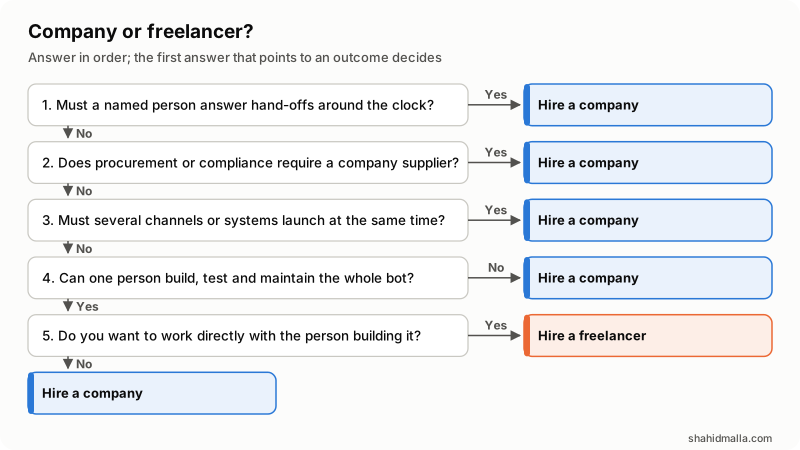
| Question | If yes | If no |
|---|---|---|
| 1. Must a named person answer hand-offs around the clock? | Hire a company | Go to 2 |
| 2. Does procurement or compliance require a company supplier? | Hire a company | Go to 3 |
| 3. Must several channels or systems launch at the same time? | Hire a company | Go to 4 |
| 4. Can one person build, test and maintain the whole bot? | Go to 5 | Hire a company |
| 5. Do you want to work directly with the person building it? | Hire a freelancer | Hire a company |
What else do people ask about AI chatbot development companies?
How long does it take to build an AI chatbot?
A chatbot that answers from your documents is 35 to 70 hours of my work by my planning estimate; the calendar time depends mostly on how quickly your questions and documents arrive. Clutch's typical 10-month timeline covers all kinds of AI development projects, not only chatbots.
Should I hire an AI chatbot development company in India or the USA?
Clutch shows $50 to $99 an hour as the average band for US AI companies and $25 to $49 for India. Time-zone overlap for hand-offs, the contract's governing law and where your data is processed matter as much as rate. I work from India and charge above Clutch's India band, so compare written scopes, not countries.
What does it mean to hire dedicated chatbot developers?
It is a staffing model: a company assigns developers to your project full time for a monthly fee, and you direct the work. You gain capacity but do the project management yourself. Ask whether the named person can be swapped without your approval.
Who owns the code generated by AI on a chatbot project?
Between you and the model provider, the provider's terms decide; Anthropic's say the customer owns its outputs, which is why the account should be yours. Whether AI-assisted code is protected by copyright is a separate legal question. Get the builder's rights assigned to you in writing either way.
If your answers point to a freelancer, my AI chatbot development page shows what I build, how I test it on your customer questions and what it costs; send me your scope there for a written quote within one business day.
Last reviewed 21 October 2026. Disclosure: I am an independent AI chatbot developer, not a company, and I sell the freelance option compared here, so I am not neutral. I am CTO at ElySpace, a freelance developer for Marmaids LLC, and founder of WHMCSPilot and MagizAI, an AI chatbot product. Clutch figures and quoted terms are as I read them on that date.