Mobile app development cost depends on screens, user roles, the backend and payments far more than on the framework. With me, fixed-price packages start at $329 for fixes and $999 for a six-screen Android and iOS MVP, and larger scopes are $55-$65 per hour or one fixed quote. Add Apple's $99 yearly membership, Google's $25 one-time fee and a yearly maintenance release.
Mobile app development cost is the total you pay to get an app built, into the Apple App Store and Google Play, and kept working there. It has four parts: the build, the store accounts and commissions, the services the app runs on, and the updates the stores require every year.
Every price here is either my own published price or a figure I read on an Apple, Google, Firebase or US government page on 3 November 2026, linked where it appears. I do not repeat the wide ranges in agency cost guides, because I cannot see what those projects included. Prices are in US dollars, for buyers in the United States, Canada and Australia.
What decides how much a mobile app costs?
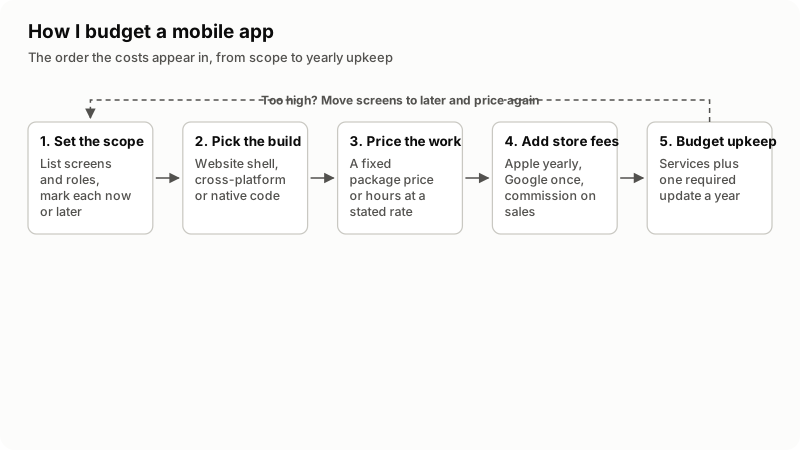
The scope decides it: how many screens, how many kinds of user, whether the app needs its own server, how money moves, and which phone features it uses. Two quotes for "the same app" usually differ because each provider assumed different answers to those questions.
| What you add | Why it costs | The cheaper version for version one |
|---|---|---|
| More screens | Each has loading, empty and error states on small and large phones | A screen list with every item marked now or later |
| More user roles | Customer, staff and admin each need their own views and permission checks | One role in the app; staff use a browser admin panel |
| Your own backend and admin panel | An API, its hosting and security, and a panel staff can use | Firebase, or the API of the site or store you already run |
| Payments | Store billing rules, server receipt checks, refunds and restore buttons | One subscription, or your existing checkout for physical goods |
| Offline use with sync | Changes made on two offline devices must merge without losing data | Online only, with a clear no-connection screen |
| Widgets, watch apps, heavy Bluetooth | Written natively in Swift and Kotlin, outside the shared code | A later version, priced on its own |
One more line moves the price at the end: unclear acceptance criteria. If nobody wrote down what "finished" means, the last weeks go into arguing about it.
Should you go native, cross-platform or turn your website into an app?
For most business apps, cross-platform is the cheaper route, because one Flutter or React Native codebase builds both the Android and the iPhone app. A website in an app shell costs less still, with one catch from Apple.
| Approach | Codebases | When it fits | Cost catch |
|---|---|---|---|
| Your website in a native shell | One small shell; pages come from your live site | A site that already works well on phones, with returning users | Apple can reject a repackaged website |
| Cross-platform (Flutter or React Native) | One, shared by both platforms | Forms, bookings, catalogs, accounts, chat and payments | Two store reviews, even with one codebase |
| Native (Swift and Kotlin) | Two, one per platform | Widgets, watch apps, heavy Bluetooth or augmented reality at the core | Every feature is written and maintained twice |
The Apple catch is guideline 4.2, Minimum Functionality, in the App Review Guidelines: an app should offer features, content and interface beyond a repackaged website. So a website app needs push notifications, native navigation or device features to stand a fair chance. My mobile app development page compares Flutter and React Native in more detail.
What does a mobile app cost with me?
A fixed price from my package list when the job fits a package, or $55-$65 per hour turned into one fixed quote when it does not. These Starter prices are from my mobile app packages, for Android and iOS from one codebase.
| Package | Starter price | What Starter covers | Listed delivery |
|---|---|---|---|
| Mobile App MVP | $999 | Up to 6 screens, sign-up and login, Firebase, test builds | 14 days |
| Website to Mobile App | $499 | Native shell, push notifications, offline screen | 7 days |
| Ecommerce Mobile App | $899 | Catalog, cart and order push from your store, its checkout | 14 days |
| Booking and Appointment App | $799 | Up to 10 services and 3 staff, reminders, admin panel | 14 days |
| WHMCS Client Mobile App | $699 | Services, invoices and tickets through the WHMCS API | 12 days |
| App Store and Google Play Publishing | $349 | One store: signed build, listing, privacy forms, submission | 4 days |
| In-App Purchases and Subscriptions | $449 | Up to 3 products, paywall, purchase and restore | 6 days |
| Mobile App Bug Fix and Update | $329 | Code review, up to 3 fixes, build restored on current tools | 3 days |
Read the Starter rows for what they leave out. The Mobile App MVP Starter plan puts the app on testers' phones but does not submit it to the stores; the Business and Premium plans add an API, an admin panel, push notifications and submission to both stores, priced on the package page. Store review comes on top of every delivery time, and Apple and Google decide how long it takes.
For a sense of the hourly rate, the US Bureau of Labor Statistics Occupational Outlook Handbook gives a median wage of $64.44 per hour, or $134,040 a year, for software developers, quality assurance analysts and testers in May 2025. That is an employee's pay before the employer's other costs, so it is a floor for in-house work, not a price. An agency adds project managers, designers and overheads on top of developer hours, which explains most of the gap between agency and freelance totals.
I work remotely; the page for your country covers time zones and contracts: United States, Canada or Australia.
What do Apple and Google charge to publish and sell an app?
Apple charges $99 per membership year and Google charges $25 once; both take a commission only when you sell digital content or features through the app. The table is what their own pages said on 3 November 2026.
| Charge | Apple App Store | Google Play |
|---|---|---|
| Developer account | 99 USD per membership year, shown in local currency during enrollment; fee waivers for eligible nonprofits, schools and government bodies | US$25 one-time registration fee; prepaid cards not accepted |
| Company account | A legal entity with a D-U-N-S Number and a working website on its own domain | An organization account; personal accounts must also meet testing and device verification requirements |
| Paid apps and in-app purchases | 15% in the Small Business Program, open to new developers and those with up to 1 million USD in proceeds the prior calendar year | US and Australian users: 10% plus a 5% billing fee on the first $1M a year. Canada: 15% on the first $1M for developers in the 15% tier, 30% above (service fees) |
| Auto-renewing subscriptions | You receive 70% in a subscriber's first year and 85% after it, or 85% throughout in the Small Business Program (subscriptions) | US and Australia: 10% plus a 5% billing fee. Canada: 15%, at any earnings level |
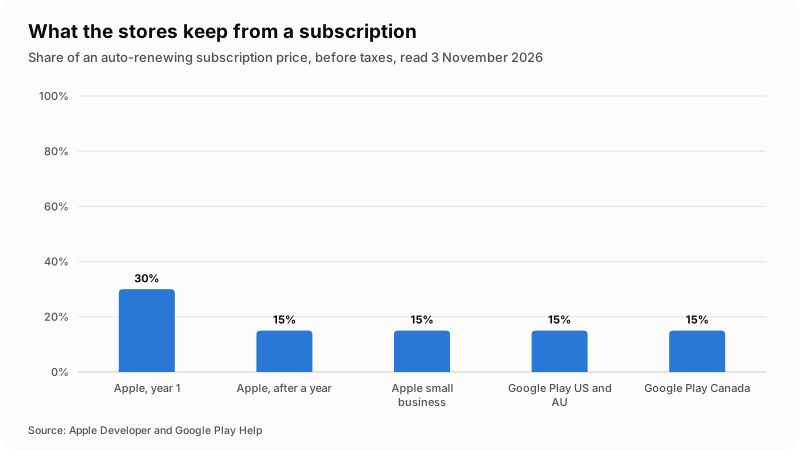
In words: only one case costs 30%, a subscriber's first year on Apple's standard terms. Apple after a year, Apple's Small Business Program, and Google Play in the US, Australia and Canada all come to 15%. Apple's lower rate needs an approved enrollment in the program, so apply before launch.
Three rules matter more than the percentages. Google's new structure applies from 30 June 2026 in the US and 30 September 2026 in Australia; above the first $1M a year, purchases other than subscriptions cost 20% plus the billing fee from users who first installed or updated the app on or after that date, and 25% plus the fee from earlier installs. Apple's guideline 3.1.3(e) says physical goods and services used outside the app must be paid for by other methods, such as Apple Pay or card entry, so a booking or shopping app pays no store commission. And on the United States storefront, Apple lets apps include buttons and external links to other ways of paying for digital content.
What does a mobile app cost to run after launch?
The recurring bill is Apple's yearly membership, the services the app runs on, and at least one maintenance release a year. At small volumes the services can cost nothing: Firebase's no-cost Spark plan covers sign-in for up to 50,000 monthly active users and 1 GiB of Firestore data with 50,000 reads and 20,000 writes a day, and lists push messaging, Crashlytics and Analytics as no-cost. File storage needs the pay-as-you-go Blaze plan, and sign-in by text message is billed per SMS.
The maintenance release is not optional, because both stores raise their minimums every year:
- Google Play's target API level requirement: from 31 August 2026, new apps and updates must target Android 16 (API level 36), and existing apps targeting Android 14 or lower stop reaching new users on newer phones.
- Apple's upcoming requirements: since 28 April 2026, uploads must be built with Xcode 26 or later using the iOS 26 SDK.
- Payment, login and push SDKs change on their own schedule, and an outdated one can stop a build.
That yearly update is what my Bug Fix and Update package covers, from $329; larger apps get a quote after I read the code. For steady work after launch, my guide on retainer versus hourly compares a monthly developer retainer with hourly work.
Re-check these figures every year: Apple's membership fee, Google's registration fee, both commission tables, Google's target API level, Apple's minimum Xcode and SDK, Firebase's no-cost limits, and the BLS wage, which is republished annually.
How do you compare mobile app quotes?
Send every provider the same written screen list, then compare hours, rate and exclusions rather than totals. Use this short checklist on every quote:
- Does its screen list, marked now or later, match yours?
- Which framework and which backend, and why?
- Is submission to both stores included, or only test builds?
- Are the developer accounts in your name, and do you receive the repository and signing keys?
- Are store fees, hosting, SMS and maps listed as excluded?
- How long is support after release, and what does the yearly update cost?
The account question matters most. An app published under someone else's Apple or Google account is, in practice, theirs, and moving it later is extra work.
When is a mobile app the wrong thing to pay for?
When the same people will not open it often. An app earns its cost through repeat use, push and phone features; a customer who visits twice a year is better served by a fast mobile website, with no store approval and no yearly membership.
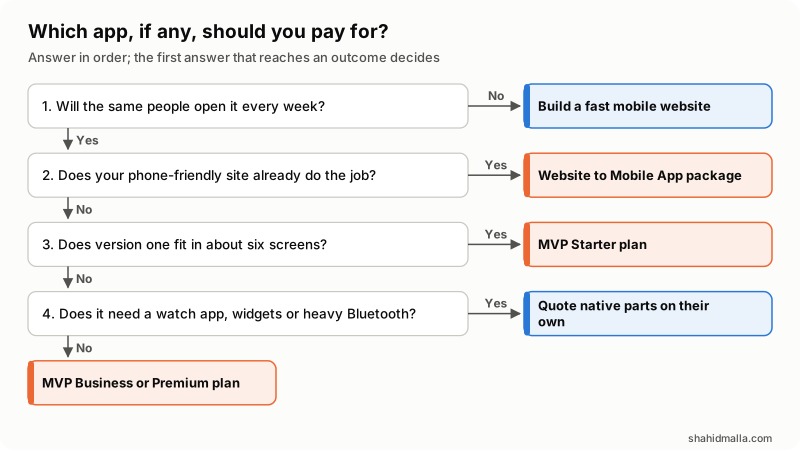
In words: people will not open it every week, so build a fast mobile website. Your phone-friendly website already does the job, so start with the Website to Mobile App package. Version one fits in about six screens, so start with the MVP Starter plan. It needs a watch app, widgets or heavy Bluetooth, so those native parts are quoted on their own. Otherwise, the MVP Business plan covers the API, admin panel and store submission, and Premium adds payments.
An app another developer left half-finished should be read before it is priced; my guide to fixing a vibe-coded app covers what that review looks for.
What else do people ask about mobile app development cost?
How much does it cost to put an app on the App Store?
Apple's membership is 99 USD per membership year and Google Play's registration is a one-time US$25, as of 3 November 2026. Those are the only mandatory store fees. My publishing package starts at $349 per store if you want the submission done for you.
How much does it cost to maintain an app?
No honest percentage fits every app, so I do not quote one. Budget Apple's yearly membership, hosting and paid services, and at least one release a year to meet the stores' new minimums. For a small app that release can be a few fixes and a rebuild on current tools.
Can I build an app for free?
You can build and test one with free tools and Firebase's no-cost plan, but publishing is not free: Apple charges its yearly membership and Google its one-time fee. The real cost of a free build is your time, plus the rebuild if the first version cannot grow.
How long does it take to build a mobile app?
My listed delivery is 14 days for a six-screen MVP and 7 days for a website-based app. Larger scopes get dates once the screen list is agreed in writing. Store review comes on top, so do not tie a launch event to an exact approval date.
Is it cheaper to build for Android or iOS first?
With one cross-platform codebase the build costs nearly the same either way, so launching one store first saves store work, not code. Google's fee is lower and paid once, but its personal accounts must meet testing requirements first. Pick the store your users' phones run.
If you want a number for your own app, I quote mobile app development and the SaaS development behind it at $55-$65 per hour or as a fixed price, after a free scoping call of about 30 minutes, with the written quote within one business day.
Last reviewed 3 November 2026. Disclosure: I sell mobile app and web development work, including the packages priced above, so I am not neutral. I am CTO at ElySpace, a freelance developer for Marmaids LLC, and founder of WHMCSPilot and MagizAI. Store fees, commissions, technical requirements and the wage figure come from the linked Apple, Google, Firebase and BLS pages as I read them on that date and may have changed since.