
Website maintenance cost has two parts: vendor bills and labor. On 3 November 2026, the bills for one small WordPress site ran from $11.81 a year for a .com domain to a few hundred dollars a year for hosting and plugin licenses. The labor is your own hours, a developer's hourly rate, or a monthly plan. My rate is $55-$65 per hour.
Website maintenance is the recurring work that keeps a live website secure, working and paid for: software updates, backups, monitoring, renewals and small fixes. It is not a redesign, which changes how the site looks or works, and it is not hosting, which is the server the site runs on. A maintenance plan is a promise to do that work on a schedule for a known fee.
Every price here is in US dollars. The end of the guide lists which ones to re-check each year.
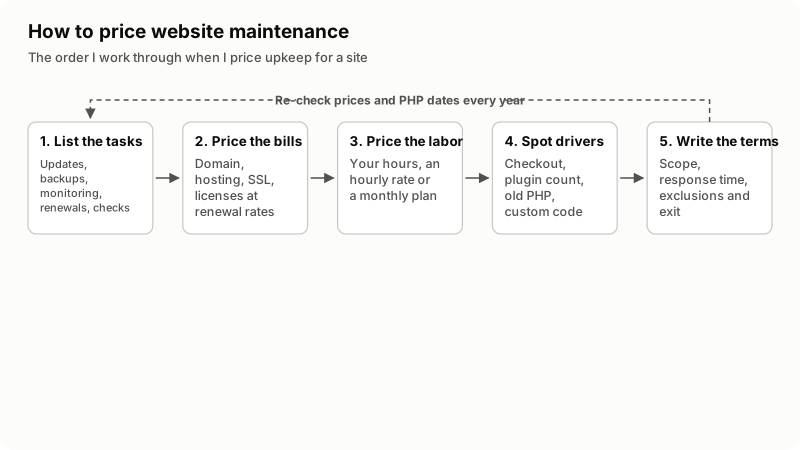
What does website maintenance actually cover?
Website maintenance covers six jobs: updates, backups, monitoring, renewals, server software upgrades and checks that forms and checkout still work. The schedule below is the one I work to on a typical WordPress business site; a static site needs far less, and a store needs more.
| Task | How often I do it | What happens if nobody does |
|---|---|---|
| WordPress core, plugin and theme updates | Weekly to monthly; security releases within days | Known security holes stay open on a public site |
| Backups, kept off the server | Daily for a store, weekly for a brochure site | A hack or a bad update has nothing to roll back to |
| Restore test | Every few months | You learn a backup is broken on the day you need it |
| Uptime and certificate monitoring | Continuous, with email alerts | Customers notice the outage before you do |
| Renewals: domain, hosting, licenses | Yearly, checked a month ahead | The site goes offline, or paid plugins stop updating |
| PHP version upgrade | When the version you run nears end of support | The server runs code that no longer gets security fixes |
| Form, checkout and link checks | Monthly and after every update | Leads and orders fail without any error you can see |
Some of this already happens without anyone. The section on configuring automatic background updates in the WordPress Advanced Administration Handbook says automatic updates arrived in WordPress 3.7, that translation files update automatically, and that since WordPress 5.6 new installations update both minor and major core releases on their own by default. Plugins and themes update automatically only in special cases, so on most sites they still need a person.
Which bills keep coming no matter who maintains the site?
Five bills arrive whether you maintain the site yourself or pay someone: the domain, hosting, the SSL certificate, paid plugin or theme licenses, and monitoring if you go beyond a free tier. They should be in your name and on your card, never folded into a developer's invoice where you cannot see them. These are regular list prices from each vendor's page on 3 November 2026; any sale price is labeled as introductory.
| Bill | Example vendor and plan | Listed price, 3 November 2026 |
|---|---|---|
| .com domain | Porkbun domain price list | $11.81 a year to register or renew, ICANN fees included |
| .ca and .com.au domains | Same Porkbun list, in US dollars | .ca $11.12 to register and $11.48 to renew; .com.au $13.70; both showed a lower sale price that day |
| Budget WordPress hosting | Hostinger Premium, 3 websites | Renews at $10.99 a month on a 48-month term, paid upfront; introductory Black Friday price on 3 November 2026: $1.99 a month ($95.52 for 48 months) |
| Managed WordPress hosting | Kinsta Single 20GB, one WordPress install | $35 a month billed monthly, or $350 a year billed annually |
| SSL certificate | Let's Encrypt | $0; default certificates are valid for 90 days, and Let's Encrypt recommends renewing every 60 days |
| Caching plugin license | WP Rocket Single, 1 website | $5 a month, billed yearly ($60) |
| SEO plugin license | Yoast SEO Premium | $118.80 a year, excluding VAT |
| Uptime monitoring | UptimeRobot | Free for 50 monitors at a 5-minute interval; Solo $9 a month billed yearly for a 60-second interval |
Two lines deserve a second look. Hosting is often sold at an introductory price for the first term, as on the Hostinger plan above, so plan for the renewal price. Let's Encrypt certificates are free, though its FAQ notes that some hosting companies charge a nominal fee for providing them.
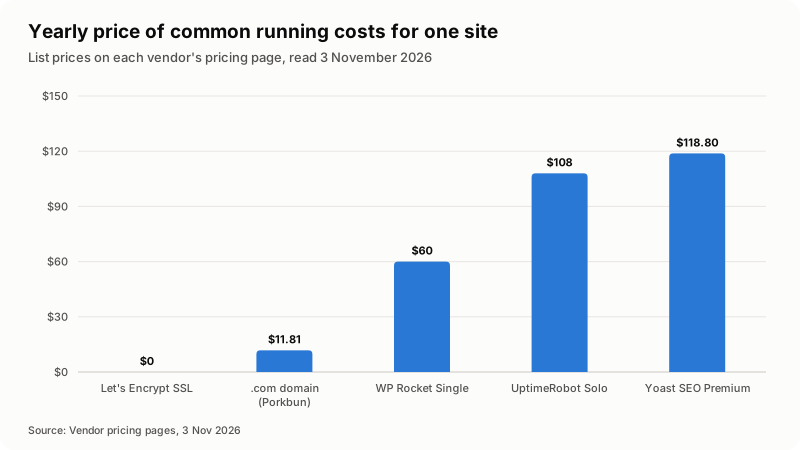
Most small sites do not need every paid item. Each license you add is one more renewal to track and one more plugin to update.
How much does website maintenance cost per month for the labor?
The labor is the variable part of website maintenance cost, and it depends on who does it and how they bill. Published agency ranges vary widely and rarely show how they were worked out, so I use only figures I can link or that I set myself:
| Who does the work | How you pay | Figure | Fits |
|---|---|---|---|
| You or a staff member | Your time | No cash cost; a learning curve | A brochure site with few plugins and someone careful |
| A vetted WordPress marketplace | Hourly estimate plus a fee | Codeable lists $80-$120 per hour plus a 17.5% service fee | One-off jobs when you want a platform to vet the developers you choose from |
| A freelance developer (me) | Hourly, or a fixed quote per scope | $55-$65 per hour | Irregular work, audits and fixes you cannot size yet |
| Setup, then monthly care | One-time setup fee, then a monthly fee | My maintenance plan setup is $99, $199 or $499 once; monthly care is quoted after I see the site | A site that has drifted and needs putting in order first |
| A monthly developer retainer | Fixed monthly fee for reserved hours | The Year With Me: On Retainer $799, Embedded $999 or Reserved $1,599 a month | A site or product with new work most weeks, not just upkeep |
The setup package covers a plugin and theme audit, backups, an uptime monitor and, on the middle tier, a staging site and a written update routine. Monthly care afterward is a separate fee, because a five-page site and a busy store need different attention. My WordPress maintenance service page describes how I run that ongoing work, and retainer vs hourly billing explains when a retainer is worth it over paying by the hour.
How do you estimate your own site's yearly maintenance cost?
Add the yearly vendor bills to the hours the site needs multiplied by the rate, then check the renewal prices, not the first-year ones. Here is the arithmetic for one example: a small WordPress brochure site on the Hostinger Premium plan after its introductory term, using the regular prices above.
| Line | Working | Per year |
|---|---|---|
| Hosting at the renewal rate (48-month term) | $10.99 x 12 | $131.88 |
| .com domain renewal | Porkbun list price | $11.81 |
| SSL certificate | Let's Encrypt | $0 |
| Caching plugin | WP Rocket Single | $60.00 |
| Uptime monitoring | UptimeRobot free plan | $0 |
| Labor, assuming 1.5 hours a month | 18 hours x $55-$65 | $990-$1,170 |
| Total | $1,193.69-$1,373.69 |
The 1.5 hours is an assumption to show the arithmetic, not a measured average. Replace it with your own: ask whoever maintains the site how long last month's updates and checks took. A store on managed hosting such as Kinsta's Single plan pays $350 a year in hosting alone on annual billing, or $35 a month billed monthly, before any extra time for testing checkout after each update.
In this example the bills are about $200 and the labor is five to six times that, so fewer plugins move the total more than cheaper hosting does.
What makes website maintenance cost more?
Complexity and neglect make website maintenance cost more, because both turn a quick update into a test session. I check these first:
- Payments and bookings. WooCommerce, checkout and booking plugins need a test on a staging copy before each update, because a broken checkout costs sales the same hour.
- Plugin count and page builders. Every plugin is a separate update from a separate author, and page builder updates can shift layouts.
- Abandoned plugins. A plugin nobody updates gets no security fixes. Replacing it, and moving its content, is real work.
- An old PHP version. The official PHP supported versions page says each branch gets two years of active support and two more of security fixes only. On 3 November 2026 it listed PHP 8.2 security support ending 31 December 2026, and 8.3 ending 31 December 2027. Moving a site to a newer PHP version often surfaces old plugin code that breaks.
- No staging site. Without a copy to test on, every update is tested live.
- Lapsed renewals. Porkbun's price list states a $200 restoration fee, on top of the normal renewal, for a domain recovered during the Redemption Grace Period. Auto-renew and a current card cost nothing.
- Custom code. A custom plugin or theme has no vendor sending updates. When WordPress or PHP changes, someone has to read and fix that code.
If most of this list applies, the site may cost less to rebuild than to keep patching. My website redesign guide covers how to tell, and the build side of that is on my web design and development page.
What should a website maintenance agreement say before you sign?
A maintenance agreement should name the tasks, the schedule, the response time, what is excluded and how you leave. Use this checklist on any offer, including mine:
- A list of tasks and how often each runs, matching the table at the top of this guide.
- Which updates run automatically and which wait for a test on staging.
- Where backups are stored, how long they are kept, and when a restore was last tested.
- The response time for urgent problems, and whether it means a reply or a fix.
- How many hours a month are included, and the rate for work beyond them.
- Domain, hosting and licenses registered to your business, with your own logins.
- What is excluded: content writing, new features, redesign work, vendor bills.
- How to cancel, and a handover of every login and the latest backup when you do.
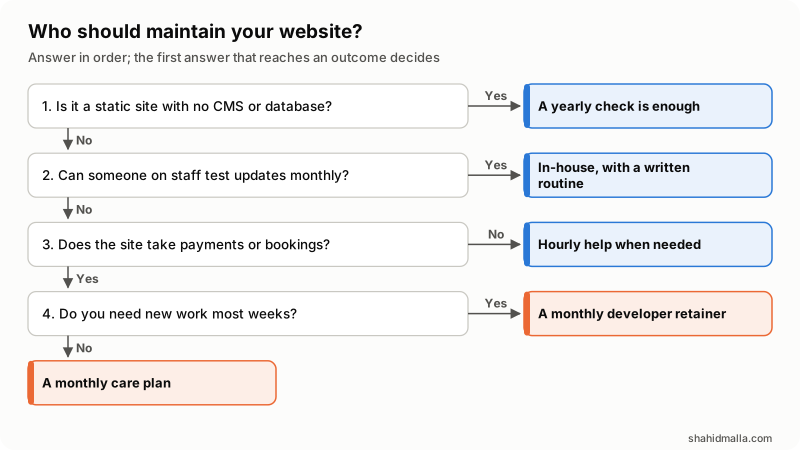
In words: a static site needs a yearly check of its domain and certificate. If someone on staff can test updates monthly, keep it in-house. If not, a site without payments or bookings is usually fine with hourly help. A site that takes payments or bookings needs a monthly care plan, or a retainer if it also needs new work most weeks.
When is a website maintenance plan not worth paying for?
A maintenance plan is not worth paying for when the site needs almost no upkeep, or when the plan only does what already happens for free. Skip it or cut it back in these cases:
- A static site. Plain HTML with no database has no plugins to update. A yearly look at the domain, certificate and contact details is enough.
- A site about to be rebuilt. Pay for backups and security updates only, and put the rest toward the new build.
- A plan that only clicks "update". Core updates already run on their own on most installs, and the same WordPress handbook page notes that WP Toolkit in cPanel or Plesk can be set to update automatically. Pay for testing, restore checks and someone accountable, not for clicks.
- Promises nobody can keep. No one can promise a site will never be hacked or go down; uptime depends on the host.
The risk of doing it yourself is skipped weeks: twenty updates at once are much harder to debug than two. Write the routine down and put it on a calendar.
What else do people ask about website maintenance cost?
How much should I pay someone to maintain my website?
Pay for the hours your site actually needs at a rate you can verify, plus your own vendor bills. A simple site might need an hour or two a month; a store needs more because every update is tested. At my $55-$65 hourly rate, two hours a month is $110-$130.
Is website maintenance worth it?
For a site with plugins, payments or leads, yes, because the alternative is paying for a cleanup or rebuild after something breaks. For a static site, rarely. Ask what one day of the site being down or hacked would cost you.
How often should a website be maintained?
Check a WordPress site at least monthly, and apply security releases within days of their release. Backups should run daily for a store and weekly for a brochure site. Renewals and PHP versions need a look once a year.
Can I maintain my website myself?
Yes, if you back up first, update one thing at a time and check the site afterward. Call a developer when an update breaks the layout or you suspect a hack.
Does website maintenance include hosting?
Usually not, and I prefer it that way. Hosting and the domain should be in your name and billed to you by the provider, so you keep them if you change developers. If an agency bundles hosting into a plan, ask whose account the server is in.
If you want a maintenance routine set up properly, or a quote for ongoing care, I start with a free scoping call of about 30 minutes and send a written quote within one business day.
Figures to re-check each year: hosting renewal rates, domain prices, plugin license prices, monitoring plans and the PHP end-of-support dates. The task list and the agreement checklist do not go out of date.
Last reviewed 3 November 2026. Disclosure: I sell website maintenance, WordPress work and a monthly developer retainer, so I am not neutral. I am CTO at ElySpace, a hosting company, a freelance developer for Marmaids LLC, and founder of WHMCSPilot and MagizAI. This guide contains no affiliate links. Vendor prices come from the linked pages as I read them on 3 November 2026; my own prices come from my packages and retainer pages on the same date.