
Vibe coding tools come in two kinds. Browser app builders such as Lovable, Bolt, v0, Replit, Base44 and Google AI Studio turn a chat into a hosted app and suit founders who do not write code. Coding agents such as Cursor, Claude Code, GitHub Copilot and Devin Desktop (formerly Windsurf) work inside a code repository and suit developers. Choose the kind first, then the tool.
Vibe coding tools are AI products that write and change software from plain-language instructions, so you describe the result instead of typing the code. Some also host the app and its database for you; others edit code you keep in your own repository. The term names the tool, not how carefully anyone checks what it writes.
I checked every tool below on 21 October 2026: that it is still sold, what you can take with you, and its entry paid plan on the vendor's own pricing page. Read it as a dated snapshot, not a ranking. I build SaaS products and CRMs with Claude Code and review every change, so I know one tool here from daily use. I am not affiliated with Anthropic or any other vendor named, and nobody paid for a mention.
What are the two kinds of vibe coding tools?
The two kinds differ in where the code lives and who runs it. A browser app builder keeps your project on the vendor's platform: you chat, it writes the code, shows a preview and usually hosts the app and a database. A coding agent runs in your editor, your terminal or a cloud session and changes files in a repository you control; hosting and the database are whatever you set up.
| Question | Browser app builder | Coding agent |
|---|---|---|
| Where you work | A chat window and live preview in the browser | Your editor, terminal, a desktop app or a cloud session |
| Where the code lives | On the vendor's platform, with export or GitHub sync | In your own repository from the first line |
| Hosting and database | Usually included, paid from plan credits or usage | Your choice, billed by whoever hosts it |
| Who it suits | A founder or team member who does not write code | A developer, or a founder working with one |
| What you review | The running preview | Each change as a diff, plus test results |
| Examples | Lovable, Bolt, v0, Replit, Base44, Google AI Studio | Cursor, Claude Code, GitHub Copilot, Devin Desktop, Google Antigravity |
The line blurs at the edges, since most builders now sync with GitHub and most agents run cloud sessions. The question that matters is where the source of truth lives on the day you leave.
Which vibe coding tools are people using in October 2026?
These are the tools that recur in this month's comparison pages and beginner guides, plus Google's two products, each confirmed on its own site on 21 October 2026. Two have changed shape: Windsurf is now Devin Desktop, and Cursor's plans now come bundled with Grok and X account features.
| Tool | Kind | What it is | What you can take with you |
|---|---|---|---|
| Lovable | Builder | Chat-built web apps, hosted by Lovable | Two-way GitHub sync or a code download |
| Bolt.new | Builder | Website and app builder with hosting and databases | A zip download you run with npm install && npm run dev, or GitHub sync |
| v0 (Vercel) | Builder | Full-stack web apps, deployed to Vercel | GitHub sync, on the free plan too |
| Replit (Agent) | Builder with a full workspace | Builds, runs and deploys apps in the browser | Zip download or two-way GitHub sync; a copy needs its secrets, database and deployment settings set up again |
| Base44 | Builder | No-code app builder with database and login | Two-way GitHub sync, listed from the $50 Builder plan up |
| Google AI Studio | Builder | Build mode: React and Node.js, optional Firebase, deploys to Cloud Run | Two-way GitHub sync or a ZIP export |
| Cursor | Agent | Desktop editor with agents, plus a CLI | Your repository |
| Claude Code | Agent | Terminal, IDE, desktop and browser; edits files, runs commands, works with git | Your repository |
| GitHub Copilot | Agent | Agent mode in VS Code, Visual Studio, JetBrains, Eclipse and Xcode, plus a CLI | Your repository |
| Devin Desktop | Agent | "The new name for Windsurf": an IDE plus local and cloud agents | Your repository |
| Google Antigravity | Agent | Agent app, CLI and IDE extensions | Your repository |
OpenAI's Codex is a major coding agent too; I compare it with Claude Code in a separate guide, linked below.
What does each tool's entry paid plan cost?
On 21 October 2026 the entry paid plans with monthly billing ran from $8 to $30 a month, but they buy very different amounts of work, so the cheapest plan is not automatically the cheapest project. The chart shows only monthly plans an individual can buy.
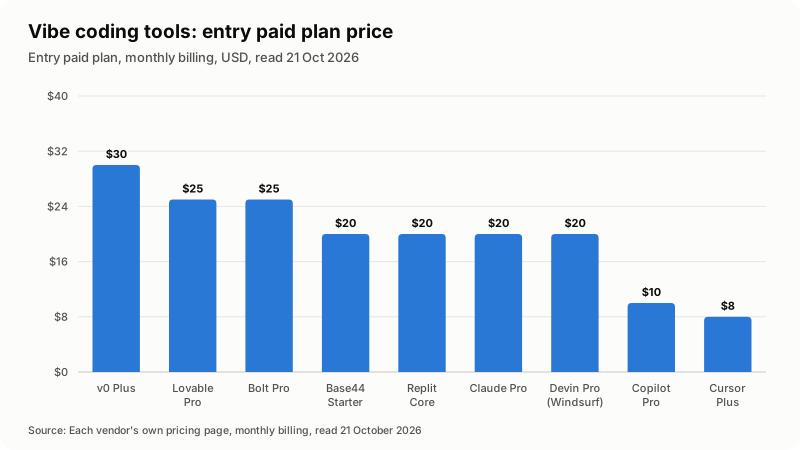
| Tool | Entry paid plan | Monthly billing | What the plan includes, per the vendor's page |
|---|---|---|---|
| v0 | Plus | $30 per user | $30 of credits a month plus $2 daily login credits; $90 shown struck through beside it |
| Lovable | Pro | $25 | 100 monthly credits plus 5 daily build credits; custom domains |
| Bolt | Pro | $25 | 10M tokens a month with rollover; your own domain |
| Base44 | Starter | $20 | 100 message credits and 2,000 integration credits a month |
| Replit | Core | $20 | $20 toward more powerful models; plan mode |
| Claude | Pro | $20 | Claude Code included; five-hour session and weekly limits |
| Devin (Windsurf) | Pro | $20 | Larger quotas, frontier models from several labs, Devin Cloud agents |
| GitHub Copilot | Pro | $10 | 1,500 AI credits a month ($15 value); Claude Code and Codex as third-party agents |
| Cursor | Plus | $8 | Grok models only; usage pool shared with Grok, refreshed weekly |
| Google AI Studio, Antigravity | Google AI Pro | Not published | Higher quota than the free plan, per Google's AI plans page |
Annual billing lowers several: Lovable to $21 a month, Bolt and Replit to $18, Base44 to $16, Claude Pro to $17 with $200 paid up front. Check the units before you compare. Lovable prices "Make the button gray" at 0.50 credits and "Add authentication with sign up and login" at 1.20. Bolt says "the larger the project, the more tokens used per message." Cursor recommends its $30 Premium plan for new AI users; Plus runs Grok models only, and from Premium up, models from other labs cost extra at API list price.
Lovable vs Bolt: how do the two app builders differ?
Lovable and Bolt both cost $25 a month on monthly billing and both build and host web apps from a chat; they differ in how usage is counted, how teams pay and how the code leaves.
- Usage. Lovable spends credits that vary by task, and monthly plan credits expire two months after issue. Bolt spends tokens, with unused Pro tokens rolling over.
- Teams. Lovable prices "by the credits they include, not by seats", so unlimited members share one balance. Bolt Teams costs $30 per member a month.
- Leaving. Lovable syncs both ways with GitHub and offers a code download. Bolt documents a zip download you run on your own machine, plus GitHub sync.
- Ownership. Lovable's FAQ says "You own your code," including customer data stored in Lovable, subject to third-party rights in the AI models. I found no equivalent sentence on the Bolt pages I read, so check its terms.
Run the same small prompt on both free plans and compare what one feature costs and how easily the code reaches your own GitHub account.
Cursor vs Claude Code: which fits a developer?
Cursor is a desktop editor with built-in agents; Claude Code is an agent that runs in your terminal, in editors including Cursor, in a desktop app and in the browser, so many developers use both.
- Cursor ships its own app and a CLI. Its Plus plan at $8 runs Grok models only and is "recommended for social creators with limited AI usage"; Premium at $30 adds cloud agents, AI code reviews and code hosting.
- Claude Code comes with Claude Pro at $20 and runs Claude models. Its usage shares one pool with the Claude apps, resetting on a rolling five-hour window with weekly limits on top.
Claude Code is the tool I use for client work. I plan before any edit, let hooks run the tests and read every diff myself. Those are habits, not features you buy, and they work in Cursor too. If you are weighing Claude Code against OpenAI's agent, read Claude Code vs Codex for a SaaS.
How do you choose the right kind of vibe coding tool?
Choose by your situation and by who will read the code, then try a tool of that kind on its free plan with a real task.
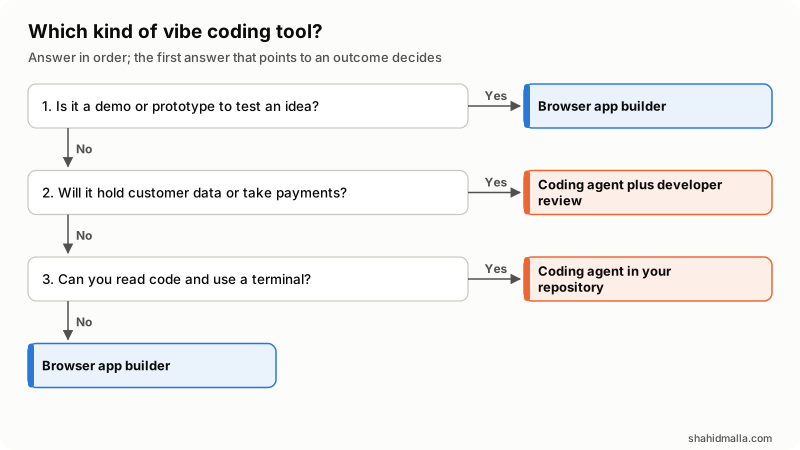
| Your situation | Tool type | Why |
|---|---|---|
| You want a clickable demo to test an idea | Browser app builder | Hosting and a database come with the plan |
| The app will hold customer data or take payments | Coding agent plus developer review | Someone has to read the access rules and payment code |
| You can read code and use a terminal | Coding agent in your repository | Every change arrives as a diff you can test |
| You do not write code and the app stays low stakes | Browser app builder | No server or repository to set up |
| It must connect to a CRM, billing system or internal API | Coding agent with a developer | Integrations need credentials, tests and staging |
| A builder prototype is getting real users | Export to GitHub, then a coding agent | The code moves to a repository you control |
What will no vibe coding tool do for you?
No plan here takes responsibility for what ships: review, security, tests, backups and account ownership stay with you. Replit's pricing page says its agent "may occasionally make mistakes," and that holds for every tool here. Before real users arrive, check:
- The code is in a GitHub repository under your account, not only on the platform.
- Hosting, database, domain and payment accounts are in your company's name.
- A person has confirmed that each user sees only their own records.
- Secrets sit in environment settings, not in front-end code or chat history.
- Tests cover sign-up, login, permissions and payments, and run before each release.
- You have restored a backup once and know what an export leaves out.
- Credits, tokens and usage-billed APIs have a spending cap.
- Changes go to a staging copy first, not straight to the live app.
Why unreviewed AI code fails, with sources and a fuller review checklist, is in my guide to AI-assisted development vs vibe coding.
When should you bring in a developer?
Bring in a developer before the app holds other people's data or money, not after something breaks. The signs:
- Real users will sign up, or you will import customer records.
- You will take payments or store billing details.
- Each new prompt breaks something that worked, and credits go into fixing the same bug.
- The app must talk to a CRM, billing system, ERP or internal API.
- An investor, client or auditor asks who reviewed the code.
A developer moves the code into your repository, adds tests, checks access rules and secrets, sets up staging and backups, then keeps building with a coding agent. My process is on how I work. If you would rather restart than repair, my SaaS MVP tech stack guide covers the stack decisions.
What else do people ask about vibe coding tools?
What is the best vibe coding tool for beginners?
No single tool is best for everyone. If you do not write code, start with a browser app builder; Lovable, Bolt, v0, Base44 and Google AI Studio all list free plans. Build the same small app on two and keep the one whose result and pricing you understand.
Is Lovable better than Bolt?
Neither is better across the board. Both cost $25 a month on monthly billing; Lovable counts credits shared by unlimited workspace members, while Bolt counts tokens and charges per member on Teams. Compare what your own app costs on each.
Is Cursor better than Claude Code?
They come from different ends: Cursor is an editor with agents built in, and Claude Code is an agent that also runs inside editors, including Cursor. Check which models each plan includes, since Cursor bills models from other labs separately.
Can you vibe code for free?
Yes, within limits. On 21 October 2026, Lovable's free plan gave 5 build credits a day up to 30 a month, Bolt's 1M tokens a month with a 300K daily cap, v0's $5 of one-time credits and 7 messages a day, and GitHub Copilot Free includes agent mode. Custom domains and higher limits cost extra.
Do you own the code a vibe coding tool writes?
With a coding agent, the code is in your repository from the start. With an app builder, read the terms and test the export; Lovable and Base44 say in their FAQs that you own your code. What protects you in practice is a current copy in your own GitHub account.
If your vibe-coded app is about to hold real customers, or you want a SaaS or CRM built with Claude Code and a human review of every change, see Hire Claude Code Developer: a free scoping call of about 30 minutes, a written quote within one business day, and $55-$65 per hour or a fixed price per scope.
Last reviewed 21 October 2026. Disclosure: I am a freelance developer who uses Claude Code for client work, so I am not neutral about it. I am CTO at ElySpace and founder of WHMCSPilot and MagizAI. I am not affiliated with, paid by or endorsed by Anthropic or any other tool vendor named here. Prices and plan details come from each vendor's own pricing page as I read it on 21 October 2026, before tax; product names are trademarks of their owners.