For a hosting business under a few thousand active clients selling standard hosting, domains and servers, WHMCS usually costs less than a custom billing system and carries less risk. A custom system starts to pay off when your billing does not fit WHMCS, such as usage, hourly or per-seat charges, or when your client count is very large, because WHMCS prices rise with clients.
A custom billing system is software built for one business that creates its invoices, takes payments, applies tax, chases failed payments and turns services on or off, with the source code owned by that business. WHMCS is a ready-made billing and automation platform for hosting companies, licensed monthly by active client count. The choice is between renting a mature product and owning code you must maintain.
My view, so you can test it: WHMCS is a good way to start and test a hosting or service business. For a long-term business with a growing client count, or billing WHMCS does not handle, a custom system can cost less over time and gives you control. I build custom billing automation. Disclosure: I also sell WHMCS development and founded WHMCSPilot, which sells WHMCS modules, so I earn from both paths. I am CTO at ElySpace, a hosting company whose client area runs on WHMCS, and founder and CEO of MagizAI. I am not affiliated with WHMCS.
WHMCS vs custom billing system: what is the real difference?
The difference is who carries the work: with WHMCS you rent features; with a custom system you pay for the build, then carry every update and rule change.
| Point | WHMCS, self-hosted | Custom billing system |
|---|---|---|
| Running cost | License that steps up with active clients, plus module renewals | The build, then developer hours for upkeep |
| Time to launch | Days | Weeks to months |
| Billing models | Recurring cycles. Usage and hourly need modules or workarounds. | Whatever you specify |
| Code | Encoded core: the WHMCS documentation lists ionCube Loader as a requirement. You extend it with modules, hooks and themes. | Yours to read and change |
| Security and compliance | Vendor patches the core. You patch the server and modules. | All yours: card data scope, tax, privacy requests, backups |
What does WHMCS cost per month in 2026?
A self-hosted WHMCS license costs $34.95 to $399.95 a month for 250 to 10,000 active clients, on the WHMCS pricing page as I read it on 19 October 2026. US dollars, excluding tax; the yearly column is my arithmetic.
| Tier | Active clients up to | Per month | Per year |
|---|---|---|---|
| Plus | 250 | $34.95 | $419.40 |
| Professional | 500 | $54.95 | $659.40 |
| Business 1,000 | 1,000 | $84.95 | $1,019.40 |
| Business 2,500 | 2,500 | $179.95 | $2,159.40 |
| Business 5,000 | 5,000 | $284.95 | $3,419.40 |
| Business 10,000 | 10,000 | $399.95 | $4,799.40 |
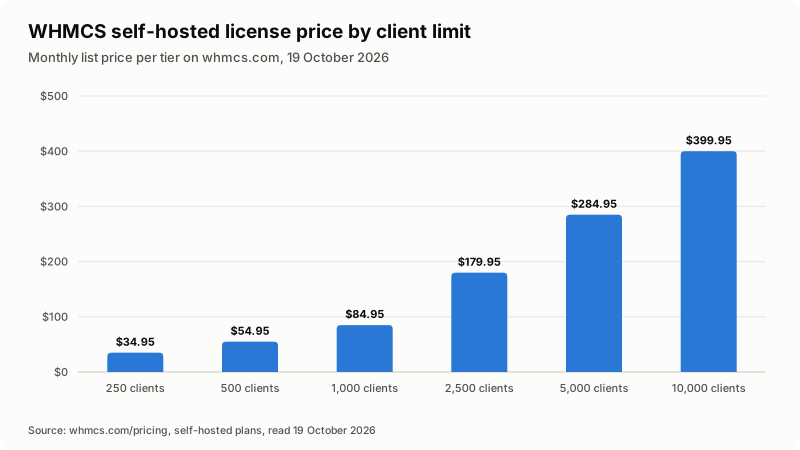
The public page lists no tier above 10,000 clients. An active client is "any client with at least one active product, service, addon or domain", and the license upgrades itself when you pass the limit unless you opt out. Fully managed plans start at $9.99 a month for 25 clients, but WHMCS Cloud "currently supports pre-approved modules", so custom modules mean self-hosting. My WHMCS pricing guide covers the plans.
How much have WHMCS prices gone up since 2019?
The Plus license for up to 250 clients cost $18.95 a month in every archived copy from July 2019 to December 2023 and costs $34.95 today: up 84 percent from July 2019 to October 2026.
| Snapshot | Plus, 250 clients | Professional | Business 1,000 | Business 2,500 |
|---|---|---|---|---|
| 16 Jul 2019 | $18.95 | $24.95, up to 1,000 clients | None. Business: $39.95, unlimited clients | None |
| 23 Jun 2021 | $18.95 | $29.95, up to 500 | $44.95 | $99.95 |
| 23 Sep 2023 | $18.95 | $29.95 | $44.95 | $99.95 |
| 3 Jan 2024 | $24.95 | $39.95 | $59.95 | $129.95 |
| 14 Jul 2025 | $29.95 | $44.95 | $69.95 | $154.95 |
| 14 Feb 2026 | $34.95 | $54.95 | $84.95 | $179.95 |
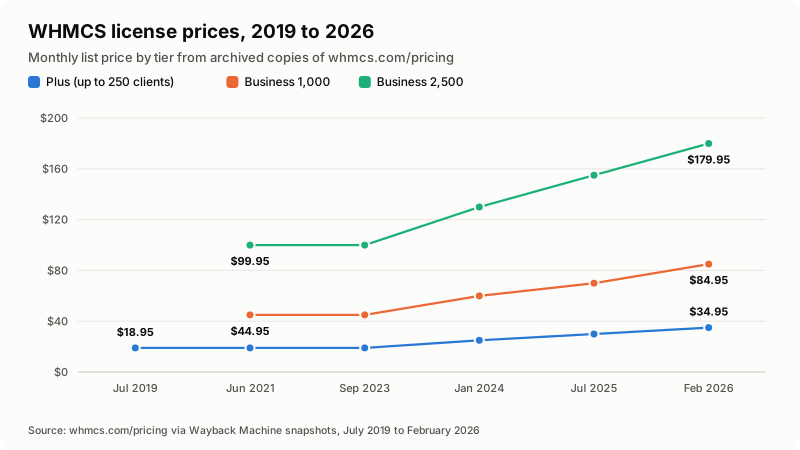
In 2019, Business had no client limit; by June 2021 it was sold in active-client tiers. From June 2021 to October 2026, Business 1,000 rose from $44.95 to $84.95, up 89 percent, and Business 2,500 from $99.95 to $179.95, up 80 percent. Each of the three increases fell between a late-year and an early-January snapshot:
- 2024: Plus $18.95 on 5 December 2023, $24.95 on 3 January 2024. Business 1,000: $44.95 to $59.95.
- 2025: Plus $24.95 on 26 November 2024, $29.95 on 8 January 2025. Business 1,000: $59.95 to $69.95.
- 2026: Plus $29.95 on 2 November 2025, $34.95 on 18 January 2026. Business 1,000: $69.95 to $84.95.
The whmcs.com footer says WHMCS is part of the WebPros family.
What do WHMCS add-ons cost on top of the license?
Paid themes and modules are a separate bill, often renewed yearly or monthly. These WHMCS Marketplace listings, read on 19 October 2026, are examples, not recommendations.
| Listing | Type | Price shown | Terms stated |
|---|---|---|---|
| Lagom WHMCS Client Theme, RS Studio | Theme | $149.00 | One website, one year of updates, renewal $149 a year |
| Proxmox VE VPS & Cloud For WHMCS, ModulesGarden | Provisioning | $59.95 | Monthly. The vendor's page lists $499.95 a year or $2,999.95 one time. |
| Advanced Billing For WHMCS, ModulesGarden | Usage and hourly billing | $35.95 | Billing period not stated on the listing |
| Stripe Checkout Payment Gateway, PalaceSoft | Payment gateway | $34.99 | Lifetime license, marked compatible with WHMCS 8.13 |
That theme plus the yearly Proxmox license adds $648.95 a year, and each module needs retesting on every WHMCS upgrade. ElySpace uses the Lagom theme, and WHMCSPilot sells modules in this market.
What does a custom billing system include, and what does it cost?
A hosting billing system needs about ten parts to replace WHMCS, and many hours go into parts clients never see: tax, failed payments, suspensions and tests. Hours are my estimates for a Laravel build, not a quote.
| Component | Minimal, hours | Fuller, hours |
|---|---|---|
| Client accounts, two-factor login, staff roles | 20-30 | 30-45 |
| Products, cycles, upgrades with pro-rata | 20-35 | 40-60 |
| Recurring invoices, credit notes, refunds | 35-50 | 50-70 |
| Payments through hosted checkout, webhooks, retries | 25-40 | 50-80 |
| Tax: VAT or GST rates, tax IDs, reports | 15-25 | 30-50 |
| Dunning, suspension, unsuspension | 15-25 | 20-35 |
| Provisioning through a panel or hypervisor API | 30-45 | 60-100 |
| Domains through a registrar API | Left out | 40-60 |
| Emails; a ticket desk in the fuller build | 10-20 | 50-80 |
| Usage or hourly metering | Left out | 40-80 |
| Audit log, tested backups, GDPR export and deletion | 20-30 | 30-45 |
| Tests for every money path, data import, parallel run | 50-80 | 60-115 |
| Total | 240-380 | 500-820 |
At my rate of $55-$65 an hour, I estimate a minimal build at $13,200 to $24,700 and a fuller one at $27,500 to $53,300. Upkeep, my estimate again, is 60 to 120 hours a year, or $3,300 to $7,800, for framework and PHP updates, gateway API changes, tax changes and fixes.
Use a hosted checkout so card numbers never touch your server: Stripe's security guide says a business handling card data directly "might be required to meet more than 300 security controls in PCI DSS". For tax, the European Commission's VAT One Stop Shop page sets an EUR 10,000 EU-wide threshold for EU sellers of electronic services to consumers in other member states; above it, each customer's country rate applies.
Is a custom billing system cheaper than WHMCS over five years?
Not for a typical host. In this example, not a quote, a host growing from 250 to 2,500 active clients spends $9,661.75 on WHMCS over five years and $40,200 on a minimal custom build, at my estimate's midpoint. Assumptions:
- Today's WHMCS prices held flat. WHMCS raised self-hosted prices in 2024, 2025 and 2026 per the snapshots, so treat the WHMCS line as a floor.
- Each year billed for twelve months at that year's tier.
- Add-ons: the Lagom renewal ($149) and the yearly Proxmox license ($499.95).
- Custom: 310 hours at $60 ($18,600) in year 1, then 90 hours ($5,400) of upkeep a year.
- Server, gateway fees and staff time left out, since both need them. No custom WHMCS modules.
| Year | Active clients | WHMCS tier | WHMCS that year | WHMCS total so far | Custom that year | Custom total so far |
|---|---|---|---|---|---|---|
| 1 | 250 | Plus | $1,068.35 | $1,068.35 | $18,600 | $18,600 |
| 2 | 500 | Professional | $1,308.35 | $2,376.70 | $5,400 | $24,000 |
| 3 | 1,000 | Business 1,000 | $1,668.35 | $4,045.05 | $5,400 | $29,400 |
| 4 | 1,750 | Business 2,500 | $2,808.35 | $6,853.40 | $5,400 | $34,800 |
| 5 | 2,500 | Business 2,500 | $2,808.35 | $9,661.75 | $5,400 | $40,200 |
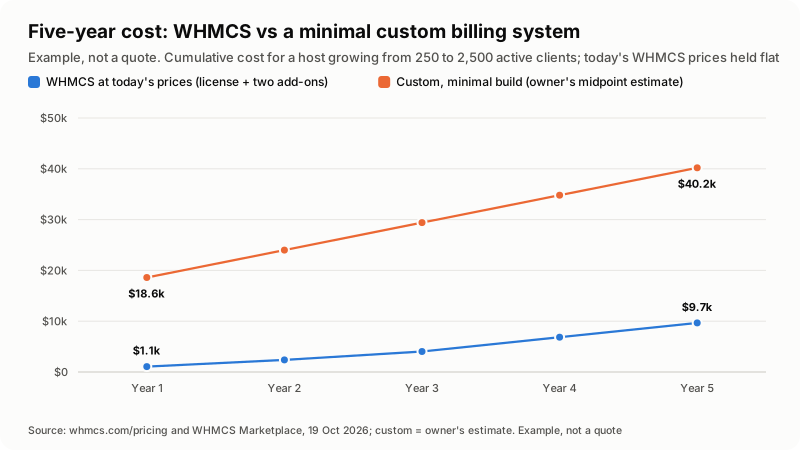
Across my estimate range, the custom column ends between $26,400 and $55,900. The break-even rule: custom wins only when its yearly upkeep costs less than the license plus modules, and the gap repays the build. At today's prices with the same add-ons, WHMCS costs $5,448.35 a year at Business 10,000. Against my midpoint upkeep of $5,400, that saves $48.35 a year, so a midpoint build never catches up; at the low end of my estimate it saves $2,148.35 a year and catches up in about 4.6 years. With no public price above 10,000 clients, use a threshold: over five years, a midpoint build costs less only if the license would exceed about $616 a month with these add-ons, or about $386 a month at the low end of my estimate.
Below 10,000 clients, custom pays off only when WHMCS would need heavy custom work anyway. If it needs a usage engine, seat-based invoicing and a rebuilt client area, add those module hours and their upkeep to the WHMCS column; my guide to WHMCS module development cost shows how they add up. Then the gap closes sooner, and you own the result.
When does WHMCS stop fitting your billing?
WHMCS stops fitting when you do not charge a fixed price per cycle, or your billing workflow is your own:
- Usage or hourly billing. Hourly VPS needs a module or a credit workaround; my WHMCS hourly billing guide compares the options.
- SaaS seats and in-app checkout. Seats, trials and in-app checkout sit awkwardly beside a separate client area; see my WHMCS SaaS billing guide.
- Workflows WHMCS was not designed around, such as approvals before provisioning. Hooks bend WHMCS a long way, but every bend is code to maintain.
- Large client counts, where the license reaches thousands of dollars a year.
- You must read or change the core, which the encoded files do not allow.
When is a custom billing system the wrong choice?
Custom is wrong whenever WHMCS already does the job and its license is small next to the build:
- A small client base. The Plus license is $419.40 a year, less than eight hours of my time.
- Standard hosting. Shared, reseller and VPS hosting with domains is what WHMCS and its modules were built for.
- No budget after launch. Billing without upkeep breaks when a gateway changes its API. If $3,300 to $7,800 a year is out of reach, do not build.
- Compliance you cannot carry. Card data scope, invoice rules, VAT or GST and privacy requests become your specification and tests. Each new gateway or tax regime is new code.
- Security. You own the login, the admin panel and the data, so a breach is yours.
- One developer. If only one person understands the code, insist on documentation and code you own.
Is there a middle path between WHMCS and a custom system?
Yes, and for many hosts it is the answer: keep WHMCS for accounts, invoices and support, and write custom modules or hooks only for what it does not do. A usage-rating or provisioning module costs a fraction of a full build, though it ties you to WHMCS upgrades; see WHMCS custom module development.
Or change product: open-source billing systems remove the license and give you readable code, and some commercial ones sell licenses without client tiers. I compare seven in WHMCS alternatives.
What should you check before you decide?
Write these down before asking anyone, me included, for a quote:
- Active clients today and in three years, priced at that tier on the pricing page.
- Every way you charge: native to WHMCS, needs a module, or impossible.
- Every paid module and theme with its yearly renewal.
- Custom WHMCS work you already pay for, and the hours each upgrade costs.
- The gateways you need, and whether each offers hosted checkout.
- Your tax registrations and invoice rules in each country you sell to.
- Who maintains a custom system if its developer is unavailable, and who owns the code.
What do people ask about WHMCS and custom billing?
Is WHMCS free?
No. The cheapest self-hosted license, Plus, is $34.95 a month on the pricing page today, excluding tax. The fully managed Starter plan is $9.99 a month for 25 active clients.
Is WHMCS open source?
No. The WHMCS documentation lists ionCube Loader as a requirement because the core files are encoded. You extend it through modules, hooks, themes and the API.
Did WHMCS raise its prices in 2026?
Yes. Archived copies show Plus at $29.95 on 2 November 2025 and $34.95 on 18 January 2026, and Business 1,000 went from $69.95 to $84.95. Prices also rose at the start of 2024 and 2025.
Is WHMCS worth it?
For a standard hosting business, usually yes. At 2,500 clients the license is $2,159.40 a year at today's price, below the low end of my upkeep estimate for a custom system. It stops being worth it when bending it costs more than owning your own.
How much does custom billing software cost?
My estimate for a hosting billing system is $13,200 to $24,700 minimal and $27,500 to $53,300 fuller, plus $3,300 to $7,800 a year of upkeep. Other developers quote differently, so compare quotes on the same written scope.
If the checklist points to a custom billing system, my SaaS and custom billing development page sets out how I scope one, with a free scoping call of about 30 minutes and a written quote within one business day.
Last reviewed 19 October 2026. Disclosure: I sell custom billing systems and WHMCS development, so I am not neutral. I founded WHMCSPilot, which sells WHMCS modules, so I earn from both paths. I am CTO at ElySpace, a hosting company whose client area runs on WHMCS, a freelance developer for Marmaids LLC, and founder and CEO of MagizAI. I am not affiliated with WHMCS.