An AI SEO agent is software that reads your Search Console and crawl data, decides what to fix, and then makes the change. It can safely automate analysis, technical checks and small reversible page edits. Link building, outreach and strategy stay human, because Google treats manipulated links and mass-produced pages as spam.
An AI SEO agent is a program that connects to a site's own data sources, works out which SEO tasks are due, and carries them out on a schedule without being prompted each time. The difference from an SEO tool is the last step: a tool hands you a report, an agent writes the change.
Every rule below comes from official documentation read on 16 November 2026 and linked where it is used. I sell an SEO agent of my own, so I use it as one worked example.
What does an AI SEO agent need before it can start?
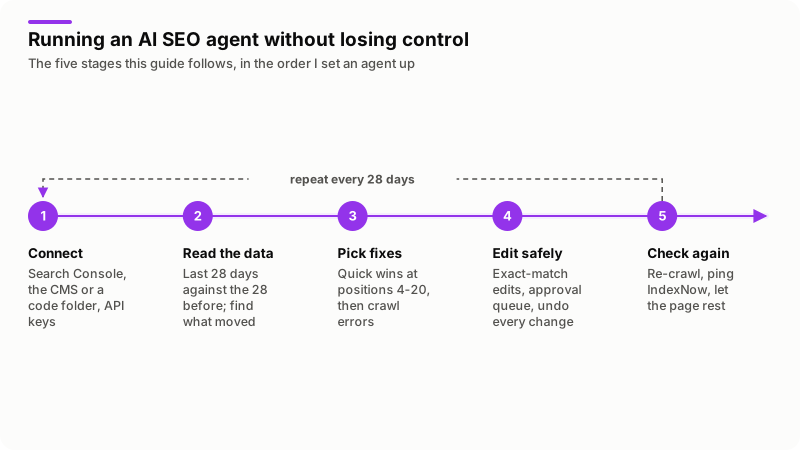
Read access to your search data, write access to your pages, and a written list of pages it may never touch. Without the first it guesses, without the second it is a reporting tool, and without the third it will eventually edit the one page you could not afford to lose.
Search Console access is the part people get wrong. The Search Analytics: query reference shows the property is addressed either as a URL-prefix property such as https://www.example.com/ or as a Domain property written sc-domain:example.com, and that reading data needs only the webmasters.readonly scope.
| Connection | What it gives the agent | Without it |
|---|---|---|
| Google service account on Search Console | Clicks, impressions, positions, URL inspection | Every suggestion is a guess |
| CMS connector or a code folder | The ability to write a change and undo it | You have an audit, not an agent |
| Cloudflare or CDN token | SSL, cache and bot settings, cache purge after an edit | Visitors keep the old copy |
| IndexNow key | A push to participating search engines after a change | Changes wait for the next crawl |
| Free backlink keys (Moz, Open PageRank, Bing) | A rough view of who links to you | Link work runs blind |
Write the deny list before the first run, not after the first mistake. Mine starts with checkout, pricing and legal pages.
How does an agent read Search Console data?
Through the Search Analytics API, by comparing one window of days against the window before it. The usual shape is the last 28 days against the 28 before, with a 90-day chart behind it, so a drop is traced to the pages and searches that moved.
Three details in the API reference change how you read the output. Dates are interpreted in Pacific time, not yours. Rows come back sorted by clicks descending, unless you group by date, in which case they are sorted by date, oldest first; rowLimit is valid from 1 to 25,000 with a default of 1,000, paged with startRow. And Google states that the API "does not guarantee to return all data rows but rather top ones", so a long-tail query missing from the response has not necessarily left Google.
The agent also has to live inside published quotas, set out on the Search Console API usage limits page.
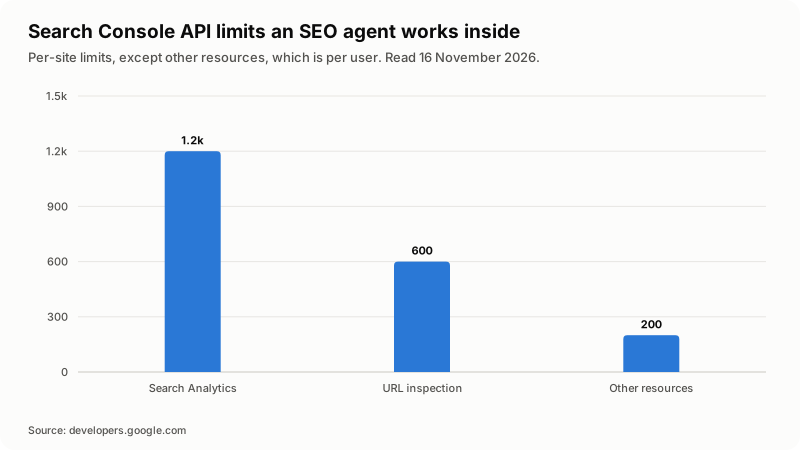
| Resource | Documented limit | Scope |
|---|---|---|
| Search Analytics | 1,200 queries per minute | Per site, and per user |
| URL inspection | 600 per minute, 2,000 per day | Per site |
| All other resources | 200 per minute, 20 per second | Per user |
A second kind of limit, called load quota, sits behind those and is measured in 10-minute and one-day chunks. Google says queries grouped or filtered by page and query string together are the most expensive, that load rises with the date range queried, and that you should avoid requerying the same data, such as pulling all of last month over and over. A well-written agent caches yesterday's pull and asks only for the difference.
Which quick wins can an agent find on its own?
The ones that are arithmetic rather than judgment. Five patterns fall out of Search Console data with no opinion required, and an agent finds them because it checks every row every day.
- Positions 4 to 20. Pages already ranking below the top three on a search with real impressions. That gap is usually a title, an intro and an internal link, not a new page.
- Low click rate for the position held. A page at position 3 with a click rate far under its neighbors normally has a title or description that does not match the question asked.
- Pages competing for the same search. Two URLs trading places on one query, where one of them should link to the other and stop trying.
- Content gaps. Searches that bring impressions to the site but have no page of their own.
- Poorly linked pages. Pages with few or no internal links pointing at them, found by joining the crawl to the search data.
What the agent cannot do is decide which of those matters to the business. A quick win on a page that sells nothing is still the wrong week's work. I reorder the list before anything runs.
Which crawl and technical checks run unattended?
Nearly all of them, because they are comparisons against a known-correct state. A crawl checks status codes, titles, H1s, canonical tags, structured data, alt text, broken links and orphan pages, and none of that needs a human. Three checks earn their keep fastest.
- Indexing. Daily URL inspection of a rotating set of pages catches a page that stopped being indexed. The rotation is forced by the quota above: 2,000 inspections per day per site means a large site is sampled.
- Stray copies and accidental noindex. A staging copy left reachable on another host competes with the real site, and a weekly check costs nothing.
- Speed from field data. Lab scores move around. The CrUX API returns real-visitor data as three-bin histograms and a p75 value, split by phone, tablet and desktop, which is the number worth tracking.
AI search checks belong in the same group: whether AI crawlers get through robots.txt and the firewall, whether pages answer their question in the opening lines, and whether an llms.txt file exists. Keep that last one in perspective. Google's AI optimization guide says you can ignore llms.txt files for Google Search, "as Google Search itself doesn't use them", and that keeping one for other services will "neither harm nor help" your visibility there. My guides on Google AI Mode SEO and showing up in ChatGPT search cover what each vendor documents.
Which page edits are safe to automate?
Edits that are reversible in one step, verifiable by a script, and harmless if wrong. A title tag rewrite passes. A pricing table rewrite does not, whatever the model believes about your prices.
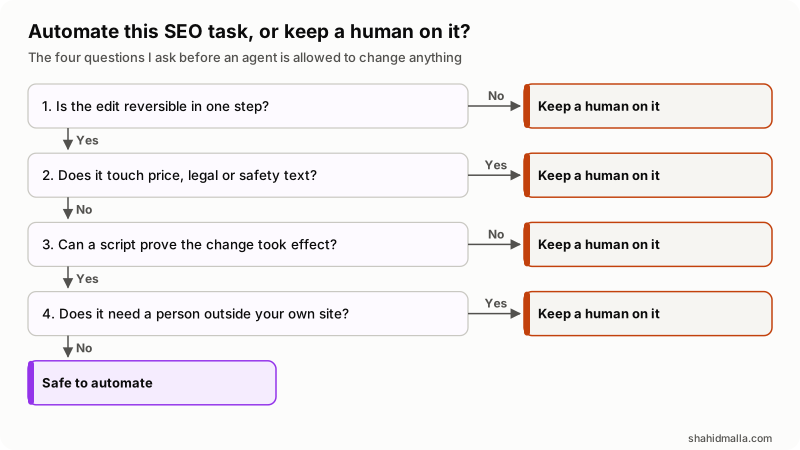
In words: keep it human if the edit cannot be undone in one step, if it touches price, legal or safety text, if no script can confirm it took effect, or if it needs a person outside your own site to agree to something. Only a task that clears all four is safe to hand over.
Guard rails turn that test into code. These five are built into my own agent, and I would want the same from any tool that edits live pages.
| Guard rail | What it stops |
|---|---|
| Each "find" text must match exactly once on the page | A near-match replacing the wrong paragraph |
| At most 20% of a page's text removed in one edit | A rewrite that deletes half the page and its rankings |
| Prices are never changed | A model inventing a number a customer then holds you to |
| A changed page rests 14 days before it is touched again | Edit loops that make the result impossible to read |
| Undo through CMS revisions or file backups, plus an audit log | A bad run you cannot roll back or explain |
Run new sites in a watch-only mode first, then a mode where every edit waits in an approval queue, and only then anything closer to autopilot.
Why do link building and outreach stay manual?
Because Google's own policies name automated link creation as spam, and because outreach is a relationship rather than a task. The spam policies for Google web search define link spam as "creating links to or from a site primarily for the purpose of manipulating search rankings", and the examples include "using automated programs or services to create links to your site", paid links, excessive exchanges, and guest posts or press releases carrying optimized anchor text.
An agent told to go and get links does exactly what that list names: it submits forms at scale.
The same page catches rank-tracking features. Google classes "scraping results for rank-checking purposes or other types of automated access to Google Search conducted without express permission" as machine-generated traffic, a policy violation and a breach of its terms of service.
What an agent can usefully do with links is the preparation: pull what free sources expose, group the gaps, draft a 90-day plan, and write outreach emails for a person to edit and send. Mine does that and never submits a form or sends an email. The send button stays with a human.
How do you stay inside Google's scaled content policy?
By never letting the agent publish a page no person has read. Google's spam policies define scaled content abuse as "when many pages are generated for the primary purpose of manipulating search rankings and not helping users", and the first example is "using generative AI tools or other similar tools to generate many pages without adding value for users".
The policy is about purpose and value, not about which tool typed the words. Google's guidance on AI-generated content says appropriate use of AI or automation is not against its guidelines, that it aims to reward quality "however it is produced", and that using AI "doesn't give content any special gains. It's just content." The same page suggests disclosing AI involvement where a reader might reasonably ask how something was made, and advises against listing AI as the author.
Four rules keep a writing agent on the right side of that line. Cap how many new pages go live each week. Name a human reviewer per page. Make the agent cite its sources. Kill any page that exists only because a keyword existed. My guide on whether Google penalizes AI content goes through the wording.
How do you check the agent did no harm?
By measuring after the rest period rather than during it, and by testing the undo path before you need it. The honest measurement window is the next 28-day comparison. This is the checklist I work through before a site moves off the approval queue.
- An allow-list and a deny list are both written down.
- One edit has been rolled back by hand, successfully, on this site.
- The audit log is readable by someone who is not a developer.
- Alerts fire on new noindex tags, new 404s and changed canonicals.
- The CDN cache is purged after every edit.
- A 28-day comparison is scheduled two weeks after the first batch.
Be precise about index pings. The IndexNow documentation allows up to 10,000 URLs per POST and says an HTTP 200 response "only indicates that the search engine has received your URL". Received is not crawled, and crawled is not indexed.
As one worked example, my own SEO Agent runs the loop described here, with the guard rails in the table above and edits through a WordPress connector or a code folder. It is $499 once, with a year of updates and support, installed with the buyer within five business days; that price was read on my SEO Agent module page on 16 November 2026, and the SEO Agent case study shows the screens. Disclosure: SEO Agent is my own product, so treat it as an example and not a recommendation.
What else do people ask about AI SEO agents?
Can an AI SEO agent replace an SEO agency?
It can replace the repetitive half: audits, reporting, monitoring, the first draft of a fix. It cannot replace decisions about which markets to compete in, which pages deserve investment, or who will link to you and why.
Is using an AI SEO agent against Google's rules?
No, not by itself. Google's published guidance says appropriate use of AI or automation is not against its guidelines. What breaks the rules is using automation to create links, to mass-produce pages with no value, or to scrape Google Search without permission.
Can an AI SEO agent build backlinks?
It should not. Google's spam policies list "using automated programs or services to create links to your site" as link spam. An agent can research targets, rank them and draft the emails. A person decides who to contact and presses send.
Can an AI SEO agent track my Google rankings?
Only through data Google gives you, which in practice means average position in the Search Analytics API. Scraping Google Search for rank data is machine-generated traffic under the spam policies, so a tool promising live rank numbers from scraped results is taking a risk on your behalf.
Does an AI SEO agent work on a site that is not WordPress?
It depends on how it writes changes. A tool built only around a WordPress plugin stops at WordPress. One that can also edit a folder of template or content files works anywhere those files live.
If you want an agent built around your own stack and your own rules rather than a subscription, that is AI agent development work, and it starts with a free scoping call of about 30 minutes and a written quote within one business day.
Last reviewed 16 November 2026. Disclosure: SEO Agent is my own product and I sell AI agent development, so I am not neutral. I am CTO at ElySpace, a freelance developer for Marmaids LLC, and founder of WHMCSPilot and MagizAI. Policy wording, API limits and protocol details come from Google's Search Central documentation, the Search Console API reference, the CrUX API documentation and IndexNow.org as I read them on that date.