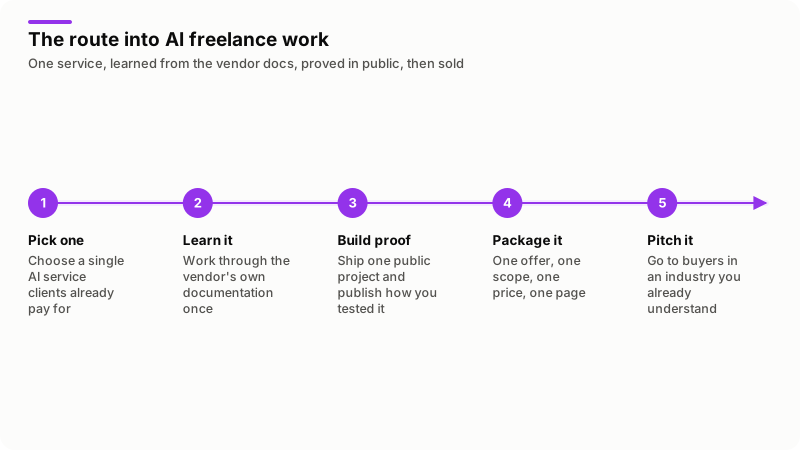
To become an AI freelancer, pick one AI service that clients already pay for, learn it from the vendor's own documentation, ship one public project that proves it works, and then pitch buyers in an industry you already understand. AI integration, AI chatbot development, AI video editing and data labeling all grew on Upwork last year. Start with the one closest to work you can already do.
An AI freelancer is an independent contractor who sells a service built on AI models rather than selling the models themselves. The work is almost always one of four things: wiring a model into software someone already runs, building a chatbot or an agent, producing and editing media with AI tools, or preparing the data that models are trained and tested on. What the client is paying for is judgment about what the model should and should not do, not access to the model.
Every outside figure below comes from a page I read on 8 November 2026 and is linked where it is used. I give no earnings figures, because the numbers that circulate online cannot be checked, and what you make depends on the service, the buyer and the country.
What does an AI freelancer actually sell?
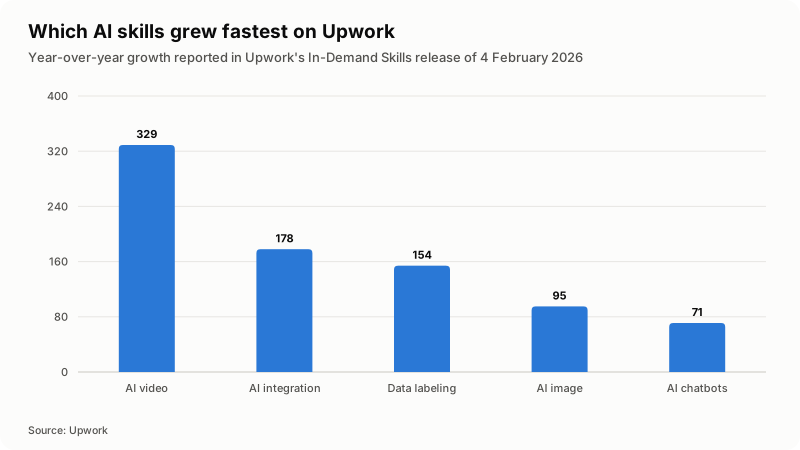
Clients buy a finished outcome that happens to use a model. The clearest public signal of which outcomes they are buying is Upwork's In-Demand Skills release, published on 4 February 2026 and read on 8 November 2026. The skills that grew fastest in it are applied ones, not research ones.
| Service | Growth, year over year | What the client asks for in the brief |
|---|---|---|
| AI video generation and editing | +329% | Cut an hour of raw footage into short clips with captions in several languages |
| AI integration | +178% | Put a model inside the app, CRM or billing system we already run |
| AI data annotation and labeling | +154% | Label our records consistently so a model can be trained and tested on them |
| AI image generation and editing | +95% | Produce product images in our style, at the sizes each channel needs |
| AI chatbot development | +71% | Answer our customers from our own documentation, and stop when it does not know |
Read those as money moving toward applied work, not as a count of job posts. The release's methodology note describes the figures as growth in freelancer earnings on completed jobs, with the demand coming from the United States, over calendar 2025 against the same period in 2024, and a skill only qualifies once it passes $100,000 in aggregate freelancer earnings in its category. The release puts the skills that explicitly reference AI at 109 percent growth year over year, and CNBC's report on the same release adds the comparison that matters to a beginner: AI-related skills more than doubled, while other high-demand skills grew 23 percent.
Fiverr's and Upwork's own public category pages both refused automated requests on the day I wrote this, so I am quoting no category names, counts, prices or gig numbers from either. If you want the mechanics of either platform, my comparison of Fiverr and Upwork for developers covers fees, payouts and badges with the help center pages linked.
Which AI service should you start with?
Start with the one nearest to work you can already do, because your first client is buying the old skill as much as the new one. A video editor who learns AI editing is credible on day one; the same editor announcing an agent practice is not.
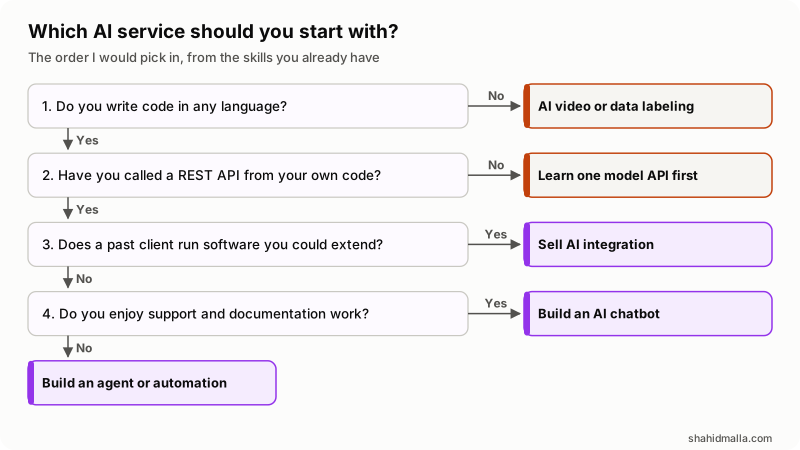
In words: if you do not write code, start with AI video or data labeling, where the bar is craft and consistency rather than engineering. If you write code but have never called a REST API from your own program, learn one model API before you sell anything. If a past client already runs software you could extend, sell AI integration to them first. Otherwise choose between a chatbot, if you like support and documentation work, and an agent or automation if you prefer plumbing.
What skills does each AI service need?
Each service has a small, specific set of things you must be able to do, and in every case the vendor's documentation is the ground truth rather than a course.
| Service | What you must be able to do | Documentation to work through |
|---|---|---|
| AI integration | Call a model API from a server you control, define a tool with a JSON input schema, handle the round trip where the model returns a tool use block and your code returns a tool result | Tool use with Claude |
| AI chatbot development | Ground answers in the client's own content, decide what the bot refuses, log conversations, hand off to a human | Prompt engineering overview |
| AI agents and automation | Chain steps, give a model tools and memory, connect a vector store, test the workflow rather than one prompt | Integrate AI in n8n, the Model Context Protocol |
| AI data annotation and labeling | Write a labeling guide two people would follow the same way, configure the labeling interface, measure agreement between annotators | Label Studio overview |
| AI video generation and editing | Edit from the transcript, reframe one cut for each platform, translate captions, fix the artifacts the model leaves behind | Premiere Pro AI features |
The Model Context Protocol is an open standard for connecting AI applications to external systems, which its own documentation compares to a USB-C port. It is what clients mean when they ask for an agent that can reach their tools.
What should you build to prove you can do the work?
Build one project per service, publish it, and publish how you tested it. A tested small project beats an untested impressive one, because the client's real fear is that your AI work will be confidently wrong in front of their customers.
| Service | The project that proves it | What you publish |
|---|---|---|
| AI integration | One AI feature added to an open-source app you did not write, such as a classifier on incoming records | The repository, the diff, the reason you chose that model |
| AI chatbot development | A bot answering from one public manual, refusing when the manual does not cover the question | A live demo, the system prompt, twenty test questions with the answers you accepted |
| AI agents and automation | One workflow moving real data between two services a small business uses | The workflow export, a video of a run, the failure cases you handled |
| Data annotation and labeling | A few hundred items of a public dataset labeled against your own written guide | The guide, the exported annotations, your agreement score |
| AI video editing | One raw recording cut three ways: long, short and vertical, with captions | The three cuts side by side and the time each took |
The test set is the part beginners skip and buyers notice. Anthropic's guide to defining success criteria and building evaluations gives the shape: criteria that are specific, measurable, achievable and relevant, graded on a held-out set, with edge cases such as empty, very long and hostile input written in deliberately. Twenty questions in a spreadsheet with a pass or fail column turns "it seems to work" into a number you can put in a proposal.
Where do your first AI clients come from?
From people who already know you, from the platforms, and from being visibly useful in one narrow place.
- Your existing clients and employers. The fastest first AI job is adding a feature for someone who already pays you. They have the data, the access and the trust. That work has a name on Upwork's list: AI integration, the fastest-growing skill in its coding and web development category.
- The marketplaces. Fiverr and Upwork put you in front of buyers who are already spending, at the cost of fees and a slow start. My guide on winning a first freelance client covers the pitch, and there is a separate one on Upwork proposals.
- The communities around the tools. Answer questions in the forum of the exact tool you build on. People asking how to connect a model to their stack are describing paid work out loud.
Whichever route you take, read the platform's AI rules before you deliver anything. My guide on using AI as a freelancer goes through disclosure, client data and who owns AI-assisted work, and that ground does not need repeating here.
How long does it take to get paid AI work?
For someone who can already build and ship software, the honest range is weeks for a first small job and months for a steady flow. For someone starting from no technical background, it is longer, and the first paid work is usually media or data work rather than engineering.
- Weeks one and two. Choose the service. Work through the documentation in the table above and build the smallest thing that runs end to end.
- Weeks three to five. Build the proof project and the test set, and publish both with a short write-up.
- Week six. Write the offer: one scope, one price, one page. Rewrite your profile so the first line names the service and the buyer, not the model you use.
- Weeks seven to ten. Pitch. Start with people who already know you, then the platforms. Expect most of it to go nowhere, and keep sending.
- After the first delivery. Ask for the review, ask what else is broken, and write the second offer out of the answer.
Two things stretch this: learning to code while also learning AI is two jobs, so give it a year rather than a quarter, and a new marketplace account with no reviews takes time to rank, which is why the first job is worth taking at a modest price for the review alone.
What should you have ready before you pitch?
This is the short list I would want in place before sending anything.
- One named service, written as an outcome, not as a tool list.
- One public project with the code or the output visible.
- A test set of at least twenty cases with recorded pass or fail results.
- A written scope that says what is included, what is not, and what you need from the client.
- A price, and a rule for what changes it.
- A plan for the client's data: where it goes, which provider sees it, and how long you keep it.
- Two sentences that explain, without jargon, what the model can and cannot be trusted with.
What goes wrong for new AI freelancers?
The usual failure is selling access to a model instead of a result, and the second is promising accuracy you have not measured.
- Selling the tool. "I use the latest models" is not an offer. "I will answer your support email from your own documentation and show you the twenty questions it got right" is.
- No evaluation. Without a test set you cannot tell a good change from a bad one, and neither can your client.
- Hidden running costs. API usage is the client's bill after you leave, so put an estimate in the quote.
- Client data handled casually. Pasting a customer list into a consumer chat tool is a contract problem, not a technical one. Use the API, check the provider's data settings, and say in writing what you did.
- Chasing the highest-growth category. The fastest-growing skill on that Upwork list is video work. If you have never edited video, that number is not an opportunity for you, it is a crowd.
There is also a case for not doing this at all. If you have deep skills in a field with steady demand, adding AI to that work usually pays better than restarting as a generalist, the argument in my guide on AI tools for freelancers.
What else do people ask about becoming an AI freelancer?
Do you need a degree to become an AI freelancer?
No. Buyers ask for work they can look at, references they can check and a clear scope. A degree helps for research and machine learning roles, but the services growing fastest on Upwork are applied, and they are judged on shipped work.
Do you need to know how to code?
It depends on the service. AI integration, chatbots and agents are software work, and you will not get far without being able to call an API and deploy something. AI video, AI image work and data labeling are craft and process work, where consistency and a written guide matter more than code.
How much should an AI freelancer charge?
Price the outcome and the risk, not the hours the model saves you. I charge $55 to $65 per hour for development work, which reflects 13 or more years of delivery rather than a starting rate, and for defined scopes I quote a fixed price instead. Work out what the result is worth to the buyer, then check that your price covers rework, API costs and the test set.
Is AI freelancing already too crowded?
The general end of it is crowded, and the specific end is not. Anything that needs access to a client's system, their data and their rules still needs a person who can be accountable for it. That is why AI integration heads Upwork's fastest-growing list for coding and web development, while no prompt-writing skill appears anywhere on those lists.
If you would rather hand a build to someone who has already done it, I take this work as an AI developer and build production chatbots through AI chatbot development, with a free scoping call of about 30 minutes and a written quote within one business day.
Last reviewed 8 November 2026. Disclosure: I sell AI integration and chatbot development, so I am not neutral. I am CTO at ElySpace, a freelance developer for Marmaids LLC, and founder of WHMCSPilot and MagizAI. The growth figures come from Upwork's In-Demand Skills release of 4 February 2026 and CNBC's report on it, and the technical details from the Anthropic, Model Context Protocol, n8n, Label Studio and Adobe documentation, all read on 8 November 2026.