
No. Google does not penalize AI-generated content just because AI wrote it. Its own guidance says appropriate use of AI or automation is not against its guidelines, and that it rewards quality "however it is produced." What Google acts against is using AI, or anything else, to mass-produce pages with little value for readers, which its spam policies call scaled content abuse.
AI-generated content is text, images or other page material produced wholly or mainly by a generative AI model. AI-assisted content is the softer version, where a person writes and uses AI for research, structure or editing. Google's guidance judges both by the same test: whether the page helps the people who read it.
Everything below comes from Google's own pages, which I reread on 3 November 2026: the Search Central guidance on generative AI content, the spam policies, the people-first content page, two Search Central blog posts, the Manual actions help page and the Search Quality Rater Guidelines. Quotes are short so you can check them.
What does Google actually say about AI-generated content?
Google says the method does not matter; the value does. Its February 2023 post, Google Search's guidance about AI-generated content, answers the question directly: "Appropriate use of AI or automation is not against our guidelines." The same FAQ adds that "Using AI doesn't give content any special gains. It's just content."
The current rule page, Google Search's guidance on using generative AI content on your website, is shorter and more practical. It says generative AI "can be particularly useful when researching a topic, and to add structure to original content." It then draws the line: using AI tools "to generate many pages without adding value for users may violate Google's spam policy on scaled content abuse."
| Google page | What it says about AI content | Date shown on the page |
|---|---|---|
| Guidance on generative AI content | Useful for research and structure; mass pages without added value may break the scaled content abuse policy; fact-check everything, including metadata | Last updated 1 October 2026 |
| Spam policies for Google web search | Scaled content abuse applies "no matter how it's created"; violating sites "may rank lower in results or not appear in results at all" | Last updated 28 August 2026 |
| Creating helpful, reliable, people-first content | Ask Who, How and Why; AI disclosures help where readers would wonder how content was made | Last updated 5 October 2026 |
| Blog: guidance about AI-generated content | AI use is fine unless the primary purpose is manipulating rankings | Posted 8 February 2023 |
| Blog: March core update and new spam policies | Scaled content abuse builds on the older policy on automatically-generated content | Posted 5 March 2024 |
| Search Quality Rater Guidelines (PDF) | Generative AI alone does not set a page's quality rating; low-effort scaled pages get Lowest | Dated 11 September 2025 |
Read together, the pages ask one question: is the page original, accurate and made for people, or made to attract search visits? Whether a machine helped is not the test.
Where does AI content cross the line into spam?
AI content becomes spam when it is produced at scale mainly to manipulate rankings. The spam policies define scaled content abuse as "when many pages are generated for the primary purpose of manipulating search rankings and not helping users," and say it covers unoriginal content that provides little to no value "no matter how it's created." Google lists these examples:
- Using generative AI or similar tools to generate many pages without adding value for users.
- Scraping feeds, search results or other content to generate many pages, including through synonymizing, translating or other obfuscation.
- Stitching or combining content from different web pages without adding value.
- Creating multiple sites to hide the scaled nature of the content.
- Creating many pages that make little or no sense to a reader but contain search keywords.
The history matters. Google's March 2024 post on new spam policies says the policy "builds on our previous spam policy about automatically-generated content" and applies "no matter whether content is produced through automation, human efforts, or some combination of human and automated processes." So a team of writers churning out rewrites is in the same bucket as a script calling an AI model. The spam policies page also names "attempting to manipulate generative AI responses in Google Search" as part of what Google counts as spam.
Here is how common uses of AI line up against those pages:
| How AI is used | What Google's pages say | Risk |
|---|---|---|
| Researching a topic and outlining a page you write | Named as a useful use of generative AI | Low |
| Drafting a page that a person rewrites with real experience and fact-checks | Judged like any other content: helpful, original, accurate | Low |
| Data-driven pages such as scores, weather or transcripts | Cited by Google as long-standing helpful automation | Low |
| Hundreds of pages generated from a keyword list with no review | First example of scaled content abuse | High |
| Rewriting or translating other sites' articles in bulk | Scaled content abuse through obfuscation | High |
| Invented authors with AI headshots and fake credentials | Called "a form of deception" on the people-first page | High |
| AI product titles and descriptions in Google Merchant Center | Must be specified separately and labeled as AI-generated | Policy requirement |
What happens to a site that breaks the policy?
It loses visibility, either through Google's automated systems or through a manual action by a person at Google. The spam policies say Google detects violations "through automated systems and, as needed, human review that can result in a manual action," and that sites in violation "may rank lower in results or not appear in results at all."
| Automated ranking or spam systems | Manual action | |
|---|---|---|
| Who decides | Google's automated systems, such as SpamBrain | A human reviewer at Google |
| Do you get told? | Not listed in the Manual actions report, which covers actions by human reviewers; you see a traffic drop | Yes, in Search Console's Manual actions report and message center |
| Labels that fit AI misuse | None shown | "Major spam problems" (names scaled content abuse) or "Thin content with little or no added value" |
| How to recover | Improve or remove the weak pages and wait for Google to reassess | Fix every affected page, then select Request Review |
The Manual actions report help page is strict about the fix: "Fixing the issue on just some pages will not earn you a partial return to search results." It says most reconsideration reviews "can take several days or weeks." For the Major spam problems action, Google asks you to provide examples of the bad content you removed and the good content you added.
A site can also lose traffic after publishing thin AI pages without any manual action, because Google's automated ranking systems are designed to prioritize helpful, people-first content. That is not a penalty in the formal sense, but the effect on traffic is the same.
How do Google's quality raters judge AI-written pages?
Raters judge effort, originality and added value, not the tool. The Search Quality Rater Guidelines (the version dated 11 September 2025, which Google served when I downloaded it) say: "the use of Generative AI tools alone does not determine the level of effort or Page Quality rating." The same passage says AI tools can produce both high quality work and Lowest quality content.
Three sections matter most for AI content:
- Section 4.6.5, Scaled Content Abuse. Raters give the Lowest rating to sites "made up of content created at scale with no original content or added value for users," even when they cannot tell whether AI was used.
- Section 4.6.6, little to no effort, originality or added value. Lowest applies when all or almost all of the main content is copied, paraphrased, "auto or AI generated," or reposted with little to no effort, originality and added value. Section 4.6.7 adds that leftover words like "As an AI language model" are a sign of content summarized or paraphrased by generative AI tools.
- Section 4.5.3, deception. "AI generated content with made up 'author' profiles" is given as an example of a deceptive website.
Two caveats from Google itself. The generative AI guidance says rater ratings "don't directly influence ranking"; raters help Google test its systems. And the people-first page defines effort in a way that fits AI directly: "using generative AI to produce large amounts of text without manual oversight or curation represents little to no effort."
Can Google tell whether a page was written by AI?
Google does not say it labels pages as AI-written, and its guidance does not depend on that. The 2023 FAQ says Google has "a variety of systems, including SpamBrain, that analyze patterns and signals to help us identify spam content, however it is produced." None of the Google pages I read describe an AI detector or say Google uses one for ranking.
That makes "will it pass an AI detector?" the wrong question for Google Search. A human-written page that adds nothing can rank poorly, and an AI-assisted page that is accurate and original can rank well. The rater guidelines even tell raters to give the Lowest rating to suspected scaled content "even if you are unsure of the method of creation."
How do you use AI for content without risking your rankings?
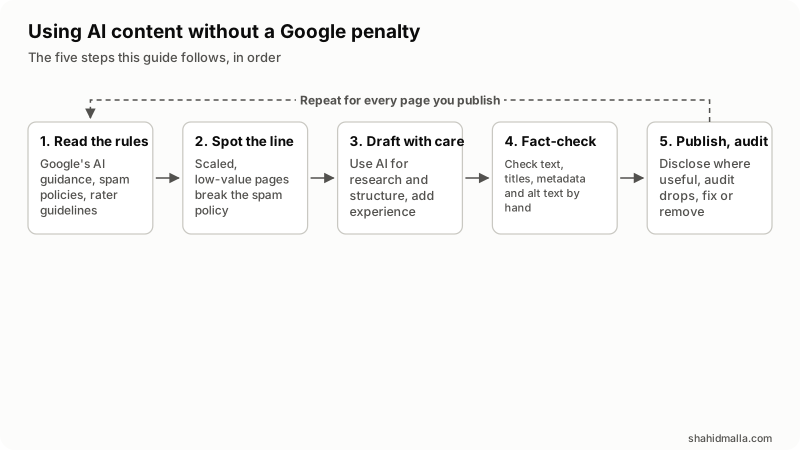
Use AI as a tool inside a process a person is responsible for. This is the workflow I recommend, built from Google's own wording:
- Start from a real reader question. Google's people-first page asks whether your audience "would find the content useful if they came directly to you." Pick topics your customers ask about, not topics that merely look like traffic.
- Bring the experience yourself. AI can summarize what is already online. It cannot add your test results, your client questions, your prices, your photos or your judgment. Google asks whether content shows "first-hand expertise and a depth of knowledge."
- Use AI where Google says it helps. Google names researching a topic and adding structure to original content.
- Fact-check every claim by hand. Google warns that "generative models don't retrieve facts, but predict a likely sequence of words," and calls it "critical to manually factcheck and review all AI-generated content." Check numbers, names, dates, quotes and links against the source.
- Review the parts readers see in Search. The same page extends the review to title elements, meta descriptions, structured data and image alt text.
- Put a real person's name on it. Use accurate bylines where readers would expect one. Never invent an author, a headshot or credentials.
- Disclose when a reader would ask. Google says AI or automation disclosures "are useful for content where someone might think 'How was this created?'" For AI images, add image metadata; Merchant Center requires the IPTC DigitalSourceType value TrainedAlgorithmicMedia on AI-generated product images.
- Publish at the pace you can review. Google's warning signs include "using extensive automation to produce content on many topics." If nobody has read a page carefully, it is not ready.
For how this fits Google's AI features in search results, see my guide to Google AI Mode SEO, and for other engines, ChatGPT SEO.
What should you check before publishing an AI-assisted page?
Check that a person stands behind every sentence. Run this short checklist on each page:
- The page answers a question your audience actually asks.
- It contains something not already on the pages ranking for that query: experience, data, examples or analysis.
- Every figure, name, date and quote was checked against a primary source, and the source is linked.
- The title, meta description, structured data and alt text were checked by a person.
- No leftover AI phrasing or filler, a real named author, and a disclosure where readers would ask.
- The page is not one of many near-identical pages targeting keyword variations.
- You are not changing the page date unless the content substantially changed.
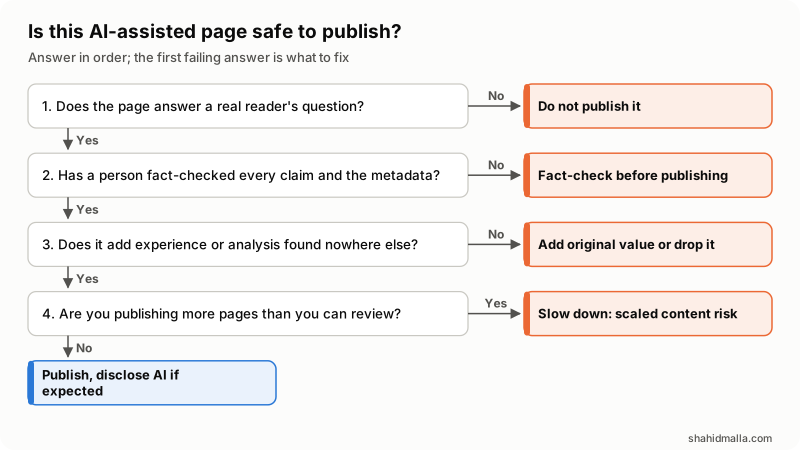
In words: if the page answers no real reader question, do not publish it. If nobody has fact-checked it, do that first. If it adds nothing found nowhere else, add original value or drop it. If you are publishing more pages than you can properly review, slow down, because that is the pattern the scaled content abuse policy describes. Otherwise publish, with a disclosure where readers would expect one.
What should you do if AI content already hurt your traffic?
Find out which kind of drop it is, then fix the pages rather than the dates. Google's people-first page suggests "an audit of the drops you may have experienced": which pages fell, and for which searches.
- Open the Manual actions report in Search Console. If it lists an action, follow the steps above and request a review only after every affected page is fixed.
- If there is no manual action, sort the pages that lost clicks and compare them with the questions on the people-first page.
- Improve the pages you can make genuinely useful: add experience, correct facts, merge near-duplicates.
- Remove or exclude from Search the pages you cannot improve. The spam policies say that if you host scaled content, "exclude it from Search."
- Do not bulk-change publish dates or add and delete pages just to look fresh. Google says plainly, "No, it won't" help.
What else do people ask about AI content and Google?
Is AI-generated content against Google's guidelines?
No. Google's FAQ says appropriate use of AI or automation is not against its guidelines. It becomes a violation when AI is used to generate content primarily to manipulate search rankings, which is covered by the spam policies.
Will AI-written content rank on Google?
It can. Google says using AI gives content no special gains: if it is useful, helpful, original and shows E-E-A-T, "it might do well in Search," and if not, it might not. The method does not decide the result.
Should I disclose that I used AI?
Disclose where a reader would reasonably wonder how the content was made. Google's people-first page also suggests explaining how automation was used and why it was useful.
Can I list AI as the author of an article?
Google's FAQ advises against it: an AI byline is probably not a good way to make AI involvement clear to readers. Name the real person responsible and describe the AI's role in a disclosure instead.
How much AI content is too much for Google?
Google sets no percentage. The test is whether a page has real effort, originality and added value, and whether you are generating pages faster than anyone can make them useful. Google also says it has no preferred word count.
If you want a site built around your own expertise, with AI features that serve visitors, see my web designer-developer and AI Mode website development services.
Disclosure: I am a freelance web designer-developer and I sell website and AI development work, so I am not neutral. I am not affiliated with Google. Quotes and dates come from Google's pages as I read them on 3 November 2026; Google updates these pages, so check the linked versions before acting.
Last reviewed 3 November 2026.