A custom CRM costs what its scope costs. I sell a standard sales CRM at a fixed price of $599 to $2,999, because it starts on my own CRM base. From an empty project the same scope is 72 to 131 hours at $55 to $65 an hour. An agency bills several people for the same scope, which is where most of the gap sits.
Custom CRM development cost is the price of building a customer record system around one company's own process, instead of renting seats in a hosted product. It is set by scope and by who does the work, not by a market rate. Two honest quotes for the same brief can differ several times over, because they describe different teams.
How much does a custom CRM cost?
With me it has a published price. The 7-day CRM package, read on 16 November 2026, runs $599 for one pipeline with contacts, tasks, three roles and one import, $1,399 once quotes as PDF, payment links and an audit log are added, and $2,999 for up to four pipelines with record-level permissions. A scope those plans do not cover is quoted from the hours below, my planning estimates rather than a quote.
| Work area | Hours from an empty project | Hours on my CRM base |
|---|---|---|
| Scope call, written scope, acceptance checklist | 3-6 | 3-6 |
| Data model and migrations for your record types | 6-10 | 3-5 |
| Contacts and companies with timeline, notes and files | 8-14 | 2-4 |
| Pipeline board, owners, follow-ups, tasks, reminder emails | 13-23 | 3-7 |
| Roles, record permissions, audit log | 8-14 | 2-4 |
| Quote or invoice PDF, payment link, signed webhook | 10-18 | 4-8 |
| One import with duplicate handling and a row report | 6-14 | 4-10 |
| Dashboard with the figures you read weekly | 5-10 | 2-5 |
| Tests, staging run-through, deployment, restore check, handover | 13-22 | 7-12 |
| Total | 72-131 | 30-61 |
Read the two columns as the same product built twice. The scope call does not shrink, and your import, payment flow and handover shrink least, because they are yours alone. The rest shrinks because sign-in, permissions, the audit log, the board, the importer and PDF output already exist and are tested. The fixed price on my 7-day custom CRM page rests on that base, which is why it sits below the hours times my rate.
Why do agency quotes for the same CRM come out higher?
Because you are buying a team and the structure around it, not only build hours. Neither option is dishonest. They are different products.
- More people per hour of code. A workshop, a designer, a manager, a developer and a tester each bill for the same feature, and each handoff costs time nobody writes code in.
- Sales and overheads. Pitching, account management, offices and salaries between projects sit inside the rate.
- Risk padding. A firm that will not see your data until week three prices that uncertainty, often twice.
- Subcontracting. Some quotes are a freelancer's hours with a margin on top. Ask who writes the code.
The higher price buys continuity if one person leaves, several specialists at once, and a contract a procurement department will accept. For a small company replacing a spreadsheet, that is rarely the blocker.
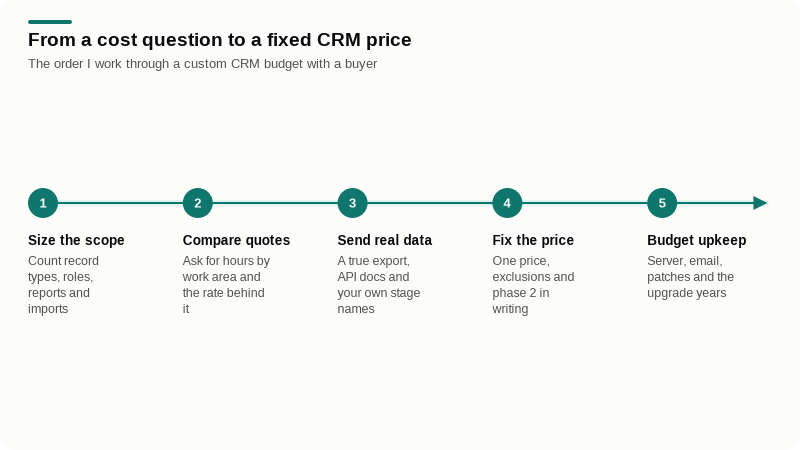
I do not repeat the ranges published in agency cost guides, because I cannot verify how those figures were measured or which scope they describe. Ask any provider, me included, for hours by work area and the rate behind the total, because quotes only compare at that level. My own trade-offs are in agency versus freelancer.
What drives the price of a fixed-scope CRM quote?
Six things, and you control most of them before the build starts. A second department and native mobile apps are separate projects.
| What you add | Why it costs | What keeps it down |
|---|---|---|
| Record-level permission rules | A check on every screen, export and API route, plus a test per rule | Write the rules down first |
| An integration with an outside system | Credentials, field mapping, retries and a safe place to test | Prefer public docs and a sandbox; a nightly file beats a live sync |
| A data import | Duplicate rules, mixed date and currency formats, files with no owner | Send the real export early; delete dead rows at source |
| Reports and charts | Each figure needs an agreed definition and a query that stays fast | Name the three to five numbers you read |
| Taking payment inside the CRM | A signed webhook, retries, failed payments, reconciliation | Sandbox first; leave invoicing where it works |
| Several languages or currencies | Every label, PDF and email doubles, plus rounding and tax rules | One language and currency at launch |
Permissions are the row buyers underestimate most. A CRM where everyone sees everything is cheap; one that keeps two sales teams apart needs the same rule proved on every list, export, search and API route.
What should you send to get a quote instead of a range?
Six items turn an estimate into a fixed price. Send them before the first call.
- How a lead reaches you now, and who touches it until money arrives.
- Your pipeline stages in your own words, and what makes a deal won.
- The roles, with one sentence each on what that role may not see.
- A real export of your data, mess included, not a tidy sample.
- Every system the CRM must read or write, with each API's documentation.
- The reports you read weekly, whether payment happens inside the CRM, and the date that matters.
From the quote that comes back, ask for the exclusions, who owns the code and hosting, and what the payment schedule is tied to. Mine are written on how I work, and the balance falls due after an acceptance checklist passes. Payments for my work are final, so ask every question before you sign.
Tests belong inside that price. Laravel ships with Pest and PHPUnit support configured, and a feature test is how a permission rule still holds after the next change. A quote with no test line moves the testing onto your staff.
How do I turn those hours into one fixed price?
By breaking the scope into modules small enough to estimate, then pricing the risk of fixing the number at all.
- Split the scope into modules with one acceptance line each, such as "a sales user cannot open another team's deal".
- Estimate each module low and high, and price near the high end for anything touching a system or dataset I have not opened.
- Add a contingency sized by how much of the work depends on other people's systems, data or approvals.
- Price the risk, not only the hours. A fixed price moves every overrun onto me, so it is not the bottom of the range times my rate.
- Write the exclusions beside the price. Everything else becomes a phase 2 line with its own quote and date.
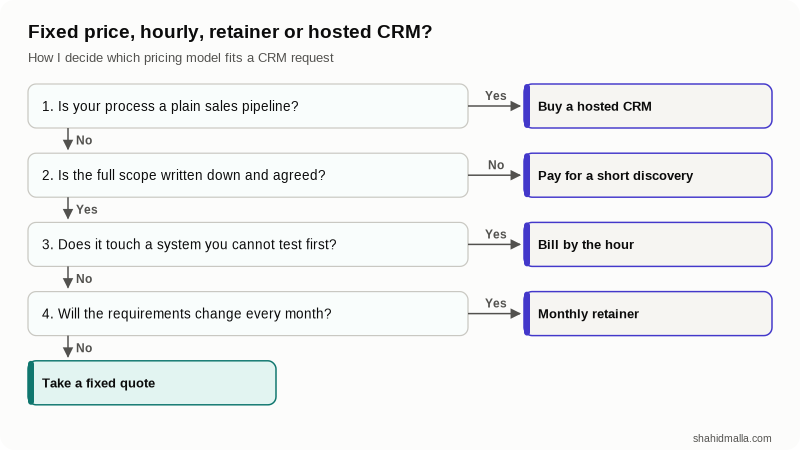
In words: an ordinary sales pipeline means buy a hosted CRM. A scope nobody has written down means a short paid discovery that ends in something somebody can price. An integration with no public documentation, or data nobody has opened, means $55 to $65 an hour, because a fixed price there is a guess with a margin on it. Monthly change suits a monthly developer retainer, which retainer versus hourly compares. Everything else gets one fixed number.
What does a custom CRM cost to run each month?
Far less than the build, and on your own accounts rather than through me. These are list prices I read on 16 November 2026.
| Item | Figure | Where it comes from |
|---|---|---|
| Server with the database on it | $12 to $48 a month | DigitalOcean Basic Droplets: 2 GiB $12, 4 GiB $24, 8 GiB $48 |
| Server backups | 20% or 30% of the server price | Same page: 20% weekly or 30% daily, or usage plans from $0.01 per GiB a month |
| Notification and reminder email | $0.10 to $0.16 per 1,000 emails | Amazon SES: $0.16 per 1,000 on the Essentials plan, or $0.10 a la carte |
| Card fees on payments you collect | A percentage of each payment | Set by your provider and country, so read your own market's page |
| Upkeep | $55 to $260 a month | My planning estimate of 1 to 4 hours at $55 to $65: patches, log checks, small changes |
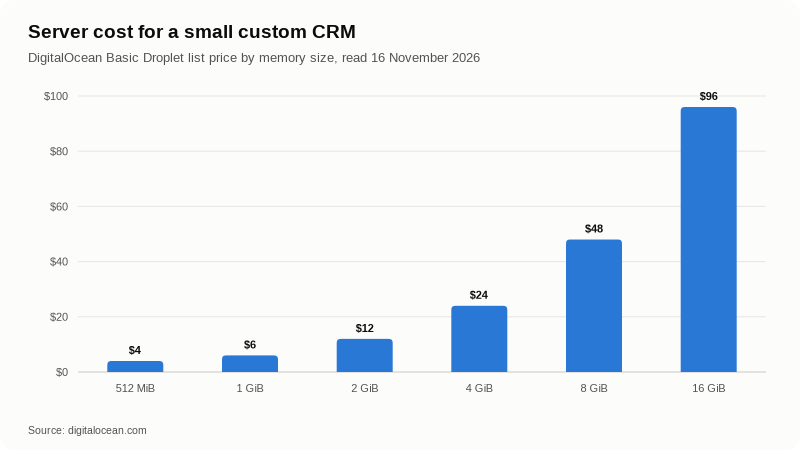
A CRM for a team of ten is not a demanding application: a few thousand rows and a database that fits in memory. The 2 GiB or 4 GiB line is the honest starting point.
What do the framework and PHP upgrade years cost?
Four to twelve hours in specific years, by my planning estimate, and it is the cost most quotes leave out. Software you keep for five years sits inside two support clocks. The Laravel release notes give a major release each year, bug fixes for 18 months and security fixes for two years. The PHP project's supported versions page gives each branch two years of active support and two more of security fixes only. Both read on 16 November 2026:
| Release | Bug fixes or active support until | Security fixes until |
|---|---|---|
| Laravel 12, released 24 February 2025 | 13 August 2026, already past | 24 February 2027 |
| Laravel 13, released 17 March 2026 | Q3 2027 | 17 March 2028 |
| PHP 8.2 | 31 December 2024 | 31 December 2026 |
| PHP 8.3 | 31 December 2025 | 31 December 2027 |
| PHP 8.4 | 31 December 2026 | 31 December 2028 |
| PHP 8.5 | 31 December 2027 | 31 December 2029 |
Two rows matter for a CRM quoted now. PHP 8.2 stops getting security fixes on 31 December 2026, so a new build should not start on it. Laravel 13 needs PHP 8.3 as a minimum and supports up to 8.5, so a server pinned to an old branch quietly blocks the next framework upgrade. My Laravel 13 upgrade guide covers that work, and website maintenance cost applies the same logic to smaller sites.
When is a per-seat CRM subscription cheaper?
Usually when the team is small and the process is an ordinary pipeline. Work it out from your own invoice:
yearly subscription = seats x price per seat per month x 12
Compare that with the build price plus a year of running cost above. A build does not grow when you hire; a subscription does, and it stops being yours the month you stop paying. The build wins sooner for a team adding users, for a process the hosted tool models badly, and when customer data must sit on a server in your own name.
I print no vendor's per-seat price here, because neither pricing page I opened on 16 November 2026 served its figures to me. Your own renewal invoice is the only seat price true for you anyway.
Which custom CRM costs do buyers forget?
The ones on your side of the line, which is why two quotes at the same price can land differently.
- Your team's hours. Answering questions, approving the data model, testing on staging.
- Cleaning the old data. Deciding which of three records for one company is correct is your work, and it has no shortcut.
- Running both systems for a week. Double entry during a cutover is a staff cost almost nobody quotes.
- Training, phase 2 and a tested restore. Postponed features still get bought, and a backup nobody has restored is not a backup.
When is a custom CRM not worth the money?
When the cost buys less than the alternatives, which happens more often than a developer's website admits.
- Five people and a plain pipeline. A hosted CRM is cheaper and needs no developer.
- Nobody can answer questions during the build. Every day of silence costs a day.
- You want the price fixed and the scope open. Those two cannot both be true.
- There is no budget for upkeep. Unpatched software becomes a liability fast.
- The real problem is an undecided process. Software sets it in code either way, so decide first.
A fixed price cannot absorb features added after sign-off, clean contradictory records, or shorten another company's approval queue. For scope see custom CRM development, and for timing, how long a custom CRM takes.
What else do people ask about custom CRM cost?
Why is custom CRM development so expensive?
Usually it is not the code, it is the number of people billing for it and the uncertainty being priced. The parts that cost money are record-level permissions, integrations with systems the developer cannot test, and importing data nobody has cleaned. Strip those three down and the same CRM gets much cheaper.
Is it cheaper to build your own CRM than to pay per seat?
Not for a small team on an ordinary pipeline. A build is a one-off cost plus upkeep, and a subscription grows with every hire, so the answer turns on how many seats you expect and how badly the hosted tool fits. Do the sum over three years, including hosting, email and the upgrade years.
Can I build a CRM myself with an AI coding tool?
You can get contacts, companies and a pipeline board working quickly. The parts that take experience are the ones nobody demos: permissions that hold under every export and API route, a webhook that survives a retry, an import that merges duplicates, and a restore you have tested. I use AI coding agents on every build and still review every change.
Who owns the code when you pay for a custom CRM?
Whatever the quote says, which is why it has to say something before work starts. On my builds the quote states the license for the code written for you and for my reusable base, you receive the repository at handover, and the server, database and payment accounts are in your company's name.
To turn this into a number for your own process, the scoping call of about 30 minutes is free and the written quote follows within one business day.
Last reviewed 16 November 2026. Disclosure: I sell custom CRM development, so I am not neutral. I am CTO at ElySpace, a freelance developer for Marmaids LLC, and founder of WHMCSPilot and MagizAI. The hour figures are my own planning estimates, not a quote.