
Vibe-coded apps break over time because nobody owns the code. Each prompt adds code and little gets cleaned up, frameworks and platforms ship breaking changes, later prompts undo security fixes, and queries that were fine for ten users slow down at ten thousand. A product with paying users needs a developer who reads the code, keeps it tested and documented, and schedules upgrades.
Vibe coding technical debt is the future cost of code that an AI tool generated and no developer reviewed: logic copied instead of reused, no tests, no record of why things work the way they do, and dependencies frozen at whatever was current on the day of the prompt. Like any debt it is cheap to take on, and you pay interest on it every time someone changes the app.
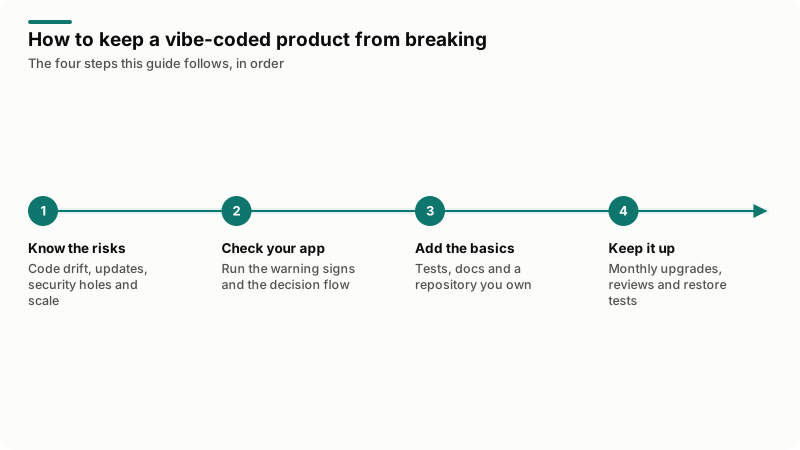
This guide is about the months after launch. If your app is broken today, start with my guide to fixing a vibe-coded app; if it has not launched yet, run the vibe coding security checklist first.
Why do vibe-coded apps break after launch?
Because four kinds of change keep arriving after the demo, and nobody is assigned to absorb them. The code does not decay by itself; the world around it moves, and the code was never shaped to be changed.
| Force | What happens over the months | Early warning sign | What prevents it |
|---|---|---|---|
| Maintainability | Each prompt writes a new copy of logic instead of reusing the old one | Fixing one bug breaks another screen | Tests first, then shared modules |
| Updates | Runtimes reach end of life; packages and platforms change their APIs | Build warnings and deprecation emails | A monthly upgrade routine with a test run |
| Security | New prompts reopen what an audit closed | Old audit findings come back | Access and policy tests on every change |
| Scale | Queries without indexes; slow work inside web requests | Pages slow down as tables grow | Indexes, background jobs, query review |
Even people who love vibe coding say this. Jason Lemkin of SaaStr, whose team has built more than 12 vibe-coded apps used more than 800,000 times, writes in a post about maintaining them: "A prototype requires almost no maintenance. Production at scale requires daily maintenance." Lemkin puts the minimum at 30 to 60 minutes a day for apps with thousands of users and warns that owners who treat their apps as "done" are the ones "whose apps will slowly rot."
How does AI-generated code become hard to change?
It grows by addition. An assistant asked for a feature writes new code next to the old and rarely merges two similar functions, because nobody asked. Months later the same business rule lives in four files, and the next fix lands in one of them.
GitClear measured this trend in its AI Copilot Code Quality report, published in February 2025, which classified 211 million changed lines of code written between January 2020 and December 2024. Moved lines, a sign of refactoring, fell from 24.8% of changed lines in 2021 to 9.5% in 2024. Copy/pasted lines rose from 8.4% to 12.3%, and 2024 was the first year in its data in which copy/paste outnumbered moves. GitClear also recorded "an 8-fold increase in the frequency of code blocks with 5+ duplicated lines during 2024." The report ties this to the spread of AI assistants; it shows a trend that grew alongside adoption, not proof of cause.
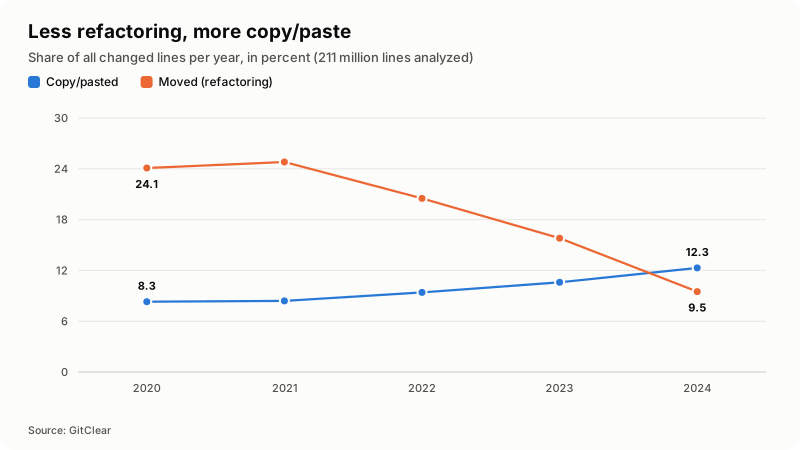
| Year | Moved lines (refactoring) | Copy/pasted lines |
|---|---|---|
| 2020 | 24.1% | 8.3% |
| 2021 | 24.8% | 8.4% |
| 2022 | 20.5% | 9.4% |
| 2023 | 15.8% | 10.6% |
| 2024 | 9.5% | 12.3% |
Google's DORA research found a related cost at team level. Its 2024 report found that as AI adoption increased, delivery throughput fell by an estimated 1.5% and delivery stability by an estimated 7.2%. In the 2025 report throughput turned positive, but "AI adoption does continue to have a negative relationship with software delivery stability." DORA's explanation: without strong automated testing, version control and fast feedback, "an increase in change volume leads to instability." A founder prompting an app alone has the change volume and none of those controls.
Which updates will break a vibe-coded app?
The ones nobody scheduled. Everything installed on launch day has its own release calendar, and the app stays behind until something forces the move.
| Change | Real example | What it means for your app |
|---|---|---|
| Runtime end of life | Node.js lists version 20 on its end-of-life page, last updated March 24, 2026 | No more security patches; packages drop support over time |
| Platform key change | Supabase's API keys page says it is "deprecating the anon and service_role keys by the end of 2026" | A planned swap to the new keys, tested on every client |
| Major package versions | Semantic Versioning raises the major number for "incompatible API changes" | A jump from version 3 to 4 can break code that built yesterday |
| Outdated AI suggestions | Supabase warns that a long key starting with eyJ suggested by a tool or AI assistant "was written for the legacy keys" | Prompts can bring retired patterns back into new code |
Node.js spells out what end of life means: the release line "will no longer receive updates, including security patches." Its release page adds that "Production applications should only use Active LTS or Maintenance LTS releases." Supabase says creating the new keys does not revoke the legacy ones, so you can switch over and test before you disable the old keys, if someone plans it.
The fix is routine, not heroics. GitHub's Dependabot opens pull requests that keep dependencies "updated, even when they don't have any vulnerabilities," and by default waits 3 days after a release before proposing it. Those pull requests are only safe to merge when tests run on them, which is why tests come before upgrades.
Why do security holes come back after they are fixed?
Because the next prompt does not know why the fix exists. An agent asked to make the dashboard load faster may loosen a database policy or move a permission check into the browser, and nothing stops it unless a test fails.
The models are not getting safer on their own either. Veracode's 2026 GenAI Code Security Report found that "roughly 44% of AI code generation tasks introduced a risky security vulnerability" in its tests, and that the average security pass rate of 56% is "barely changed from 55% in the first report", while models write syntactically correct code "nearly 100% of the time." Code that runs is not code that is safe.
What holds a fix in place is a test that fails when the hole reopens: sign in as user B and request user A's records, call admin routes while signed out, send an unsigned payment webhook. Those checks have to run on every change, not once before launch.
What happens when a vibe-coded app gets real traffic?
It slows down where nobody looked: queries without indexes, access rules evaluated row by row, and emails, exports or AI calls done inside the web request. A demo with fifty rows hides all three.
If your app runs on Supabase, its Row Level Security guide is direct about the first two: "Add an index on every column your policies filter on," because "an unindexed filter column turns a read into a sequential scan." It also recommends wrapping functions such as auth.uid() in a select, so Postgres can "cache" the result "per-statement, rather than calling the function on each row." Each fix is small; finding where it is needed takes someone who reads query plans.
- Index every column used in a filter, a join or an access policy.
- Move email, exports, webhooks and AI calls to a background queue with retries.
- Paginate lists on the server; never load a whole table into the browser.
- Rate-limit login, sign-up and any route that costs you money per call.
- Read the slow-query log every week once real users arrive.
How do you know your product needs a developer now?
When the app holds something you cannot afford to lose, such as paying customers, personal data or your credibility with investors, and nobody can explain how it works. A prototype with test data can keep running on prompts alone. Two or more of these signs mean it is time:
- Every new feature breaks something that used to work.
- You avoid updating packages because the last update broke the build.
- Nobody knows which Node.js, framework and database versions the app runs on.
- The only documentation is the chat history inside the builder.
- You have never test-restored a backup.
- A problem fixed in an earlier audit has quietly come back.
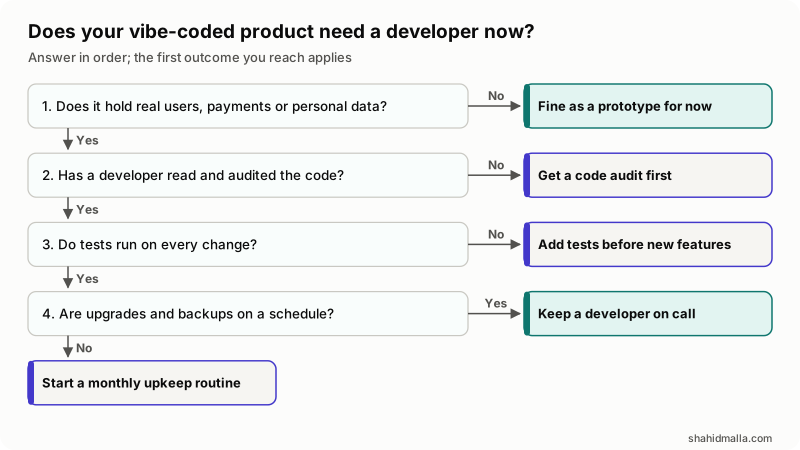
- Does it hold real users, payments or personal data? If not, it is fine as a prototype for now.
- Has a developer read and audited the code? If not, get an audit before anything else.
- Do tests run on every change? If not, add them before the next feature.
- Are upgrades and backups on a schedule? If not, start a monthly upkeep routine; if yes, keep a developer on call.
What does a developer behind the product do each month?
Keeps the code changeable. Most of it is unglamorous and repeats every month.
| How often | Task | Why it matters |
|---|---|---|
| Every change | Read the diff, run the tests, check access rules | Stops a prompt from reopening a fixed hole |
| Weekly | Review errors, slow queries and failed background jobs | Finds problems before customers report them |
| Monthly | Apply dependency and security updates on staging, then production | Keeps upgrades small instead of a yearly rewrite |
| Monthly | Restore a backup to staging | Proves the backup works before you need it |
| Quarterly | Refactor the most-changed module; check end-of-life dates | Pays down debt where it costs the most |
| Every release | Update the docs and the AI rules files | The next person, or agent, starts from the truth |
Documentation is the part founders skip and every later developer pays for. At minimum:
- A README that gets the app running on a new machine.
- An architecture note: the main modules, where business rules live, which outside services the app uses.
- A decision log: one paragraph per choice that is not obvious, such as why orders are confirmed by webhook.
- A runbook: deploy, roll back, restore a backup, rotate a key.
- Rules files for the AI tools (CLAUDE.md, AGENTS.md or .cursor/rules), so future prompts follow the same structure.
How can I back your vibe-coded SaaS as its developer?
This section is my own offer, so read it knowing that I am selling. I am Shahid Malla, a freelance full-stack developer with 13+ years and 900+ projects, and I take over AI-built products and keep them running. I build with Claude Code myself, so I will not ask you to stop using AI; I make it safe to keep using.
- First, an audit. I read the code and write down what is exposed, what is fragile and what is sound. If it needs repair, that is a vibe-coded app rescue, with a fixed quote after the audit.
- Then structure. Business rules moved into one place, tests on sign-up, login, permissions and payments, and the code in a GitHub repository under your account.
- Then documentation. The README, architecture note, decision log, runbook and AI rules files above, written for whoever comes next.
- Then upkeep. Monthly upgrades, a review of every AI-written change and scaling work as traffic grows, billed hourly at $55 to $65 or through my monthly developer retainer, The Year With Me.
When the product outgrows its first build, I rebuild modules as SaaS development and keep the data that is sound. Every account stays in your name; I work under an invited login you can remove. No app is unbreakable. What you get is a developer who knows the code when something breaks.
What else do people ask about vibe coding technical debt?
Can a vibe-coded SaaS handle thousands of users?
Often, as far as its data model allows. The usual limits are ordinary: missing indexes, slow work inside requests, logic in the browser. When the data model fits the business, a developer fixes those without a rewrite; when it does not, the fix is a partial rebuild.
Is vibe coding sustainable for a long-term product?
It can be, if someone owns the code. SaaStr runs more than 12 vibe-coded apps in production with daily care. What fails is treating the app as finished: no tests, no upgrades, nobody who can explain it.
How often should a vibe-coded app be updated?
Apply security updates as soon as they pass your tests, other dependency updates monthly in small batches, and check runtime and platform end-of-life dates every quarter. Small regular upgrades cost less than one large upgrade after two years of drift.
Can I keep using Lovable, Bolt or Cursor after a developer takes over?
Yes. Agree which work stays in the builder and which goes through reviewed pull requests, protect the main branch, and keep rules files in the repository. My Claude Code workflow for client projects shows how I set that up.
How much does it cost to maintain a vibe-coded app?
It depends on the app's size and how fast it changes, so nobody can price it honestly without reading the code. Developer time is separate from the hosting, database and email bills, which my guide to website maintenance cost breaks down.
If your AI-built product has real users and nobody owns the code yet, tell me about it: a free scoping call of about 30 minutes, then a written quote within one business day.
Last reviewed 6 November 2026. Disclosure: I sell the audit, rescue and maintenance work described here, including the monthly retainer The Year With Me, so I am not neutral. I build with Claude Code, but I am not affiliated with Anthropic, Supabase, GitHub, Veracode, GitClear, SaaStr or any AI coding tool named here. I am CTO at ElySpace, founder of MagizAI and WHMCSPilot, and a freelance developer for Marmaids LLC. Every source was read on its own page on 6 November 2026.