A real estate website costs what its listing features cost. On my fixed-price plans an agent site starts at $249, an agency site at $299, and a property listing portal other agents pay to use at $799. A live MLS or IDX feed is a separate subscription on top: the vendor plans I read today publish about $90 to $125 a month.
Real estate website cost is two numbers, not one: the one-time build price, and the monthly subscriptions the site needs in order to keep showing property data. The build covers design, pages, the listing admin and the lead forms. The subscriptions cover hosting, the domain, map calls and, if you want live MLS listings rather than your own, an IDX feed plus whatever your MLS charges for data access.
Every price below comes from my own published package list or from a vendor's or MLS's own page, read on 3 November 2026 and linked where it appears. None of it is an industry average.
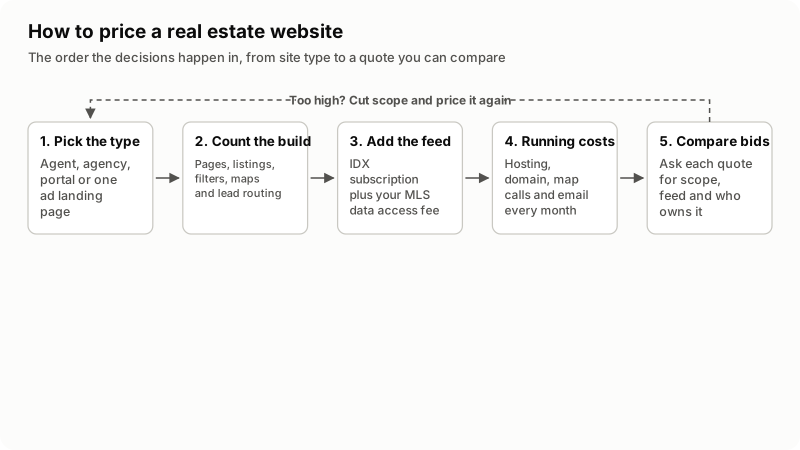
Which type of real estate website are you paying for?
Start here, because the type decides the price far more than the design does. A page that sells one apartment and a portal where fifty agents upload their own stock are different products with the same label.
| Type | What it does | Starting price on my plans |
|---|---|---|
| Ad landing page | One page, one property or offer, a lead form and a call button | $149 |
| Agent website | Your own listings, your bio, an inquiry form on every property | $249 |
| Rental listings website | Rental stock, viewing requests, tenant inquiries | $249 |
| New development site | Floor plans, unit availability, brochure download | $249 |
| Agency website | Shared property search plus a profile and inbox per agent | $299 |
| Property listing portal | Agent and owner accounts, listing submission, paid and featured listings | $799 |
| Property management portal | Units, tenants, documents, rent payments, owner statements | $949 |
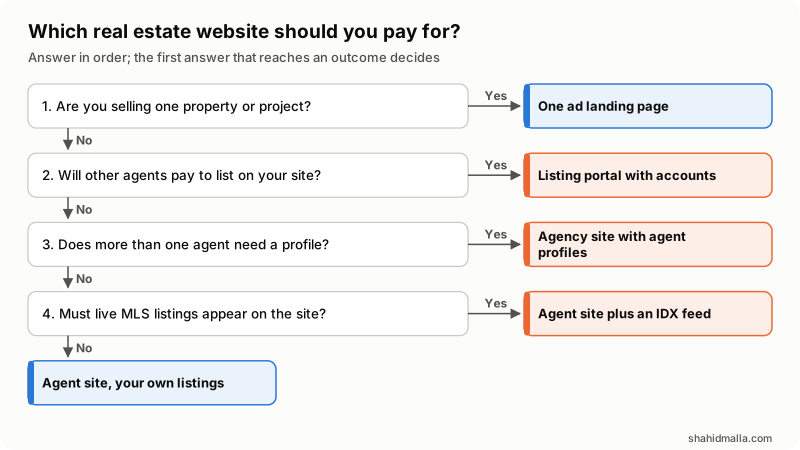
In words: one property or one project means an ad landing page, not a website. If other agents will pay to list on your site, you are building a portal and the price moves into four figures. If more than one agent needs a profile and their own inbox, you need an agency site. Otherwise an agent site is enough, and the only remaining question is whether live MLS listings have to appear on it, because that adds a subscription.
What does the build itself cost?
The build is the one-time number, and on a fixed scope it is knowable before anyone starts.
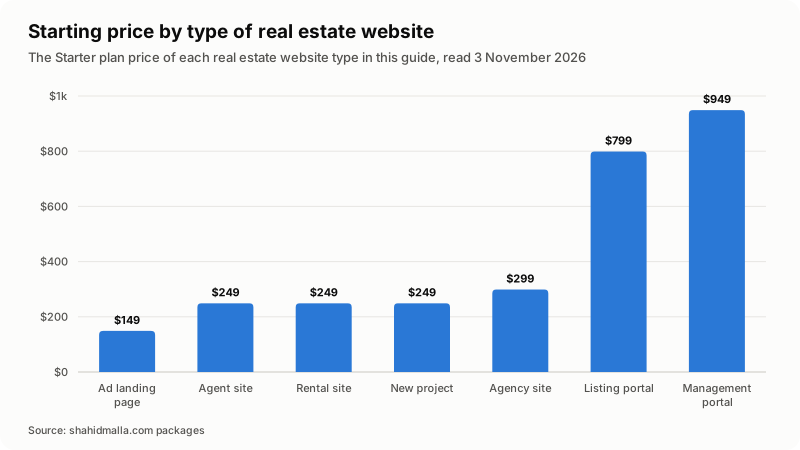
In table form, with the delivery time quoted on the same page: ad landing page $149 in 3 days, agent website $249 in 5 days, rental listings website $249 in 5 days, new development site $249 in 4 days, agency website $299 in 6 days, property listing portal $799 in 14 days, property management portal $949 in 15 days. Those are entry plans; the Business and Premium plans of the same packages cost more.
| What pushes the price up | Why it costs more | Example from my plans |
|---|---|---|
| Search filters | Area, price, type and bedroom filters need indexed fields and a result page that stays fast | Agent site: $249 Starter has no filters, $549 Business does |
| Map search | Pins, clustering and a map that loads without blocking the page | Agent site: map search appears on the $1,199 Premium plan |
| Agent logins | Each agent edits only their own listings; the office manager sees all | Agency site: logins start on the $699 Business plan |
| Lead routing to a CRM | Inquiries pushed by webhook or CSV into Follow Up Boss, HubSpot or similar | Agency site: CRM export on the $1,399 Premium plan |
| Payments and accounts | Paid listings, subscriptions, moderation and refunds are a billing system | Portal: $799 Starter to $3,999 Premium |
| Importing old listings | Photos, prices and agent assignments moved from a spreadsheet or an old site | Listed as a $99 extra for up to 50 properties |
Anything outside a package scope is quoted by the hour at $55 to $65, or as a fixed quote for the whole scope. If you want the general picture of what web work costs before you narrow it to real estate, my web designer cost guide covers the same ground for ordinary business sites.
What do MLS and IDX feeds add to the cost?
They add a monthly subscription and a wait, and they are the line most quotes leave out. IDX stands for Internet Data Exchange: NAR's policy of that name lets MLS participants authorize limited electronic display of their listings by other participants, which is why another brokerage's homes can appear on your site. The data itself arrives over the RESO Web API, the standard transport the industry is moving to from the older RETS, built on OData so a developer can query it like any REST service.
You pay for two things, even when one invoice arrives: the IDX vendor's software, and your MLS's data fees, which some MLSs bill to you and others bill to the vendor to pass on. Published vendor prices as of 3 November 2026:
| Vendor | Published price | What the plan includes |
|---|---|---|
| Showcase IDX | $94.95 a month Essentials, $124.95 a month Premium; $849.50 and $1,195 a year | WordPress plugin, live feeds for its MLS network, lead capture, map search, 2 seats on Essentials and 5 on Premium |
| Panda IDX | $89.99 a month website, $119.99 a month website plus CRM, one-time setup fee quoted separately | Hosted IDX website, up to 2 MLS boards on the website plan and 3 on the combined plan |
| iHomefinder | Plan prices not published; the hosted website add-on is listed at $50 a month plus $500 setup | IDX platform, lead tracking and CRM; the page asks for a call to get your number |
Then the MLS side. Each MLS publishes its own schedule, so the only honest answer is to read yours. IRES MLS in Colorado publishes a full one: a $150 one-time IDX setup fee, $8 a month for the IDX vendor, $20 per participant per month for an IDX feed on your own URL, and $12 per participant for a subdomain. A VOW feed, which a brokerage may show only to consumers who register with it first, costs $300 to set up and $35 per participant per month there. That page also says all its monthly fees are billed to the vendor, so at an MLS like this one the cost reaches you inside your vendor's invoice. Showcase IDX describes the same thing from the vendor side on its pricing page: an MLS pass-through fee that it says typically ranges from $0 to $33 a month, shown during signup when the MLS charges one.
Budget for the wait as well as the money. Showcase IDX's signup description is the normal sequence: you e-sign documents for your MLS, approval usually takes one to five business days, and only then do you get the IDX key that activates the feed. No developer can shorten that; the approval belongs to the MLS and the account has to be in your name.
Outside the United States the model changes. In Canada, CREA runs the REALTOR.ca DDF, a managed service where broker owners control how listings are shared, including a national shared pool members can display on their own websites and a member website feed for your own office's listings. Australia runs on portal APIs rather than a shared feed. Domain's Listings Management API is written for CRMs: a PUT creates or updates a residential listing, and once an agency grants OAuth permission the integrator can pull that agency's listings back. Its Agents and Listings API reads agency and agent listings. Plan the integration around which direction the data flows in your market.
What will the site cost every month after launch?
Less than most people fear, unless you take an IDX feed. The build is the big number; the monthly bill is small until property data or ad traffic is involved.
| Line | Who you pay | What to expect |
|---|---|---|
| Domain | Your registrar, in your own name | An annual renewal. Keep it in your account, not the developer's. |
| Hosting | Your host, in your own name | A monthly or annual plan. Not included in a fixed build price. |
| IDX subscription | The IDX vendor | About $90 to $125 a month on the plans published above |
| MLS data access | Your MLS, or your vendor as a pass-through | Per the MLS's own fee schedule; some bill the vendor, who adds it to your invoice |
| Maps | Google Maps Platform | The Essentials Dynamic Maps SKU has a free cap of 10,000 map loads a month, then $7.00 per 1,000 up to 100,000 |
| Email and CRM | Your provider | Only if you buy one; lead email itself is part of the build |
The map line is the one that surprises people, so check it against Google's own pricing list. A quiet agent site rarely passes the free cap; a portal where map search is the main way people browse can, because every map load counts.
How do you compare two real estate website quotes?
Ask both quotes the same questions, and compare the answers rather than the totals. Price differences between serious bids are usually scope differences in disguise.
- How many listings does the price cover, and what happens at the cap?
- Are search filters and map search in this price, or a later upgrade?
- Who adds a property after launch, and is there an admin I can use myself?
- Is the IDX subscription included, billed to me, or not included at all?
- Whose name is on the MLS account, the domain and the hosting?
- How many revisions, and what counts as a revision?
- What is the delivery time, counted from which day?
- What happens to the site and its data if I stop paying?
The last one matters most with hosted platforms. A monthly platform price usually buys a site you rent; a build you own sits on your own hosting and stays yours. Neither is wrong, but a $90 a month hosted site and a $299 build are not the same purchase, and comparing them on price alone is how people end up paying twice. My website redesign guide covers what to keep when you move off one.
When is the cheapest real estate website the wrong buy?
When the cheap option cannot hold the thing your business runs on. Four cases where I say so on the call:
- You need live MLS listings on day one. The feed, not the site, is the critical path. Order the IDX account before the build; MLS approval runs on its own clock.
- Your listings change hourly. A site where you retype prices by hand is cheaper to build and more expensive to run. Price the feed in.
- You are building a portal. Accounts, payments, moderation and refunds are a billing system with a property search attached. A listings theme will not carry it, and retrofitting is dearer than starting right.
- Compliance text is not optional. License numbers, brokerage identification and seller opt-outs are rules your MLS and your broker of record set, not design choices. I publish exactly what you send me and do not advise on the wording.
One thing I will not price: a promise about rankings or lead volume. Nobody can honestly sell either. A site can be built to load fast, put an inquiry form on every property, and mark up each listing so search engines and assistants can read it.
What else do people ask about real estate website costs?
How much does an IDX website cost per month?
On the plans I read on 3 November 2026, about $90 to $125 a month for the vendor subscription, plus whatever your MLS charges for data access and any pass-through the vendor adds. Showcase IDX lists $94.95 and $124.95 a month, and Panda IDX lists $89.99 and $119.99 a month with a separate one-time setup fee. iHomefinder publishes no plan price at all, only a $50 a month hosted website add-on with a $500 setup that sits on top of it.
Can I copy listings from Zillow or Realtor.com onto my site?
No, and that is not how IDX works. Listings reach your website because your brokerage is approved by your MLS for an IDX feed, which is why signup starts with e-signing MLS documents and ends with an IDX key issued to you. Your own listings are different: you can always publish those, and exporting them from an old site or a spreadsheet is a normal part of a build.
Is a $200 real estate website template worth it?
For a single agent with a handful of listings and no feed, often yes. A template stops being worth it the moment you need search filters, agent logins, a feed or anything that touches money: a theme cannot fake those parts. The honest test is whether you will be editing the site yourself next month.
How long does a real estate website take to build?
On my fixed-price plans, 3 days for an ad landing page, 5 to 6 days for an agent or agency site, 14 days for a listing portal and 15 days for a property management portal, counted from the day your content arrives. Add the MLS approval window on top if a feed is involved: Showcase IDX puts that step at one to five business days, depending on your MLS, and it is outside anyone's control.
Does a real estate website cost more in Canada or Australia?
The build does not, because the work is the same. The data layer differs: Canadian members share and receive listings through CREA's REALTOR.ca DDF, while Australian agencies publish to the portals from their CRM and read listings back through a portal API. Budget for a different integration, not a different website.
If you want a number for your own case, the fixed-price real estate website packages list scope, plans and delivery days in the open, and I quote anything outside them as web design and development work after a free scoping call of about 30 minutes, with a written quote within one business day.
Last reviewed 3 November 2026. Disclosure: I sell real estate website development, so I am not neutral, and the package prices here are my own. I am CTO at ElySpace, a freelance developer for Marmaids LLC, and founder of WHMCSPilot and MagizAI. The IDX, MLS, map and portal API figures and definitions come from Showcase IDX, Panda IDX, iHomefinder, IRES MLS, Google Maps Platform, the National Association of REALTORS, RESO, CREA and Domain as I read their own pages on 3 November 2026; I have no commercial relationship with any of them.