
Stripe Billing is a toolkit you operate: you stay the merchant, you own the tax registrations and the chargebacks, and you pay 0.7% of billing volume on top of card fees. Paddle is a merchant of record: it becomes the legal seller, charges 5% plus 50 cents all in, and files the VAT. Choose Paddle to stop doing tax work, Stripe to keep control.
A merchant of record is the legal entity that sells your product to the customer. Paddle's documentation defines it as the entity responsible for the sale, which takes on the matching liabilities: collecting sales tax, meeting PCI requirements, and honoring refunds and chargebacks. Stripe Billing leaves all three with you, and that sentence is most of the difference between the two products.
Every rate here comes from the provider's own pricing page or documentation, read on 28 November 2026, and is linked where I use it. One number is deliberately missing. Stripe sets its card rate per country and its pricing page serves the rate card for wherever you load it from, so I quote Stripe's product fees and leave the card rate for you to read on your own country's page.
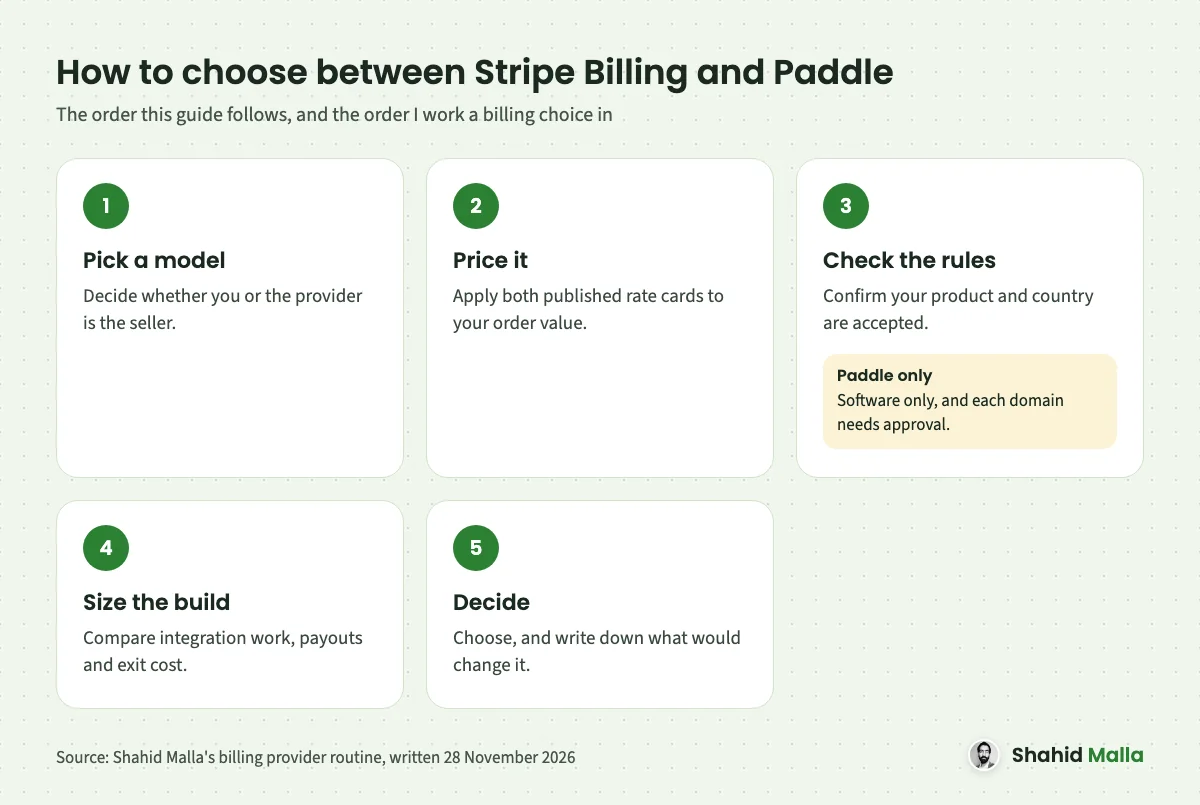
Which model are you actually choosing between?
You are choosing between being the seller and hiring one, not between two checkout widgets. Stripe Billing sits on Stripe Payments and adds subscriptions, trials, proration, Smart Retries, a hosted customer portal and quotes. Your company stays the merchant on the card statement, the taxpayer in every country you sell into, and the party a bank asks for evidence on a dispute.
Paddle inverts that. Its merchant of record model puts Paddle between you and the buyer: no VAT, GST or sales tax registrations, no chargeback or PCI scope, no billing support desk, and no local entities needed to accept local payment methods. Your name appears on the customer's statement alongside Paddle's.
| Question | Stripe Billing | Paddle |
|---|---|---|
| Who is the legal seller? | You | Paddle |
| Whose tax registrations are they? | Yours, in every jurisdiction you owe | Paddle's |
| Who answers a chargeback? | You, with a fee per dispute | Paddle |
| Who handles billing support emails? | You | Paddle |
| What can you sell? | Most lawful businesses Stripe accepts | Software and digital products only |
| Headline price | Card rate plus 0.7% of billing volume | 5% plus 50 cents, all inclusive |
Stripe now sells the other model too. Managed Payments is Stripe's own merchant of record product at 3.5% per successful transaction in addition to the normal Payments fees, covering indirect tax compliance and remittance in more than 75 countries along with fraud, disputes, invoicing and customer support. So the real choice is three-way, and two of the three are Stripe products.
What will each one charge you per transaction?
Paddle publishes one number; Stripe publishes a stack, and you add up the layers you switch on. Every Stripe percentage below sits on top of the card rate, not instead of it.
| Line item | Published rate | Charged on |
|---|---|---|
| Paddle, pay as you go | 5% + 50c | Each checkout transaction. No monthly or migration fee. Paddle asks sellers of products under $10 to contact it for bespoke pricing. |
| Stripe Payments, standard | Your country's card rate | Each card charge. The pricing page serves the rate card for the country you load it from, so read your own. |
| Stripe Billing | 0.7% | Billing volume, including transactions processed off Stripe, excluding one-off invoices. |
| Stripe Tax | 0.5% | Each transaction where you are registered. The standalone Tax API is $0.70 per transaction. |
| Stripe Managed Payments | 3.5% | Each transaction, in addition to Payments fees. |
| Stripe disputes | $15 each | Received, countered and appealed bill separately. The countered fee returns only on a win. |
| Stripe custom domain | $10 per month | Checkout or portal on your own domain. |
So the arithmetic is short, and you have to finish it yourself. Paddle is 5% plus 50 cents and stops there. Stripe on the same order is your card rate plus 0.7% for Billing, plus another 0.5% for Tax if you switch it on, or your card rate plus 3.5% if you send the order through Managed Payments instead. Run it on last month's real orders, not on an average order value, because the flat 50 cents bites hardest on the small ones.
Which side wins turns almost entirely on that card rate, and the percentages are not the whole stack: dispute fees and the cost of whoever files your returns sit outside them, and Paddle's single number already contains both. The clearest case for Stripe is a business selling mostly at home, where the Tax layer may not be needed at all.
Neither headline rate is the whole cost. Paddle's payout reconciliation report itemizes Paddle fees, tax, FX fees, chargeback fees, retained fees kept on refunds to cover gateway costs, and SWIFT fees on the payout itself.
Who owes the tax, and who answers the chargebacks?
On Stripe, both are yours. On Paddle, both are Paddle's. That is the line that decides this for most small teams.
Stripe Tax calculates, collects and monitors registration thresholds, and its documentation says Stripe can register on your behalf and file through Stripe or its partner network. What none of that moves is the obligation. The registrations stand in your company's name and the returns are yours. Stripe's own Tax page is blunt about the size of that job: rules vary by what and where you sell, European registration thresholds run from zero in Spain to 90,000 pounds in the UK, non-EU businesses selling digital goods into the EU collect from the first sale, and a seller who does not collect pays the overdue tax out of its own pocket.
Disputes work the same way. Stripe bills $15 to receive a dispute, $15 to respond manually and $15 to appeal, and only the countered fee comes back, only on a win. Smart Disputes charges 30% of the disputed amount on disputes it wins for you. On Paddle the chargeback is against Paddle, and you see a fee on the payout report instead of a case queue.
The counterweight: handing over tax hands over the invoice. Paddle issues it as the seller, which is fine for self-serve SaaS and a problem for enterprise buyers who want your company on the purchase order.
Can your product be sold on each one at all?
Paddle is narrower than most comparisons admit, and this check belongs before the pricing argument. Its acceptable use policy says Paddle is built to serve software companies, covering B2B SaaS, consumer software and games, and is not a good fit when the primary offering is human services or physical goods.
The prohibited list is long and specific. Physical products and anything needing physical delivery are out, so Paddle cannot cover a physical and a digital line at once. Also out are human services not tied to a software offering, with legal advice, coaching and IT services named directly, plus digital marketplaces that let other sellers sell, payment services of any kind, trading and financial advice, gift cards and stored value, gambling, adult content, marketing services, travel services, and a copyright group naming illicit streaming services, streaming downloaders and IPTV. If you sell hosting with managed support hours attached, read that page line by line.
There is a second gate. Paddle's go-live checklist says live checkout only works on approved domains, submitted under Paddle > My account > Settings > Website approval. The same page adds that your default payment link's host must match an approved domain exactly or be its www version, so app.example.com needs its own approval even when example.com is approved. Sandbox domains approve automatically, which is why teams hit this on launch day.
How much integration work does each need?
Both are an afternoon for a checkout and a week for everything around it. The week goes on the state machine behind the checkout call: which webhook grants access, what happens on a failed renewal, and how a downgrade prorates.
| Integration job | Stripe Billing | Paddle |
|---|---|---|
| Checkout | Checkout, Payment Links or custom Elements | Paddle.js overlay or inline checkout |
| Granting access | Subscription and invoice webhooks | subscription.created and subscription.updated |
| Failed payments | Smart Retries and up to three recovery automations | Paddle Retain handles dunning and recovery |
| Localized prices | Adaptive Pricing, conversion fee from 2% shown to the buyer | 30+ currencies across 200 markets |
| Usage-based billing | Meters API for basics, Metronome for the rest | In early access at the time of writing |
| Test environment | Test mode keys | Separate sandbox account, own catalog and keys |
Usage-based pricing is the one place where neither answer is comfortable. Stripe's Billing pricing page sends advanced usage billing to Metronome, a separate product starting at $0.04 per 1,000 ingest events plus 0.8% of billing volume, while basic metering stays in Billing through the Meters API with 100 million events a month included. Paddle lists usage-based billing as early access. If metering is the core of your pricing, budget for building the rating layer yourself, as in my SaaS MVP tech stack guide.
When does the money reach your bank account?
Stripe pays on a rolling schedule; Paddle pays monthly. For a young company that can matter more than the fee difference.
Stripe's payouts documentation says the first payout after your first live payment is typically scheduled to complete within 7 to 14 days depending on industry, country and risk, and later payouts follow your account's schedule. Instant Payouts cost 1% of the amount, with a $0.50 minimum.
Paddle's model is a calendar. Its documentation states that when your balance meets the minimum threshold, Paddle creates the payout on the 1st and sends payment by the 15th, to the bank or Payoneer details in your dashboard. In the worst case, money taken on the 2nd of a month reaches you six weeks later. Model that against payroll before you sign.
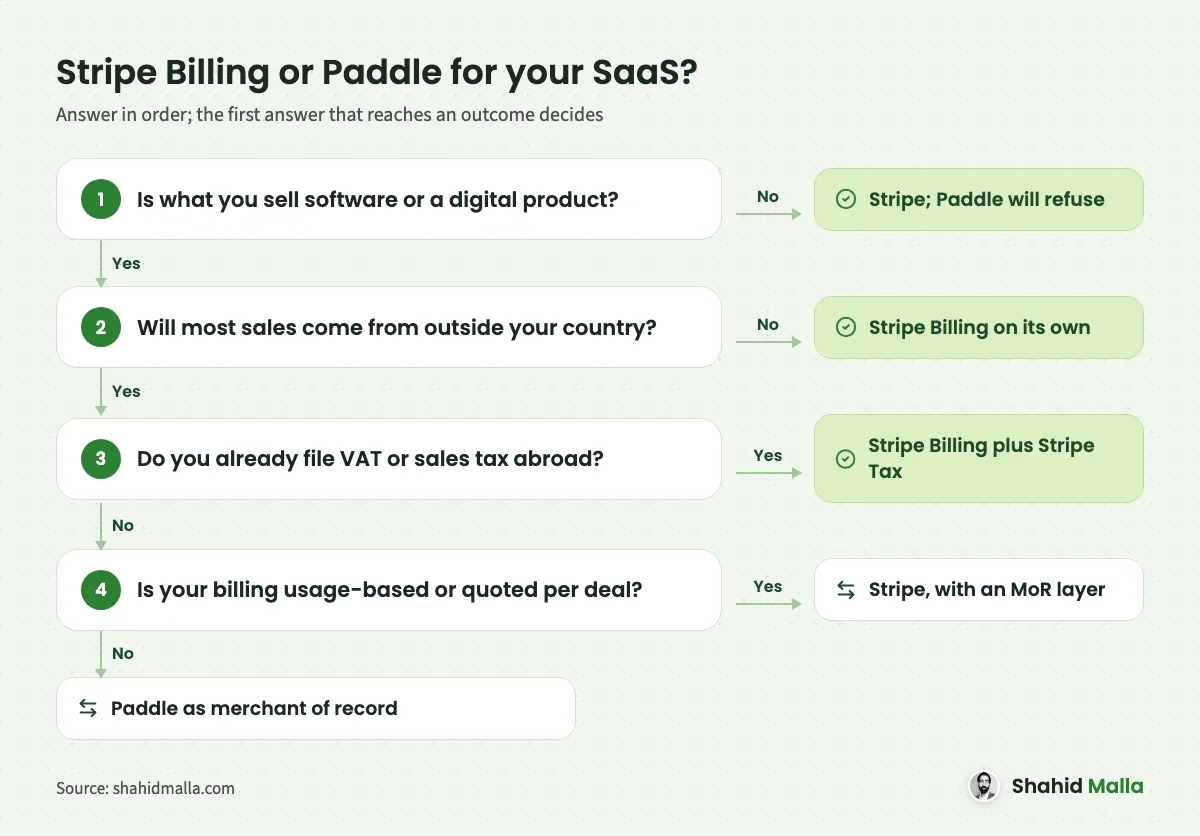
In words: if what you sell is not software, Paddle will refuse you. If most sales are domestic, Stripe Billing on its own is enough. If you sell globally and already file tax abroad, add Stripe Tax and stay on Stripe. If you sell globally and do not, a merchant of record is worth its margin, and Paddle fits unless your billing is usage-based or quoted per deal.
How hard is it to leave later?
Harder than either marketing page suggests, and what makes it hard is the stored card, not the data export. Paddle's pricing page states there are no lock-in periods and that your data is yours and can be migrated, which is true of the records. The credentials are another matter: under a merchant of record the cards were charged by Paddle's acquirer, not yours, so a move means a credential migration between providers or asking every subscriber to re-enter a card.
A live example is running now. Lemon Squeezy, itself a merchant of record, has closed new sign-ups and will stop processing transactions on 31 March 2027, leaving its sellers a move that its own notice says usually takes four to eight weeks. Write the exit plan into the decision rather than after it.
What should you check before you commit?
Run this list against both providers before you write any integration code.
- Does your product appear on Paddle's prohibited list, including the services you bundle with it?
- Is your business registered in a country the provider accepts, and does it sell to your customers' countries?
- What share of your revenue is domestic? That decides whether foreign tax work is worth doing in house at all.
- Do any customers need your own company named as the seller on the invoice or purchase order?
- Is your pricing plain recurring plans, or does it meter usage? Metering changes the answer.
- How long can you wait for the first payout, and does a monthly cycle fit payroll?
- If you leave in two years, how do the stored cards move?
When is each one the wrong choice?
Paddle is the wrong choice when your product is not software, when enterprise buyers need your name on the contract, when your pricing is metered, or when you cannot wait for a monthly payout.
Stripe Billing is the wrong choice when nobody on your side will own tax compliance. Collecting the right amount is automated, and Stripe will register and file for you, but the registrations and the liability stay in your company's name, and an unregistered seller pays uncollected tax out of its own pocket. If no one will own that, a merchant of record's margin is cheaper than the penalty.
A third wrong answer is picking a provider before the pricing model is settled; rewiring billing after launch is a migration, not a config change. If you sell hosting rather than pure SaaS, the comparison changes again: WHMCS already does subscription billing and provisioning in one place, as my WHMCS SaaS billing guide and WHMCS Stripe integration guide cover.
What else do people ask about Stripe and Paddle?
Is Paddle a payment gateway?
No. A gateway moves a card payment and leaves you as the merchant. Paddle is a merchant of record: the legal seller of your product, carrying the tax, chargeback and PCI obligations of that role. Payment processing is one part of what the 5% buys.
Is Paddle more expensive than Stripe?
It depends on a number neither company puts in a headline. Paddle is 5% plus 50 cents with payments, tax, chargebacks and billing support inside it. Stripe is your country's card rate plus 0.7% for Billing and 0.5% for Tax, and Stripe sets card rates per country, so there is no single answer. Its merchant of record product, Managed Payments, charges 3.5% on top of the Payments fees.
Can I use Stripe and Paddle at the same time?
Technically yes, and people do it to serve enterprise contracts on Stripe invoices while self-serve runs through Paddle. The cost is two sources of truth for subscriptions, two webhook handlers and two sets of revenue reports. Take that on when a named customer requires it, not as a default.
Does Paddle handle usage-based billing?
Paddle's documentation lists it as early access at the time of writing: include an allowance with a plan and report usage to Paddle, or meter externally and add line items to the next subscription transaction.
What happens to businesses using Lemon Squeezy?
Lemon Squeezy's own site says it has closed new sign-ups and will stop processing transactions on 31 March 2027, and recommends Stripe Managed Payments, built by the Lemon Squeezy team. Migration tooling launches on 2 December 2026 and the move usually takes four to eight weeks. Paddle is courting the same sellers with a migration guide of its own.
If you want this decided against your own orders rather than a generic comparison, I take on SaaS development work and payment gateway integration, with a free scoping call of about 30 minutes and a written quote within one business day. All sales are final, so ask every question before you order.
Last reviewed 28 November 2026. Disclosure: I build SaaS products and payment integrations for a living, so I am not neutral. I am CTO at ElySpace, a freelance developer for Marmaids LLC, and founder of WHMCSPilot and MagizAI. I am not affiliated with Stripe, Paddle or Lemon Squeezy. Every rate and policy here comes from those companies' own pages as I read them on 28 November 2026; the judgments are mine.