A SaaS MVP costs what its scope costs. I plan a first release at 92 to 168 hours from an empty project, or 50 to 100 hours on my own SaaS base code, at $55-$65 per hour or one fixed quote. The feature that is the product, the billing rules and the tenancy model move that number far more than the framework does.
A SaaS MVP is the smallest working version of a subscription product that a stranger can sign up for, pay for and use without you in the room. It is not a prototype and not a demo: it takes real money and holds real customer data. Everything that is not needed for that first paid use belongs in version two.
Every price in this guide is either my own planning estimate, marked as such, or a figure I read on a vendor's own pricing page on 31 October 2026 and linked. I do not repeat the wide dollar ranges that agency cost guides publish, because I cannot see how they were measured or what they included.
What are you actually buying in a SaaS MVP?
You are buying five things, and only one of them is the idea you described. Nearly every first release needs sign-up and sign-in, a way to take recurring money, the single feature that is the product, an admin view so you can see what customers are doing, and somewhere for it all to run. The gap between a cheap quote and an expensive one is usually how much of that list each side assumed.
Two decisions sit underneath all five and decide most of the cost. The first is tenancy: whether every customer shares one database with a tenant column, or each gets a separate database. The second is the billing model: one flat monthly plan is a day of work, while trials, proration, seats, usage metering and tax handling are a project of their own. My SaaS MVP tech stack guide covers how those two choices play out in code.
How many hours does a SaaS MVP take to build?
I plan 92 to 168 hours from an empty project, and 50 to 100 hours when I start from my own SaaS base code. At $55-$65 per hour that is roughly $5,060 to $10,920 from scratch, or $2,750 to $6,500 on the base, turned into one fixed price once the scope is written. These are my planning estimates for a single-feature B2B product with flat monthly plans, not a measured average of other people's projects.
| Work area | Hours from an empty project | Hours on my SaaS base |
|---|---|---|
| Scope call, written scope, acceptance checklist | 4-8 | 4-8 |
| Data model, migrations, tenancy decision | 8-14 | 4-7 |
| Sign-up, sign-in, reset, email verification, roles | 10-18 | 2-5 |
| The one feature that is the product | 20-40 | 18-36 |
| Plans, checkout, webhook, failed payments, cancel | 14-24 | 5-10 |
| Admin view: customers, subscriptions, sign in as user | 8-14 | 2-5 |
| Transactional email and in-app notifications | 5-9 | 2-4 |
| Queue, background jobs, scheduled tasks | 5-10 | 2-5 |
| Error tracking, logs, backups, staging environment | 6-11 | 3-6 |
| Tests, launch run-through, deploy, handover docs | 12-20 | 8-14 |
| Total | 92-168 | 50-100 |
Read the two columns against each other and the pattern is clear. Your feature barely shrinks, because nobody has built it before, and the scope call does not shrink at all. Everything else shrinks a lot, because sign-in, roles, subscription handling, the admin panel, the queue and the deployment scripts already exist and have been tested on other projects. That is the argument for starting from a base, and the same one I make for a custom CRM timeline.
Which decisions drive the price up or down?
Seven, and you control almost all of them before a line of code is written. Each has a cheaper version that still works for a first release.
| What you add | Why it costs | The cheaper version |
|---|---|---|
| A database per customer | Migrations, backups and restores all have to run per tenant, and every deploy touches many databases | One database with a tenant column, until a customer contract demands otherwise |
| Trials, proration, seats and usage metering | Each rule is a state the app can be in, and each state needs its own test and its own email | One or two flat monthly plans, card on file, cancel at the end of the period |
| Team accounts and invitations | Every screen, export and API route needs an organization check, not just a user check | One user per account at launch; add organizations when a buyer asks |
| Integrations with the customer's tools | Credentials, field mapping, retries, rate limits and a sandbox to test against | A CSV import and a webhook out, which cover most of the same need |
| A design drawn from scratch | Mockups, revisions and hand-built components for every screen and every state | A component library styled to your colors and type |
| Compliance commitments | Audit evidence, data residency, retention rules and access logs are ongoing work, not a feature | Sensible defaults now; start the audit when a deal actually requires it |
| A mobile app beside the web app | A second codebase, two store reviews and two release cycles | A responsive web app that installs to the home screen |
Two more things move the number. Unclear acceptance criteria add hours at the end, because nobody can say whether the work is finished. A founder who cannot answer questions for a week adds calendar days, which on a fixed quote is my problem and on an hourly contract is yours.
What will the MVP cost to run every month?
Less than most founders fear at launch, and more than they expect once traffic arrives. The table below is entry pricing I read on each vendor's own page on 31 October 2026. Prices change, so treat it as a dated snapshot and check the links before you budget.
| What it covers | Example service | Entry price, read 31 October 2026 |
|---|---|---|
| App hosting, database, queue | Laravel Cloud | Starter $5 a month plus usage, with $5 of usage credit included |
| Front end and preview deploys | Vercel | Pro $20 a month, which includes $20 of usage credit; extra developer seats $20 a month |
| Sign-in and user management | Clerk | Hobby free up to a 50,000 monthly retained user limit per app; Pro $20 a month billed annually, $25 monthly |
| Transactional email | Postmark | Basic $15 a month for 10,000 emails, then $1.80 per 1,000 |
| Error and performance monitoring | Sentry | Team $26 a month billed annually with the default pre-paid data, 50,000 errors included |
| Taking payment | Stripe | No monthly fee; a percentage per payment that Stripe publishes per country, so read the rate for where your company is registered |
Three of those lines are worth a second look. Clerk counts monthly retained users, not sign-ups: its page defines one as a user who returns 24 hours or more after signing up. Clerk's page also prices its Billing product at 0.7% of billing volume on top of the payment processor's fee, the kind of percentage that disappears into a spreadsheet and reappears at scale. And hosting is not one number: it tracks how awake your app is.
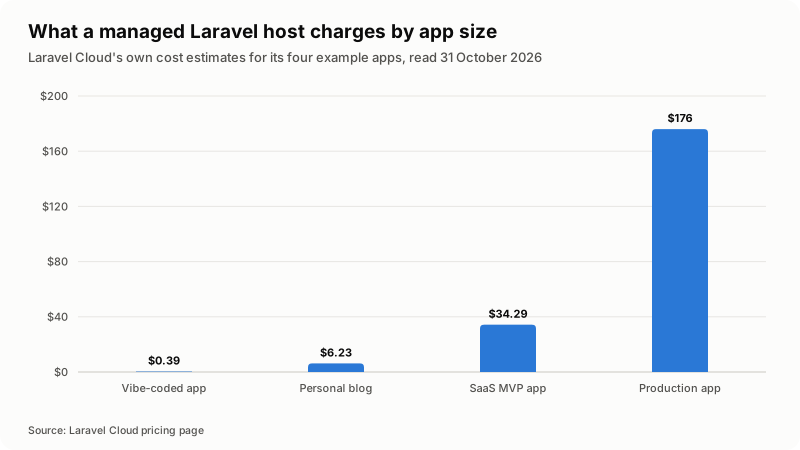
The same four figures in words. Laravel Cloud's calculator estimates about $0.39 a month for its vibe-coded app example, about $6.23 for a personal blog, about $34.29 for its own SaaS MVP example, and about $176.00 for a production app with workers running all the time. The SaaS MVP scenario assumes 240 awake hours a month, 20 GB of database storage, a 1 GB cache and two workers. Add those entry prices together and a small live SaaS lands at roughly $60 to $120 a month across hosting, email, monitoring and sign-in, and it rises with customers rather than with time.
How do you cut the scope before you ask for a quote?
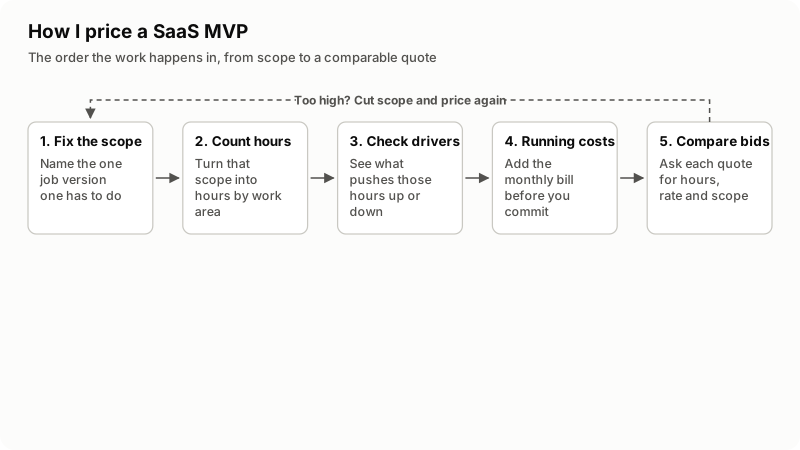
By writing down the one job version one must do, then testing every other item against it. The list below is what I ask for on a scoping call, and preparing it before you approach anyone makes every quote you receive comparable.
- One sentence naming who the customer is and the single job the product does for them.
- The first paid use. Describe, step by step, what a customer does between landing on the site and getting value. Anything off that path is version two.
- Your pricing. How many plans, monthly or yearly, trial or no trial, per user or per account.
- The three to five numbers you will look at every week. Those define the admin view and the dashboard.
- Data you already hold and need imported, with a real export file, not a description of one.
- Anything that is not negotiable: a region your data must stay in, a tool it must connect to, a deadline tied to an event.
- An acceptance checklist: the list of things that must work before you pay the balance.
That last item is the one founders skip and the one that protects them.
How do you compare the quotes you get back?
Put them side by side on hours, rate and what is excluded, never on the total alone. A total is one number; it hides the three things that actually differ.
| Ask every provider | What a good answer looks like |
|---|---|
| How many hours, broken down by work area? | A table like mine above, not a single figure |
| What is the hourly rate behind the total? | A stated rate. Mine is $55-$65, or a fixed price per written scope |
| Who writes the code, and where do they sit? | Names and time zones. Some quotes are a subcontractor plus a margin |
| What is excluded? | An explicit list: design, content, migration, app store submission, training |
| Who owns the code and the accounts? | You do, in your own repository and your own vendor accounts |
| What happens after launch? | A support window with a stated length, then an hourly rate or a retainer |
Agency totals come out higher for reasons that are mostly legitimate: several people bill against the same feature, handoffs cost time nobody is writing code in, and sales, account management and overheads are recovered in the rate. That buys continuity if one person leaves and a contract procurement will sign. A freelancer is cheaper and faster to brief, and the risk is that it is one person. After launch, compare a monthly developer retainer against hourly work at the same rate.
When is a SaaS MVP the wrong thing to pay for?
When nobody has agreed to pay for the product yet. Software is the most expensive way to test an idea, and a paid build before that test is money spent on an answer you could get for free.
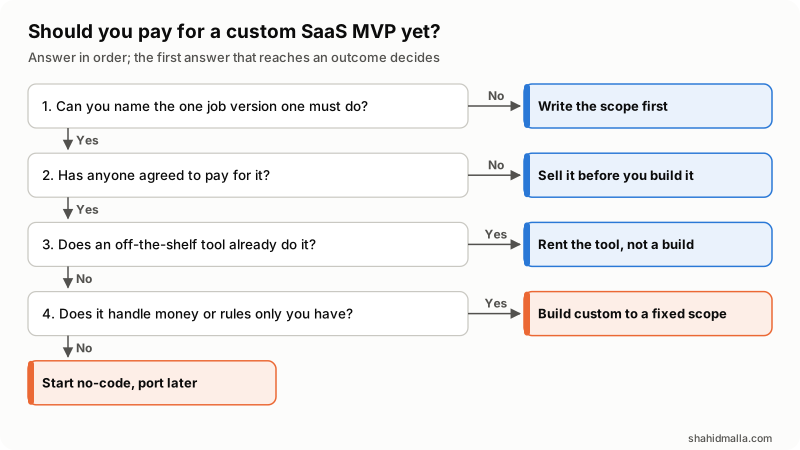
The same four questions in words. No written scope: write it before you ask anyone for a price. Nobody has agreed to pay: sell it first, even as a manual service you run by hand. An off-the-shelf tool already does the job: rent it, and spend the money on customers instead. It handles money or rules only you have: that is a custom build, and worth a fixed scope. None of the above: start in a no-code tool and port the parts that survive.
Two more cases where I say no. A product whose entire value depends on an integration I cannot test against, because there is no sandbox and no documentation, is a research project priced hourly, not a fixed-price MVP. And a scope that genuinely cannot be reduced below six months of work is not an MVP; it is version one of a platform, and it should be budgeted and staffed as one.
What else do people ask about SaaS MVP development cost?
How long does it take to build a SaaS MVP?
For the scope in my hours table, 50 to 100 hours on an existing base is roughly two to four working weeks, and 92 to 168 hours from scratch is roughly four to eight. The calendar is usually longer than the hours, because it also contains your review time, your content and your decisions. I quote both the hours and the calendar dates, and the dates assume you answer questions within a day.
Is a no-code MVP cheaper than a coded one?
To start, almost always. To run and to escape, often not. No-code gets a working product in front of customers quickly and is the right choice when you are still testing demand. The cost shows up later, when per-record or per-seat platform fees grow with usage, and when the parts that survive have to be rebuilt in code anyway.
How much should I pay a freelance developer for a SaaS MVP?
Ask for the rate and the hours rather than a market average, because published rate ranges mix regions, seniorities and project types that are not comparable. My own rate is $55-$65 per hour, or a fixed price against a written scope. A quote far below everyone else usually means a smaller scope was assumed, so compare the exclusions first.
What should a SaaS MVP include?
Sign-up and sign-in, one way to take recurring payment, the single feature that is the product, an admin view for you, and transactional email. Anything else is a candidate for version two. If you cannot explain to a stranger which one feature is the product, the scope is not finished yet.
Does AI-assisted development make an MVP cheaper?
It changes where the hours go rather than removing them. Writing a first draft of a screen or a test is much faster, while scoping, review, debugging and release work are not. The tooling itself is a small line: Anthropic's published plans on 31 October 2026 are $20 a month for Pro billed monthly, $100 for Max and $200 for Ultra, with Claude Code included from Pro upward. My Claude Code development page explains how I use it on client work, and my AI agent development cost guide covers what AI features add to a build.
Why do quotes for the same SaaS MVP differ so much?
Because the written scope is different, even when the brief was the same. One provider assumed a flat plan and a component library; another assumed trials, seats, a custom design and a mobile app. Send every provider the same scope document and the same acceptance checklist, and the spread narrows sharply.
If you want a number for your own scope, I quote SaaS development work at $55-$65 per hour or as a fixed price, after a free scoping call of about 30 minutes, with the written quote within one business day.
Last reviewed 31 October 2026. Disclosure: I sell SaaS and web development work, so I am not neutral. I am CTO at ElySpace, a freelance developer for Marmaids LLC, and founder of WHMCSPilot and MagizAI. The hours in this guide are my own planning estimates; every price is from the linked vendor page as I read it on 31 October 2026 and may have changed since.