To get your first freelance client as a developer, narrow one service you can finish in days, build two or three things a buyer can open and check, then ask the people who have already seen you work: former employers, colleagues, local businesses and communities you belong to. Marketplaces are the backup, not the start. Put the scope, the price and the payment date in writing before you code.
Your first freelance client is the first person or company that pays you money for a piece of work you scoped, delivered and were judged on. A tutorial project is not one. A favor for a friend with no price and no deadline is not one either, because it teaches you nothing about agreeing scope, invoicing, and being told the work is not what they meant.
What counts as your first freelance client?
Money changing hands for an agreed deliverable is the line. That first paid job gives you three things a practice project cannot: a person who had expectations, a record of what you charged, and work you may talk about afterwards.
So decide what you want it to produce. For almost everyone that is a reference and a public review, not the money. A small fix for a local business that will write two honest lines about you beats a larger job for someone who will never be named. Aim small on purpose: a narrow job someone already recommended you for is the one you are most likely to win, and the one least likely to go wrong while you are still learning how clients behave.
Where do first freelance clients actually come from?
From five places, and only one is a marketplace. The order below is how fast each route tends to pay off when you have no client history.
| Route | What it asks of you | What the first job looks like |
|---|---|---|
| People who have seen you work | One short, honest message. Not a pitch deck | A small fix for a past employer, or a referral |
| Businesses you already deal with | Naming one problem you noticed, with a price | A broken contact form, a slow site, an uneditable price list |
| Communities you belong to | Months of being useful first: issues, answers, patches | Paid work from a vendor whose tool you know |
| Other freelancers and small agencies | Proof you can take a ticket and not disappear | Subcontracted work under their name, rarely shown publicly |
| Marketplaces such as Fiverr and Upwork | A profile, one narrow offer, patience with ranking | A small order from a stranger, plus a public review |
Most beginners invert this list. They start with the one route where they compete against freelancers holding hundreds of reviews, and skip the four where being new matters least. If you do want to start on a marketplace, read Fiverr vs Upwork for developers first; it carries the fee and payout figures as both help centers published them on 22 October 2026.
Which route should you try first?
Work through four questions in order and act on the first outcome you reach. It stops you opening a marketplace account out of habit.
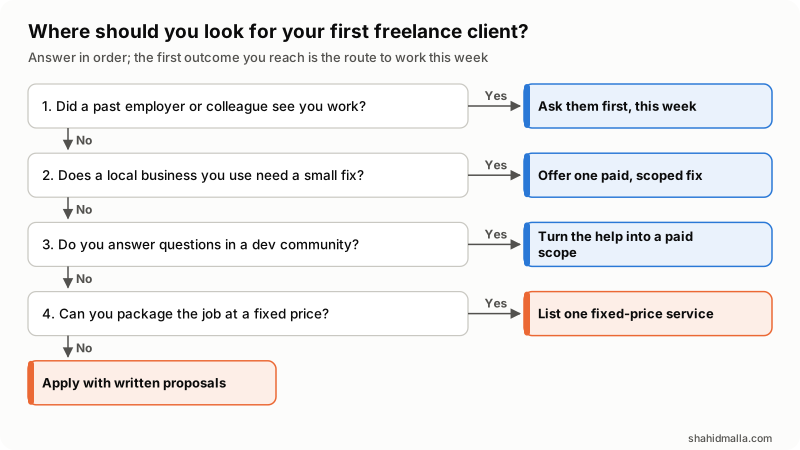
- Did a past employer or colleague see you work? Yes: ask them first, this week. No: next question.
- Does a local business you already use need a small fix? Yes: offer one paid, scoped fix. No: next question.
- Do you answer questions in a developer community? Yes: turn that help into a paid scope. No: next question.
- Can you package the job at a fixed price? Yes: list one narrow fixed-price service on a marketplace. No: apply to posted jobs with a written proposal instead. Compare the marketplaces, and their current fees, before you pick one.
What proof do you need when you have no clients yet?
Something a buyer can open in ten seconds and check without trusting you. Nobody reads a list of frameworks; people click one link, look for thirty seconds, and decide whether to reply.
- Two or three artifacts that look like paid work. Not a tutorial clone. A plugin for software one industry uses, or a script that does a boring job. Each gets a live URL or a repo.
- A README written for the buyer. The problem, the constraint you worked under, and what you would do differently with a budget. That last line convinces experienced buyers.
- Evidence you finish. Closed issues, a changelog, a dated deployment, a merged pull request in someone else's project. Finishing is what buyers doubt when you are new.
- One sentence of positioning. "I build billing and payment integrations for small hosting companies" beats "full stack developer", because people can repeat it without getting it wrong.
If your best work belongs to an employer, rebuild a small, non-confidential version of the problem and say plainly that it is a rebuild.
What should your first offer be?
One deliverable, one price, one deadline, and a stated limit on changes. A first client cannot judge your skill, so they judge how clearly you describe the work. Narrow offers also get referred, because someone can repeat them accurately.
| Offer that goes nowhere | Offer a stranger can buy |
|---|---|
| I build websites | A five-page site on your existing hosting, live in seven days, two rounds of changes |
| I fix bugs | I reproduce and fix one checkout bug on a staging copy, fixed price, report included |
| I do automation | Your contact form connected to your CRM, with an alert in your team chat, one week |
If you cannot say what "done" means in one sentence, the client cannot either, and that is where first jobs go wrong.
What do you say in the first message?
Four lines, none of them about you being new. The goal is a reply, not a contract.
- One line that proves you looked: the thing you noticed, named exactly.
- One line on what you would do first, and roughly how long it takes.
- One link to the closest thing you have built, with a six-word description.
- One easy question, then a clear next step.
Do not attach a resume, because it signals employment rather than service. Platform proposals need a different structure, since the client compares many at once, and I covered that in Upwork proposal tips for developers.
What should you charge for your first project?
Price the scope, not your confidence, and set a floor you will not go under. The floor is the number below which you would rather spend the weekend on your own project. Write it down before anyone asks.
- Quote the job, not the hour, while the scope is small and clear. Hourly billing on a first job punishes you for being slow in an unfamiliar codebase.
- Ask for a deposit before you start. Half up front on a small fixed job is a fair ask. If you work through a marketplace, read its own help pages on how and when it holds and releases the client's money.
- Charge for the second round of changes, and say so in the same sentence as the price.
- Raise the number after each finished job. A first rate is a starting point, not an identity.
For calibration only: I charge $55 to $65 an hour today, or a fixed price per scope, after 13+ years and 580+ five-star reviews on Fiverr. Do not copy the number on day one. Copy the method: a floor, a written scope, a deposit, and a price that rises with evidence.
How do you make sure you actually get paid?
Agree the payment date in writing before you start, and invoice properly even for a small job. The guidance below is official, from the United Kingdom and the United States, read on 28 October 2026.
| Point | What the official page says | What I do on a first job |
|---|---|---|
| What an invoice says | An invoice must include how much the customer pays you and when (GOV.UK) | Put the due date on the invoice itself |
| Default payment term | Unless you agree a date, the customer must pay within 30 days of getting the invoice or the service (GOV.UK) | Agree a shorter term in writing |
| Card payments | You can be charged back up to 120 days after the transaction is debited, or from when the goods or services were due, and the risk is higher for card-not-present sales such as online work (GOV.UK) | Keep the brief, the approvals and the delivery in one thread |
| Tax, United States | You must file a return if net earnings from self-employment were $400 or more, and the self-employed generally pay estimated tax quarterly (IRS) | Set money aside from the first payment |
GOV.UK also says you have the right to charge interest on late payment, and may choose not to. Outside those two countries, find the equivalent page from your own tax authority first, because thresholds and invoice contents differ by market. If you work through a marketplace, its own help center is the only reliable source for how it invoices, when it pays out and what it charges; Fiverr and Upwork each publish theirs (Fiverr, Upwork). Read the page on the day you need the number, because fees and payout rules change and no blog post stays current, including this one.
Should you take this first job?
Not every offer is worth accepting, and a bad first client costs more than a slow month. These are the four checks I run before writing code for someone new.
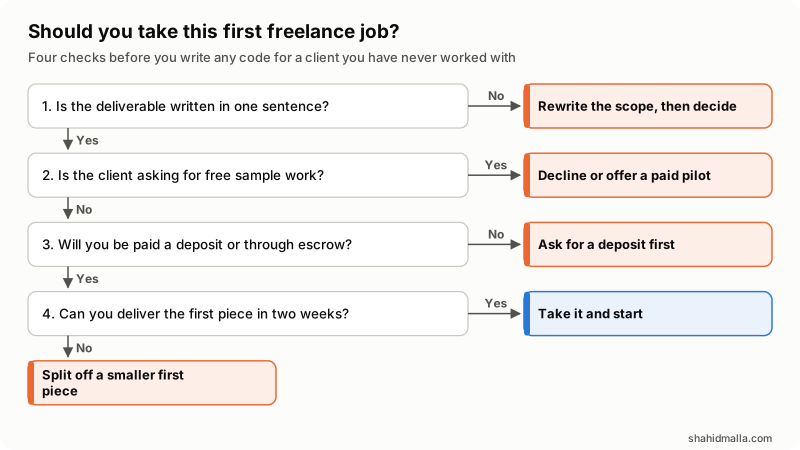
- Is the deliverable written in one sentence, in their words and yours? No: rewrite the scope together, then decide.
- Is the client asking for free sample work? Yes: decline, or offer a small paid pilot.
- Will you be paid a deposit, or through escrow? No: ask for a deposit before you start.
- Can you deliver the first useful piece within two weeks? Yes: take it. No: split off a smaller piece and quote that.
What should you have ready before you pitch?
Six things, none of which takes more than an afternoon.
- One sentence that says what you do and who for.
- Two or three links a stranger can open, each with a one-line description.
- A scope template: deliverable, exclusions, timeline, price, rounds of changes.
- A way to take money that works in your client's country.
- A floor price, written down, and the deposit you will ask for.
- A staging environment, so you never work on a client's live site.
What should you not do to win a first client?
Avoid the shortcuts that cost you the second client.
- Unpaid spec work. Building a feature to show what you can do, before anyone commits, is the usual way to lose a week.
- A borrowed portfolio or bought reviews. Reputation is the only asset you are building at this stage, and a faked one destroys the thing you came for.
- Ignoring the terms of a platform you chose to join. Read them before you move a conversation, a file or a payment off it, so you decide with the rules in front of you rather than after an email arrives.
- Shipping AI output you cannot explain. Using an AI assistant is fine and I use one, but you own every line. I wrote about keeping that controlled in my Claude Code workflow for client projects.
What else do developers ask about getting a first client?
How long does it take to get your first freelance client?
There is no honest average, and anyone quoting one is guessing. The time depends more on the route than on your skill: asking people who already know your work can bring a reply the same week, while a new marketplace profile competes with established freelancers. Work the warm routes first.
Should I work for free to get my first client?
No. Free work sets the price of your time at zero with the one person who might recommend you. If you need a first case study, offer a small paid pilot, or an introductory price with an end date attached. Open source contribution is the one kind of unpaid work that pays back, because the record is public and permanent.
What should I charge for my first freelance project?
Enough that you still care about the job in week two. Set a floor before you quote, price the whole scope rather than the hours while the work is small, and ask for a deposit. Rates vary by country and specialty, so compare against what the same scope sells for on the marketplaces, not against a blog's hourly table.
Can I get a freelance client with no portfolio?
Yes, if you can show something checkable: a repo, a live demo, a merged pull request, or a problem you solved publicly. Buyers are not asking for a portfolio website, they want a reason to believe you finish work. Subcontracting for another freelancer is the fastest route when you have nothing public.
Do I need a registered business to take my first client?
It depends where you live, so spend ten minutes on your tax authority's site before the first invoice. The IRS says you must file an income tax return if your net earnings from self-employment were $400 or more, and that self-employed people generally pay estimated tax quarterly. GOV.UK sets out what an invoice must contain and the 30-day default term.
Is Fiverr or Upwork better for a first client?
It depends on whether you can package the work, and the honest answer is that it changes as each platform changes its fees and rules. I compared the two from their own help pages in Fiverr vs Upwork for developers, written 22 October 2026, and I wrote up what each one asks for its top badge in Fiverr's Top Rated requirements on 26 October and Upwork's Top Rated requirements on 27 October. Read the current help pages before you commit to either.
If you are on the other side of this and would rather hire someone who already has the process in place, see how I work and my page as a Claude Code developer for hire: a free scoping call of about 30 minutes, a written quote within one business day, two weeks of support after delivery.
Last reviewed 28 October 2026. Disclosure: I sell freelance development work and I freelance on Fiverr and Upwork myself, so I am not neutral, and I am not affiliated with either platform; no link here is an affiliate link. I am CTO at ElySpace, a freelance developer for Marmaids LLC, and founder of WHMCSPilot and MagizAI. The tax and invoicing points come from the IRS and GOV.UK pages linked above, as I read them on 28 October 2026; rules differ by country, so check the page that applies to you.