
An ecommerce website costs a one-time build plus two running bills: the platform and the card fees on every order. My fixed-price stores start at $199 for a single-product store and $299 for a WooCommerce or custom Laravel store. Shopify's plans start at CA$37 or A$42 a month billed yearly, and card processing takes about 1.5% to 3.5% of each sale, usually plus a fixed fee.
Ecommerce website cost is the total you pay to build an online store and keep it selling: the build, the platform or hosting, paid apps or extensions, and the payment processing fees taken from each order. The build is paid once. Everything else repeats, and once a store sells, the card fees outgrow the platform bill.
Every fee below comes from the vendor's own pricing page, read on 3 November 2026 and linked where it appears. Card rates and plan prices change, so re-check them once a year. If you want hourly rates, quote red flags and the general running costs of any business website, my web designer cost guide covers that ground; this guide stays on what is different about a store.
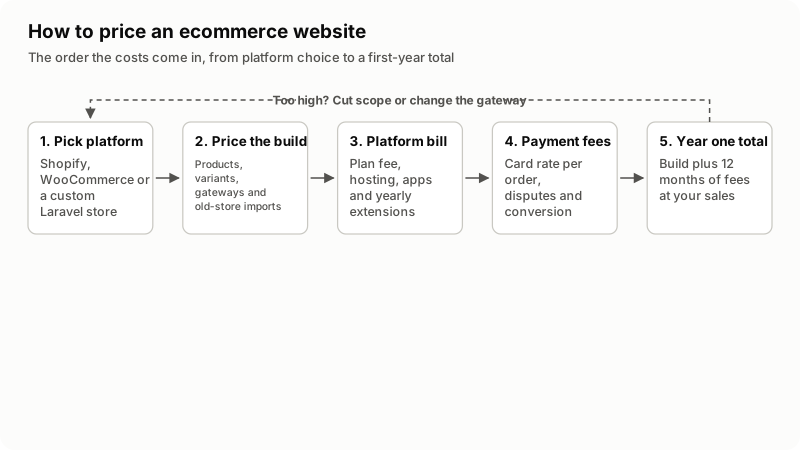
Which platform should your store run on?
Pick the platform first, because it decides which bills you get.
| Route | What you pay for | Who runs the server | Where the cost hides |
|---|---|---|---|
| Shopify | A monthly plan, apps, card fees | Shopify | An extra transaction fee if you use a payment provider other than Shopify Payments |
| WooCommerce | Hosting, paid extensions renewed yearly, card fees | Your host, in your name | Extension renewals and someone to apply updates |
| Custom Laravel store | A larger build, hosting, card fees | Your host, in your name | Every new feature is development work, not an app install |
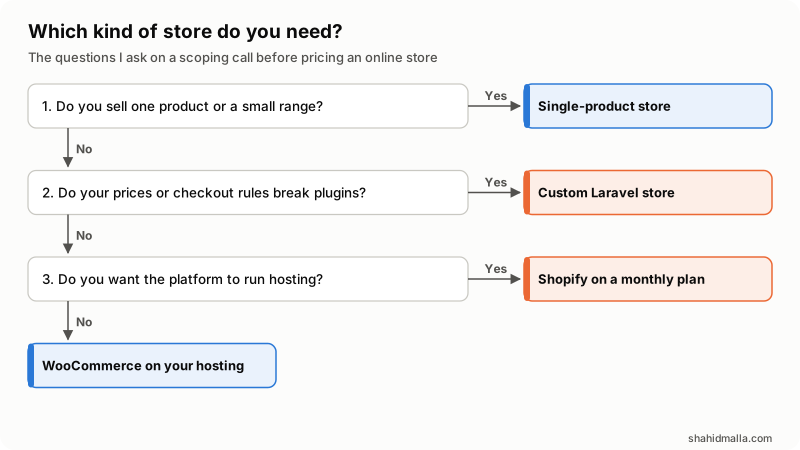
In words: one product or a small range needs a focused single-product store. Prices per customer, made-to-order products or checkout rules no plugin covers point to a custom Laravel store. If you never want to think about a server, Shopify's monthly plan buys that. Otherwise WooCommerce on hosting in your own name is the lowest-cost route I know for a normal catalog.
What does it cost to build the store?
The build is the one number you can fix before work starts. These are the Starter prices on my published ecommerce website packages, with the delivery time quoted on the same page:
| Store type | Starter price | Delivery | What Starter covers |
|---|---|---|---|
| Single-product store | $199 | 4 days | One sales page, up to 3 variants |
| Digital downloads store | $249 | 5 days | Up to 20 products, expiring download links |
| Subscription box store | $249 | 6 days | Up to 3 plans, automatic Stripe renewals |
| Store migration and rebuild | $249 | 5 days | Up to 100 products moved, with 301 redirects |
| WooCommerce store | $299 | 5 days | Up to 30 products, shipping zones, Stripe and PayPal |
| Custom Laravel store | $299 | 7 days | Catalog, cart, Stripe checkout |
| Wholesale ordering site | $299 | 6 days | Trade accounts, hidden prices, minimum quantities |
| Multi-vendor marketplace | $299 | 7 days | Seller approval, split orders, commission |
Those are entry plans. The WooCommerce store runs $699 on Business and $1,499 on Premium; the custom Laravel store runs $799 and $1,799. What moves a store up is more products, variants with their own stock, discount rules, a second gateway and customer accounts. On the Laravel store, Square or another gateway with a documented API is a $129 add-on. Work outside a package is quoted at $55 to $65 an hour or as a fixed scope.
Leaving an older store is its own cost: redirects from every old product address protect the search traffic you have. My website redesign guide explains what to keep.
What does the platform charge every month?
Shopify charges a plan fee; WooCommerce and a custom store charge nothing for the software and leave you to pay for hosting and extensions. Shopify's own pricing pages for Canada and Australia showed these plans on 3 November 2026:
| Shopify plan | Canada, billed yearly / monthly | Australia, billed yearly / monthly | Extra fee with a third-party payment provider |
|---|---|---|---|
| Basic | CA$37 / CA$49 a month | A$42 / A$56 a month | 2% |
| Grow | CA$99 / CA$132 a month | A$114 / A$149 a month | 1% |
| Advanced | CA$389 / CA$517 a month | A$431 / A$575 a month | 0.6% |
| Plus | From CA$3,400 a month | From A$3,700 a month | 0.2% |
Both pages offered 3 days free, then $1 a month for 3 months. For the current US dollar plan prices, check Shopify's US pricing page; the plan names and third-party fees were the same on every country page I read.
The third-party column matters more than the plan price. If you use Stripe, PayPal or another provider instead of Shopify Payments, Shopify takes that percentage of each sale on top of the provider's own fee. Syncing marketplace orders is free up to 50 a month, then 1%, capped at $99 USD a month.
WooCommerce's software is free to install, but the store still has a bill. Hosting is paid to your host. Paid extensions are licensed per year: the WooCommerce Subscriptions page describes it as a paid annual extension with a 30-day money-back period, though it showed me its price in a local currency. I keep the extension list short, because each one is a renewal and an update that can break checkout. A custom Laravel store has no platform fee and no renewals; the trade is that a new feature means paying a developer.
What will payment processing take from each sale?
Card processing takes a percentage of every order plus, with most providers, a fixed amount. These are the standard published online rates for a domestic card, read on 3 November 2026:
| Provider | United States | Canada | Australia |
|---|---|---|---|
| Stripe | See Stripe's US pricing page | 2.9% + CA$0.30 | 1.65% + A$0.30, GST included |
| PayPal Checkout (the PayPal button) | 3.49% + $0.49 | 2.90% + CA$0.30 | 2.90% + A$0.30 |
| PayPal Advanced Credit and Debit Card Payments | 2.89% + $0.29 | 2.70% + CA$0.30 | 1.50% + A$0.30 |
| Square, online and in-app through its APIs | 2.9% + 30¢ | 2.8% + 30¢ | 2.2% |
| WooPayments, cards | 2.90% + $0.30 | 2.90% + $0.30 | 1.75% + $0.30, plus 10% GST on the fee |
| Shopify Payments, Basic plan | See Shopify's US pricing page | 2.8% + 30¢ CAD | 1.7% + 30¢ AUD |
For the current US rates of Stripe and Shopify Payments, check the US pricing pages linked in the table. PayPal's US page also lists standard card payments at 2.99% plus $0.49, a different product from the Advanced row.
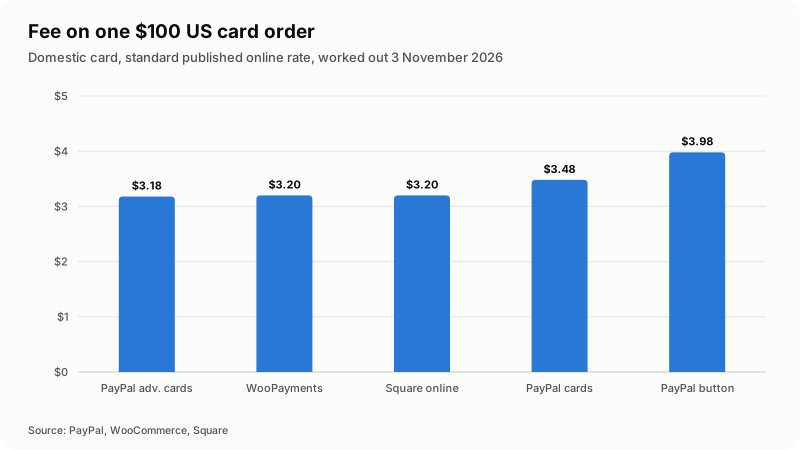
In numbers: on a $100 US order, WooPayments takes $3.20, Square online takes $3.20, PayPal's Advanced card processing takes $3.18, PayPal's standard card payments take $3.48 and a payment through the PayPal button takes $3.98. Pay Later options cost more again: PayPal lists 4.99% plus $0.49 in the US, and Square and WooPayments both list Afterpay at 6% plus 30¢.
The fixed fee hurts small orders most. On a $10 sale, 30¢ alone is 3% of the order, so compare providers on your real order size, not on the percentage.
Which smaller fees add up over a year?
The fees beyond the headline rate are the ones that surprise owners in year one. Read the rows that match how you sell.
| Provider and country | Card from another country | Currency conversion | Dispute or chargeback fee |
|---|---|---|---|
| Stripe, Canada | +0.8% | +2% | CA$15 per dispute received |
| Stripe, Australia | 3.5% + A$0.30 in total | +2% | A$25 per dispute received |
| PayPal, US | +1.50% | Separate schedule | $15 dispute fee, $20 card chargeback fee |
| PayPal, Canada | +0.80% for US buyers, +1.00% for others | Separate schedule | CA$20 dispute fee, CA$20 chargeback fee |
| PayPal, Australia | +1.00%, or +2.10% on Advanced card payments | Separate schedule | A$15 chargeback fee |
| WooPayments, US | +1.50% | +1.00% | $15 |
| WooPayments, Canada | +1.00% | +2.00% | $20 |
| WooPayments, Australia | +1.50% | +2.00% | $25 |
A few more lines from the same pages:
- Refunds keep the fee. WooPayments says its transaction fees are not returned when you refund a customer, and Stripe says the processing fee of the original payment is not returned either.
- Subscriptions can cost extra. In the US, WooPayments adds 1.00% to any order containing a subscription payment that uses the Stripe Billing engine, on the whole order, not only the subscription line.
- Card readers. Selling in person too? WooPayments charges $5 a month per active card reader in all three countries.
- Apps. Shopify apps and WooCommerce extensions each set their own price. Count every paid one into the yearly budget before launch.
Stripe's Australian page also notes lower international card pricing from 1 April 2027, which is one reason to re-read these pages every year.
How do you add it all up into a first-year budget?
Add the build, twelve months of platform and apps, and the card fees at the sales you expect. Take a Canadian store selling CA$10,000 a month in 200 orders of CA$50, all on domestic cards:
| Setup | Platform a month | Card fees a month | Total a month |
|---|---|---|---|
| Shopify Basic, billed yearly, with Shopify Payments | CA$37 | CA$340 (2.8% + 30¢ per order) | CA$377 |
| Shopify Basic with Stripe as a third-party provider | CA$37 | CA$350 to Stripe, plus CA$200 Shopify's 2% fee | CA$587 |
| WooCommerce with WooPayments | Hosting and extensions, priced by your host and vendors | CA$350 (2.90% + $0.30 per order) | CA$350 plus hosting |
| Custom Laravel store with Stripe | Hosting only | CA$350 (2.9% + CA$0.30 per order) | CA$350 plus hosting |
The arithmetic is mine; the rates are the published ones above. At this volume the card fees are about nine times the Shopify Basic plan, so a cheaper plan saves less than a better payment setup. And the third-party fee is the expensive mistake on Shopify: Shopify's 2% on top of another provider's rate costs this store CA$200 a month, CA$2,400 a year. In year one, add the one-time build to your row. From year two, only the monthly lines remain, plus renewals and any development you order.
What should you check before you sign?
Ask every quote the same list, in writing.
- Which platform, and why that one for my catalog?
- How many products does the price load, and who loads the rest?
- Which payment providers are set up, and are the accounts opened in my company's name?
- Which paid apps or extensions does the store need, at what price, and who renews them?
- Is hosting included or billed to me, and whose account is it in?
- If I move from another store, are redirects from the old product addresses included?
- What does support cost after launch?
On my builds, the domain, hosting, gateway accounts and any premium extension are paid by you, in your name, directly to those companies. My payment stages and handover are on how I work.
When is the cheapest store the wrong buy?
When the cheap option cannot carry the way you sell. I say so on the scoping call in these cases.
- Your prices are not one price. Customer group pricing and quotes that turn into orders fight a standard theme. A wholesale ordering site or a custom store costs less than a stack of plugins pretending.
- You will sell mostly abroad. International card and conversion fees add from under 1% to nearly 4% per order on the tables above. Price that before you choose a provider.
- You run subscriptions. Renewals, failed payment retries and any extra subscription fee belong in the budget from day one.
One thing I will not price: a promise of sales or rankings. What a build can deliver is a checkout tested end to end and every account in your name.
What else do people ask about ecommerce website costs?
Is WooCommerce cheaper than Shopify?
On software, yes: WooCommerce has no plan fee, and WooPayments charges no setup or monthly fee for online payments. But you pay for hosting, paid extensions and updates yourself. In the Canadian example above, both land near CA$350 to CA$380 a month in card fees and platform, so the deciding factor is usually who looks after the store, not the price.
How much does Shopify take per sale?
With Shopify Payments on the Basic plan, the online card rate I read was 2.8% plus 30¢ in Canada and 1.7% plus 30¢ in Australia, falling on the higher plans. If you use a third-party provider instead, Shopify adds 2% on Basic, 1% on Grow, 0.6% on Advanced and 0.2% on Plus, on top of that provider's own fee.
Is WooCommerce really free?
The plugin is free to install; running a store with it is not. You pay a host, a payment processor on every order, and yearly licenses for paid extensions such as WooCommerce Subscriptions. Budget for someone to apply updates too.
Is a custom-built ecommerce website worth it?
It is worth it when your pricing, products or checkout follow rules a plugin cannot express, and a waste when a standard catalog fits. A custom store has no platform fee or extension renewals, but every later feature is paid development. My custom Laravel and WooCommerce stores both start at $299, so the difference shows in the higher plans and later changes.
If you want a number for your own store, the ecommerce website packages list scope, plans and delivery days in the open, and I quote anything outside them as web design and development work after a free scoping call of about 30 minutes, with a written quote within one business day.
Last reviewed 3 November 2026. Disclosure: I sell ecommerce website development, so I am not neutral, and the package prices here are my own. I am CTO at ElySpace, a freelance developer for Marmaids LLC, and founder of WHMCSPilot and MagizAI. The platform and payment figures come from the pricing pages of Shopify (Canada and Australia), Stripe (Canada and Australia), PayPal (US, Canada and Australia), Square's developer documentation and WooCommerce, as I read them on that date. Re-check every rate and plan price yearly.