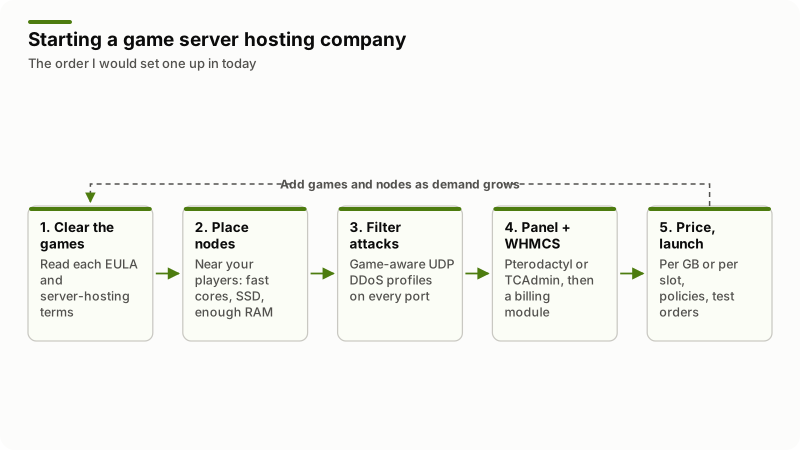
To start a game server hosting company, pick games whose publishers allow paid servers, place nodes near your players on CPUs with fast single cores and SSD storage, and buy DDoS filtering built for UDP game traffic. Run a panel such as Pterodactyl or TCAdmin, connect it to WHMCS so paid orders create servers, price per GB of RAM or per slot, and publish your policies.
A game server hosting company rents servers for multiplayer games such as Minecraft, Rust or Palworld, usually by the month. Behind the order form sit the nodes, a panel that starts, stops and limits each game server, filtering that understands game traffic, and billing that creates and suspends servers as invoices are paid or missed.
I have been CTO at the hosting company ElySpace since 2016 and I build WHMCS modules, so I am not neutral. The business basics are in my guides to starting a web hosting business and starting a VPS hosting company; this one covers what game servers change. Prices and terms below come from the linked pages, read on 5 November 2026.
Which games are you allowed to sell servers for?
Games whose publisher's terms allow paid hosting on conditions you can meet. Read each game's EULA and hosting guidelines before you build a plan; they differ by game and can change without notice.
The Minecraft EULA lets buyers install the Java Edition server and "host online play", but bars commercial use of anything Mojang made unless Mojang agrees. It calls the Minecraft Usage Guidelines "extra permissions"; they set the conditions for charging and for using the name. Facepunch's Community Server and Hosting Guidelines, updated 15 July 2025, cover its games, including Rust and Garry's Mod.
| Game and publisher | What the terms allow | Conditions that affect a host |
|---|---|---|
| Minecraft (Mojang and Microsoft) | Hosting online play; charging for access, under conditions | Nothing that looks official; Minecraft not the dominant part of your name; a disclaimer similar to "NOT AN OFFICIAL MINECRAFT [PRODUCT/SERVICE/EVENT/etc.]. NOT APPROVED BY OR ASSOCIATED WITH MOJANG OR MICROSOFT"; whom to contact and how, where "chat and forum links are not acceptable methods" |
| Rust and Garry's Mod (Facepunch) | A single fee or subscription, donations, cosmetics, a server currency, ads | Never call a server official; never distribute the game; no Facepunch DLC for players who have not bought it; breaches may mean delisting from the server browser, and serious or repeated ones a game ban |
This guide is not legal advice. Neither page has a section for companies that rent servers to others. Mojang says it cannot advise on whether a specific project complies: "If you are unsure, you should speak to an attorney for help." Two Minecraft lines touch a host's own setup. Monetized servers must not "hide or alter any of the dialogs or prompts that are part of Minecraft", including the EULA. A domain that includes a Minecraft name must not appear official, and its site may relate to Minecraft "and not to other third-party games".
Where should your game servers be located?
Where your players are. Distance shows up as ping, so pick the market first and the region second.
- Start narrow. One or two locations, for example the eastern United States and Western Europe, and add one when a region's orders fill a node.
- Let players test. Publish a test IP address per location so players can check their ping before paying.
- Pass the choice to the panel. Name a configurable option
location_idand the Pterodactyl WHMCS module builds the server where the customer chose. If no node there has the disk, CPU, RAM or a free allocation, the order fails with "Couldn't find any nodes satisfying the request".
What hardware does a game server node need?
Fast single cores, SSD storage and enough RAM for the plans you sell, without overselling memory. Core speed matters because some game servers do most of their work on one thread.
Minecraft is the documented case. PaperMC's Folia README describes a fork of Paper in which world regions tick in parallel, each at the regular 20 ticks per second, so "There is no main thread anymore". The same README calls current Paper "single threaded", one region holding every chunk. At 20 ticks per second, each tick has 50 ms. Faster cores do more per tick; more cores fit more servers on a node.
| Source | What it says | What I take from it |
|---|---|---|
| Palworld server requirements | 4 or more cores recommended; 16 GB of RAM, with a note recommending "larger than 32GB"; 8 GB boots but risks out-of-memory crashes; a fast SSD, because slow storage may corrupt saves; UDP port 8211 | Large plans only; no 8 GB Palworld plan |
| Pterodactyl Wings install guide | Linux that runs Docker; KVM works; on OpenVZ, Virtuozzo or LXC it will most likely not run; no Windows; swap recommended when hosting for others | KVM or dedicated nodes, checked with systemd-detect-virt before you pay |
The Pterodactyl site says Wings holds each container to a CPU quota, a hard memory ceiling, an IO weight and 512 processes. Keep the sum of plan memory limits below the node's RAM after the operating system's share. Kernels from 6.1 enable swap by default; older ones need swapaccount=1. Two traps from the Wings guide: some providers' modified kernels lack Docker features, and on OVH and SoYouStart servers the main drive space is probably under /home.
How do you protect game servers from DDoS attacks?
Rent nodes behind filtering that understands game protocols over UDP. OVHcloud's Game DDoS Protection page explains why: DDoS attacks usually exploit UDP, which games and voice servers use, and often hit the application layer, where standard firewalls do not help.
It is an example, not a recommendation: you turn on a per-game profile by naming the port and the game. The list includes Rust, Valheim, Counter-Strike 2, ARK, FiveM and Minecraft Bedrock; for Minecraft Java, the profile protects the Query protocol. It comes with their Bare Metal Game servers, and the page says the VPS range has none. Ask any provider:
| Question for the provider | Why it matters |
|---|---|
| Which games have a profile, on which ports? | Other games get only generic filtering |
| Is filtering always on, or started after detection? | Rerouting traffic mid-attack can lag or drop players |
| What happens above your capacity? | A blackholed IP takes every server on it offline |
| Is it included, or billed per IP or per attack? | It changes your cost per node |
Keep the panel and website on addresses apart from the game nodes, and restrict who can reach the panel host and the port Wings listens on. That is server security hardening work.
Which game panel should you run?
Pterodactyl if your games run on Linux and you want no license fee; TCAdmin if you need Windows game servers or vendor support in the price. Pelican and AMP are the alternatives.
| Panel | License | Release or price | Game nodes | WHMCS |
|---|---|---|---|---|
| Pterodactyl | MIT, free | Stable 1.15.2 (21 October 2026); 2.0 in open beta | Linux, Docker | Free official module |
| Pelican | Panel AGPLv3, Wings MIT, free | v1.0.0-rc.2 (22 October 2026), a release candidate | Docker | Official, but its README says not yet functional |
| AMP (CubeCoders) | Enterprise license for commercial use, per instance | Not stated in the Enterprise terms | Not checked | Not checked |
| TCAdmin 3 | One license per server | Professional $15.95 a month, unlimited services; Community $7.95, up to 4 | Windows and Linux | Module included |
Sources: the Pterodactyl releases, the Pelican documentation and releases, the AMP Enterprise Terms of Purchase and the TCAdmin pricing page, which labels Professional "for hosting providers selling game servers to customers" and offers a 30-day trial. AMP Enterprise licenses are "very strictly non-refundable except in exceptional circumstances", may not go to anyone under 18 and can be revoked after a chargeback, so ask CubeCoders which edition a host needs.
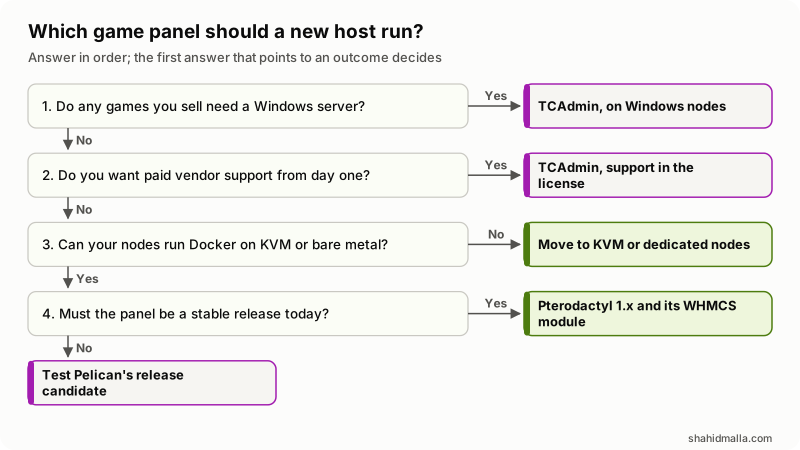
In words: Windows games mean TCAdmin, the one panel here whose pages I read list Windows nodes. Vendor support in the price also points to TCAdmin. Otherwise your nodes must run Docker on KVM or bare metal; if not, move them. Then pick Pterodactyl 1.x and its WHMCS module for a stable release, or test Pelican's release candidate on staging; its WHMCS module is not ready.
How do you connect WHMCS billing to the game panel?
With a provisioning module, so a paid order creates the server and an overdue invoice suspends it. Pterodactyl's is free: pterodactyl/whmcs, MIT-licensed, under the Pterodactyl GitHub organization. TCAdmin includes its own. The README's setup, in short:
- Copy the
pterodactyl/folder intomodules/servers/in WHMCS. - Create API credentials in the panel with the permissions the README shows.
- In WHMCS 8 or later, add a server at System Settings > Servers: the panel address as hostname, type Pterodactyl, username empty, the API key as password, Secure ticked for SSL. Test the connection, then add it to a server group.
- Create a product of type Other and choose Pterodactyl and that group on its Module Settings tab.
The module reads configurable options and custom fields by exact name: memory, disk, cpu, egg_id, location_id or backups override the product setting, and a name such as Player Slots sets that game variable. My WHMCS configurable options guide covers the pricing side.
Two limits from the README: games that need several ports are not supported yet, and older module versions cannot create servers on panel 2.x, so update the module before you upgrade the panel. Run one test order per game through create, suspend, unsuspend, upgrade and terminate; suspensions wait for the WHMCS cron. Where the free module stops, a custom provisioning module fills the gap.
How should you price game server plans?
Per GB of RAM where memory decides how well a game runs, per slot where buyers think in player counts, and either way from your cost per node.
| Model | How it maps to WHMCS | Fits | Watch out for |
|---|---|---|---|
| Per GB of RAM | A memory option sets the limit | Minecraft and modded games | Buyers guess; add a RAM note per game |
| Per slot | An option named after the player-limit variable; fixed memory per tier | Games sold by player count | Slots do not cap memory use |
| Fixed plans | One product per bundle | A first launch with few games | More products to keep updated |
Your cost per node is rent, DDoS filtering if extra, the panel license, WHMCS, backup storage, payment fees and support time, divided by the servers it holds without overselling memory. Pterodactyl and Pelican cost nothing to license, but both send configuration questions to their Discord, so fixes take your own time. TCAdmin's calculator, at its default of three machines with 12 game servers each, shows $47.85 a month before tax, or $1.33 per game server. For WHMCS itself, see my WHMCS pricing guide.
What support, backup, abuse and refund policies do you need?
Four, written before the first sale and linked from the order form.
- Support. What you fix (node, network, panel, a server that will not start), what you do not (plugins, mods) and your hours. Minecraft's guidelines rule out chat and forum links as the contact method.
- Backups. The module's
backupsoption overrides the plan's backup limit, so extra backups can be sold as an option. Keep copies off the node; restore one monthly. - Abuse. Ban attacks, malware and breaches of game terms; Facepunch makes operators responsible for their servers. The process is in my VPS company guide.
- Refunds. The window, part months and how long files are kept after cancellation.
What should you check before launch?
- Game terms linked from each order page; the Minecraft disclaimer live
- Company name and domain checked against each game's naming rules
- Nodes checked with
systemd-detect-virt; memory limits below RAM - A DDoS profile on every game port; the panel on its own address
- One test order per game through the full lifecycle
- Panel emails arriving; module debug logging off
- One backup restored from off-node storage
- Policies and a test IP per location published
When is a game server company the wrong business to start?
When nobody can answer tickets or watch attacks in the evenings and at weekends, when players are online. It is also wrong if you plan to win on price alone, or want Windows games with nobody who runs Windows servers. With no hosting experience, start with reseller hosting as in my web hosting business guide.
What else do people ask about starting a game server hosting company?
Is game server hosting profitable?
It can be, but I found no reliable public figures on game hosting margins, so I quote none. Profit depends on how many servers fit on each node, how long customers stay and how many tickets they open.
How much does it cost to start a game server hosting company?
There is no single figure: node rent and DDoS filtering vary by provider. The fixed line I could confirm is the panel: nothing for Pterodactyl or Pelican, $15.95 per server a month for TCAdmin Professional. Add your WHMCS license.
Is it legal to sell Minecraft server hosting?
This is not legal advice. The EULA lets buyers install the Java Edition server and host online play, and the Usage Guidelines allow charging for access under conditions, including a non-official look and a disclaimer. Neither page addresses rental companies, so for your own business model ask an attorney, as Mojang suggests.
Can you run game servers on a VPS?
Yes, on KVM with Docker allowed, which Pterodactyl's Wings needs; on OpenVZ, Virtuozzo or LXC it will most likely not run. Check DDoS filtering too: OVHcloud does not offer its Game DDoS Protection on its VPS range.
If you need a provisioning module the free ones do not cover, I build it as custom WHMCS module development, and plan whole launches under starting a hosting business, beginning with a free scoping call of about 30 minutes.
Last reviewed 5 November 2026. Disclosure: I sell WHMCS development and modules, so I am not neutral, and I am not affiliated with WHMCS. I am CTO at ElySpace, a freelance developer for Marmaids LLC, and founder of WHMCSPilot and MagizAI.