To make money with AI, pair an AI tool with a skill someone already pays for. The five realistic routes are doing your existing paid work faster, selling AI services such as chatbots to local businesses, freelancing with AI skills on Fiverr or Upwork, building one small AI tool, and taking a job that uses AI. None of them pays without real work and real clients.
Making money with AI means earning from work where an AI model does part of the job: you sell the result, the setup or your time, and the model is a tool you pay for. It is not a system that earns while you watch. Every legitimate route needs a buyer, a deliverable and someone accountable when the output is wrong.
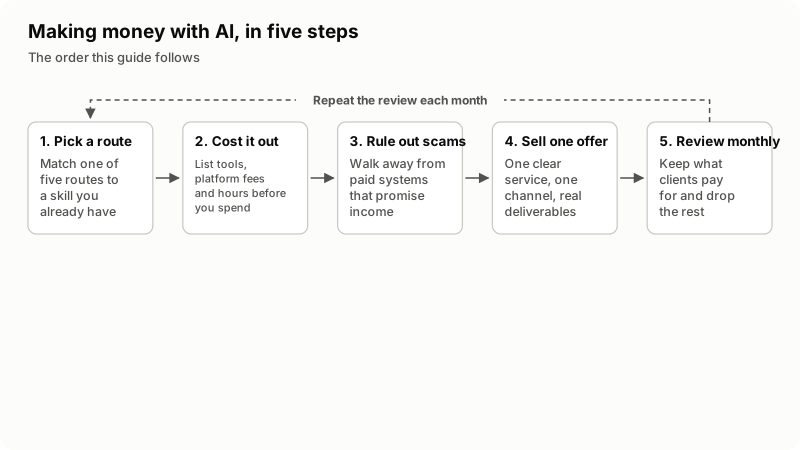
This guide is about personal income; to set up a company, read how to start a business with AI, and for marketplace levels and payouts, my Fiverr vs Upwork comparison. I sell AI chatbot and automation work as a freelancer, with 600+ reviews at 4.9 on Fiverr, so I use my own prices as examples. I quote no income figures for anyone else, because I have no honest source for them.
Which ways to make money with AI are realistic?
Five routes hold up, and each is a normal way of earning with AI added, not a new kind of income.
| Route | What it needs | Start-up cost | How clients pay |
|---|---|---|---|
| Do your existing paid work faster | A skill people already pay for, such as writing, code or bookkeeping | An AI subscription; a free plan is enough to test | As they pay you now: invoice, salary or marketplace order |
| Sell AI services to local businesses | Skill to set up a chatbot or automation, and willingness to talk to owners | A subscription, a simple website, your time for demos | Fixed price per setup, plus optional monthly upkeep |
| Freelance with AI skills on Fiverr or Upwork | A specific service, a clear listing, proof of past work | Free to list; the platform takes a fee from each order | Through the platform, after the money clears |
| Build a small AI tool | Coding skill or budget, plus time for support | Hosting, a domain, model usage per request, card fees | Subscriptions or one-time payments via a processor |
| Take a job that uses AI | Employable skills and a portfolio that shows AI work | Mostly your time | Salary or contract rate from an employer |
Missing on purpose: reselling "make money with AI" courses, buying a "done for you" AI store, and paying for a secret system. That is where the scams are.
Which route fits the skills you already have?
Start from what someone already pays you for, because AI multiplies a skill and adds little of its own. Answer in order; the first outcome you reach is your starting route.
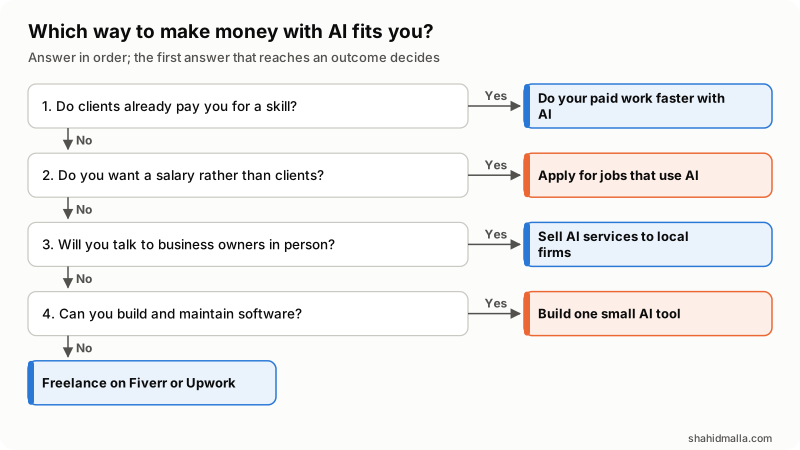
- Do clients already pay you for a skill? Do that work faster with AI; there is no new market to find.
- Do you want a salary rather than clients? Apply for jobs that use AI.
- Will you talk to business owners in person? Sell AI services to local firms.
- Can you build and maintain software? If yes, build one small AI tool. If no, freelance on Fiverr or Upwork with a narrow service.
Pick one route for the first three months. Splitting time across all five usually leaves nothing finished.
How do you make money with AI from work you already do?
You take on more of the same paid work, or deliver it sooner, because AI handles drafts and repetitive parts. It is the quickest route: the buyers, prices and payment channel already exist.
I use AI assistants to draft code and tests, then review and own every line that ships. Three things decide whether this earns more or causes trouble:
- Your contract. Some clients and employers restrict AI tools or require disclosure. Read the agreement first.
- Client data. Check the plan's data settings and the client's rules before pasting confidential material into a chat app.
- Checking. AI output can be confidently wrong. If you bill for it, you answer for it.
Fixed prices let you keep the time saved; hourly billing passes it to the client. My guide on retainer vs hourly billing covers that trade-off.
How do you sell AI services to local businesses?
Offer one concrete setup, such as a website chatbot that answers from the business's own pages, demo it on their content, and charge a fixed price. Owners buy a visible outcome, like fewer repeat questions, not "AI".
The services that sell are plain: a chatbot trained on the business's pages, a WhatsApp assistant on Meta's official API, a lead qualifier, or an automation between tools they already use. If the line between a bot that answers and one that acts is new to you, read AI chatbot vs AI agent.
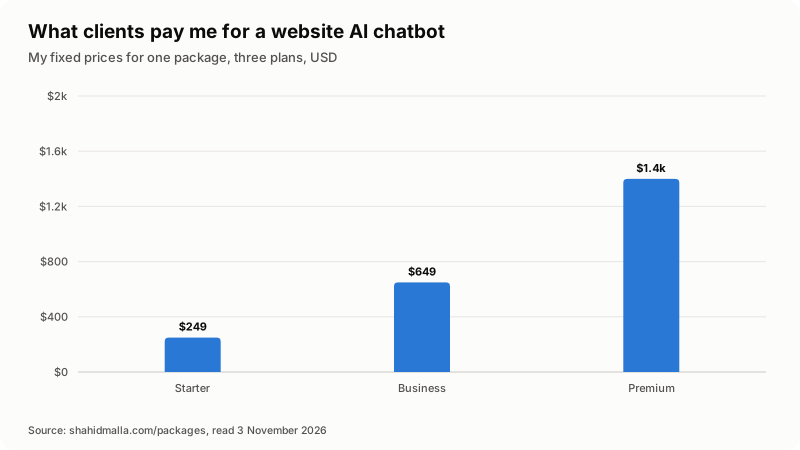
As an example, here are my own fixed prices from my AI chatbot and agent packages, read on 3 November 2026. They are my prices, not a market average.
| My package | Starter | Business | Premium |
|---|---|---|---|
| Website AI chatbot | $249, 5 days | $649, 10 days | $1,399, 18 days |
| WhatsApp AI chatbot | $299, 6 days | $699, 11 days | $1,699, 20 days |
| AI lead qualification agent | $249, 5 days | $649, 10 days | $1,499, 18 days |
| AI agent connected to a CRM | $299, 7 days | $799, 13 days | $1,999, 24 days |
Two details matter more than the price. Model usage is a running cost, so it goes on the client's own OpenAI or Anthropic account. And every bot I ship says in its first message that it is an AI assistant and offers a route to a person. Promise less than the demo shows: a bot that invents a refund policy costs you the client. My AI chatbot development page shows how I scope this work.
How do you freelance with AI skills on Fiverr and Upwork?
List one narrow AI service with a fixed scope, deliver through the platform, and accept that it keeps part of every order. "Chatbot trained on your help center" sells; "AI expert" does not.
The platform fees, as their help pages state them on 3 November 2026:
- Fiverr. How Fiverr works for freelancers says freelancers receive 80% of the client's cleared payment, and funds go through a 14-day clearing period before you can withdraw them. Fiverr's earnings page article says the 80% includes Gig Extras and tips.
- Upwork. The Freelancer Service Fee page says the fee ranges from 0% to 15% per contract, is shown when you submit a proposal or receive an offer, and is fixed once the contract begins.
On a $249 order, a 20% Fiverr fee leaves $199.20 before withdrawal costs and tax, so price for it from day one. With no reviews yet, read my guide to getting a first freelance client.
Is building a small AI tool worth it?
It can be, if you can build, host and support software and the tool solves one narrow problem for people you can reach. It is the slowest route to a first payment, because you build before anyone pays.
Each request calls a model billed per use, so every free user costs you money; set a provider spending cap before launch. Payments need a processor: Stripe's pricing page, read on 3 November 2026, lists no setup or monthly fees and a per-transaction fee that depends on the country and payment method. Add support, refunds, security, and the risk that the model provider ships your feature itself.
If you build with AI coding tools, read my guide on vibe coding security before real users sign up; a tool that leaks customer data costs more than it earns.
Which AI jobs can you apply for?
Realistic AI jobs are existing roles where AI is part of the work: developers building AI features, support staff running chatbots, content and marketing roles using AI tools, and data roles.
Proof gets you hired: two or three small working examples, such as a chatbot answering from a public document set, with a write-up of what went wrong and how you fixed it. I will not quote salaries, because pay depends on country, role and employer. Check your national labor statistics and real job posts in your city.
What does it cost to start making money with AI?
The honest start-up cost is low: an AI subscription, possibly free, your time, and platform fees taken from income. Anyone asking for thousands of dollars up front is selling something else.
| Cost | Example | Figure, read 3 November 2026 |
|---|---|---|
| AI assistant | Claude plans | Free plan $0; Pro $20 billed monthly or $17 a month billed yearly ($200 up front); Max from $100 a month |
| Marketplace fee | Fiverr or Upwork | Fiverr: you keep 80%; Upwork: 0% to 15% per contract |
| Card payments for your own tool | Stripe | No setup or monthly fee; per-transaction fee by country |
| Model usage for client bots | OpenAI or Anthropic API | Billed per use; in my packages, to the client's own account |
| Paid "AI income" programs | None needed | In the FTC cases below, buyers paid from about $2,000 to $45,000 or more |
How do you spot an AI money-making scam?
Walk away from any offer that sells a system, store or coaching program with promised earnings attached. The US Federal Trade Commission has sued several schemes doing exactly that with AI branding.
On 25 September 2024 the FTC announced Operation AI Comply, five cases at once. FTC Chair Lina M. Khan said at the time that "there is no AI exemption from the laws on the books." Three of the five were business opportunity schemes, and two later cases followed the same pattern:
| Case | What the FTC alleged the pitch said | Alleged cost to buyers |
|---|---|---|
| Ascend Ecom (Sept 2024) | "Cutting edge" AI tools would earn thousands of dollars a month in "passive income" | At least $25 million in consumer losses |
| Ecommerce Empire Builders (Sept 2024) | Build an "AI-powered Ecommerce Empire"; ads claimed $10,000 a month | Training near $2,000; stores up to $35,000 |
| FBA Machine (Sept 2024) | AI-powered tools and a "7-figure business" | More than $15.9 million in losses |
| Click Profit (Mar 2025) | A "proprietary system powered by artificial intelligence" and "passive income" | A management fee of at least $45,000; at least $14 million in losses |
| Air AI (Aug 2025) | Buyers would earn back "tens of thousands of dollars in a matter of days or months," backed by refund promises | Some buyers lost as much as $250,000 |
These are allegations from FTC press releases, read on 3 November 2026; check each case for its current status. The FTC article When a Business Offer or Coaching Program Is a Scam lists the warning signs: promised income or a "proven system", pressure to sign up now, card or bank details asked for first, claims you need not understand the business, a focus on recruiting, and upsells. It calls the earnings figures in such pitches "nothing but made-up numbers." The FTC's Business Opportunity Rule requires sellers of business opportunities to give prospective buyers specific information so they can evaluate the offer. If you have been targeted, report it at ReportFraud.ftc.gov.
What should you check before you spend money or time?
Run through this before you pay for a tool, course or listing, and again after your first month.
- I can name the skill a buyer pays for, without the word "AI" in it.
- I can name who buys it and where I will reach them.
- I have written down every cost: subscriptions, platform fees, model usage, hosting, tax.
- My price covers the platform's cut and the time I spend checking AI output.
- My contract allows the AI tools I plan to use, and client data stays where it is allowed.
- Nothing I am buying promises income, and nobody is rushing me.
- I have a date, about three months out, to keep what clients paid for and drop the rest.
Sometimes the answer is not to start. If you need income next month for rent, a job or more hours of work you already do is safer. If your only plan is "AI content" with no buyer in mind, you compete with everyone holding the same free tools. And if the only route that excites you needs a paid program from a stranger, reread the scam section.
What else do people ask about making money with AI?
Can a beginner make money with AI?
Yes, with some skill to sell, even a modest one such as writing clear emails or tidying spreadsheets. AI helps you deliver faster, but buyers still judge the result. With no skill and no buyer, beginners tend to pay for courses instead of earning.
Can I make money with ChatGPT or Claude without coding?
Yes. Writing, editing, research, translation and admin work all use AI assistants without code. Coding opens the tool and chatbot routes, but you do not need it to start.
Is making money with AI passive?
No. Services need delivery, tools need support, and jobs need you there. Several FTC cases above were sold on "passive income" claims, reason enough to distrust the phrase.
How long does it take to make money with AI?
I have no honest figure, and anyone who gives one without knowing your skills and market is guessing. Faster existing work can pay on the next invoice; a new listing or tool can take months to find a first buyer, or never find one.
Do I need to tell clients I use AI?
Check your contract, because some clients require disclosure or ban certain tools. My public chatbots say in the first message that the user is talking to an AI; the EU AI Act's Article 50 requires providers to design such systems so people are told they are interacting with AI, unless that is obvious. When in doubt, tell the client.
If you would rather buy a chatbot or automation than build one, my fixed-price packages are linked above, with a free scoping call of about 30 minutes and a written quote within one business day.
Last reviewed 3 November 2026. Disclosure: I sell AI chatbot, agent and automation work as a freelancer, including on Fiverr, so I am not neutral about the services route. I am CTO at ElySpace, a freelance developer for Marmaids LLC, and founder of WHMCSPilot and MagizAI. Fees, plan prices, the EU AI Act text and FTC case details come from the official pages linked above, read on that date.