Pterodactyl, Pelican, AMP and TCAdmin are the four game server control panels a hosting company is likely to shortlist. Pterodactyl and Pelican are free and open source, run every game server in a Docker container and ship free WHMCS modules. AMP is licensed per instance by CubeCoders. TCAdmin 3 is licensed per machine and runs on Windows as well as Linux.
A game server control panel is the software that creates, starts, stops and limits each game server on your nodes, and gives the buyer a console, a file manager and backups without shell access on the machine. It sits between your hardware and your billing system, so the panel you pick decides which operating systems you can sell from, which games are a config file away, and whether a paid invoice can create a server on its own.
Everything below comes from the vendors' own pages, license files and release data, read on 8 November 2026. I am CTO at the hosting company ElySpace and I write WHMCS provisioning modules for panels like these, so I am not neutral. The business decisions around the panel are in my guide to starting a game server hosting company.
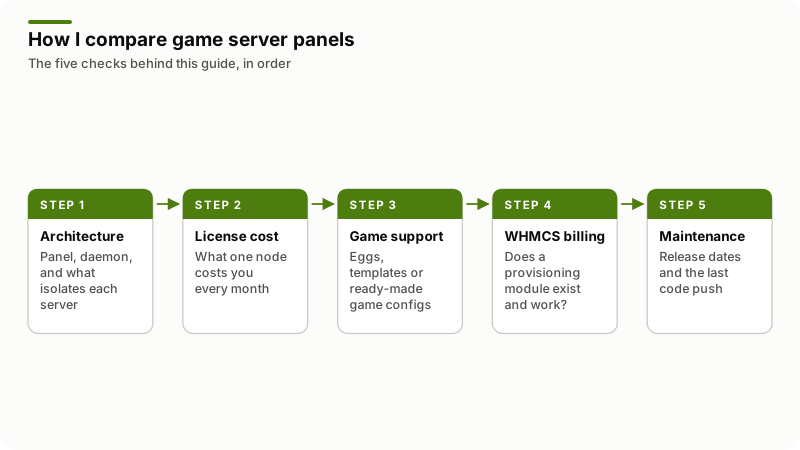
Which jobs must a game server control panel do for a host?
Five jobs, and a panel that misses one of them costs you staff time every day. The four panels answer them differently, so decide which you are actually buying.
- Create a game server on a node with set memory, disk, CPU and ports, without a human logging in.
- Isolate one customer's server from every other server on the same machine.
- Give the customer a console, a file manager, backups and a way to install mods.
- Suspend, unsuspend, upgrade and terminate on a billing signal.
- Keep shipping fixes, because a panel is an internet-facing web application sitting on your network.
Use that as the checklist. The rest of this guide takes the five checks in order.
How is each game server control panel built?
Pterodactyl and Pelican both split into a web panel and a daemon that runs each game server in its own Docker container. AMP spreads game server instances across a controller machine and any number of target machines. TCAdmin 3 installs on the operating system itself, Windows or Linux.
| Panel | Control plane | What runs the game | Where it installs |
|---|---|---|---|
| Pterodactyl | Panel in PHP and React | Wings, a Go daemon, one Docker container per server | Linux nodes with Docker |
| Pelican | Panel on Laravel | Its own Wings fork in Go, one Docker container per server | Linux, installed directly or with Docker |
| AMP | A controller machine | Game server instances, on the controller or on target machines | Source not published; CubeCoders publishes container images |
| TCAdmin 3 | Panel, database and monitor | Game and voice services on the host | Windows and Linux, or one Docker image |
The Pterodactyl panel repository describes a panel built with PHP, React and Go that runs all game servers in isolated Docker containers, with the daemon in a separate Wings repository. The panel can sit on a small web server while Wings runs on every machine that holds games.
Pelican is the same shape with newer parts. Its Getting Started page asks for PHP 8.5 or 8.4 with the usual extensions, Apache, NGINX or Caddy, and MySQL 8.4+, MariaDB 10.11+, PostgreSQL 17+ or SQLite. It installs directly or with Docker, warns that OpenVZ will not work unless specifically configured, and tells Pterodactyl users a documented migration keeps their data.
AMP is the outlier. CubeCoders' GitHub organization holds issue tracking, documentation, templates and container images, but not the panel source, so there is no code to read before you buy. Its licensing counts instances rather than machines: the editions comparison sheet says an Enterprise license may be spread over any number of machines, with no price difference between controller and target nodes.
TCAdmin 3 is the only one of the four whose own site lists Windows nodes. The TCAdmin home page names Windows Server 2012 through 2025 plus Windows 10 and 11, and Ubuntu, Debian, AlmaLinux, Rocky Linux, Red Hat, Fedora and CentOS, with one official Docker image that packages the panel, database and monitor together.
What does each game server control panel cost?
Two of the four cost nothing to license, one publishes a per-machine price, and one quotes on request. Prices and license files below were read on 8 November 2026.
| Panel or edition | License | Published price | Charged per |
|---|---|---|---|
| Pterodactyl | MIT | Free | Nothing to count |
| Pelican | Panel AGPL-3.0, Wings MIT | Free | Nothing to count |
| AMP Enterprise | Commercial subscription | Not published | Game server instance |
| TCAdmin Community | Commercial subscription | $7.95 a month | Server, up to 4 services |
| TCAdmin Professional | Commercial subscription | $15.95 a month | Server, unlimited services |
| TCAdmin Enterprise | Commercial subscription | Custom | Fleet |
Pterodactyl's LICENSE.md is the plain MIT text. Pelican's panel is AGPL-3.0 and its Wings is MIT, worth a lawyer's minute if you plan to modify the panel and run it as a service. The TCAdmin pricing page labels Professional as the edition "for hosting providers selling game servers to customers", includes support, updates and the WHMCS module in every license, and starts each one with a 30-day free trial. Its calculator, left on its default settings, returns $47.85 a month for 36 game servers covered, which it prints as $1.33 per game server.
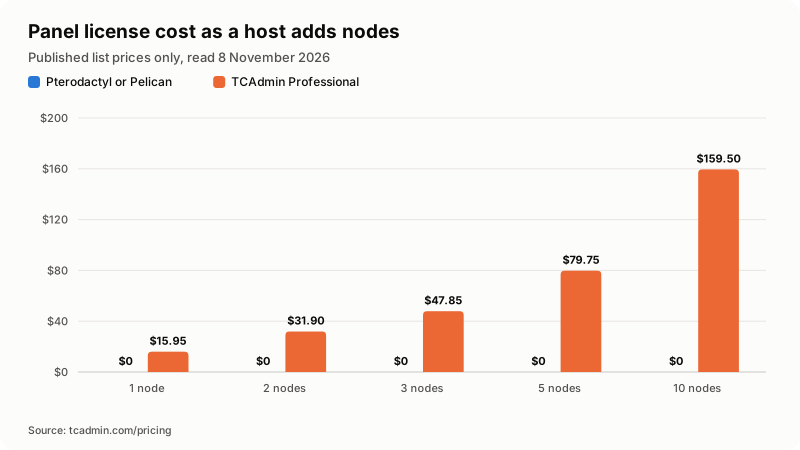
In numbers: Pterodactyl and Pelican stay at $0 at one, two, three, five and ten nodes. TCAdmin Professional is $15.95, $31.90, $47.85, $79.75 and $159.50 a month for the same node counts, because it is charged per machine and not per customer. CubeCoders publishes no AMP Enterprise figure, so it cannot sit on the same chart. Nothing here includes node rent, DDoS filtering or your WHMCS license.
Read the AMP Enterprise Terms of Purchase before you commit. The license is a subscription, may not be sold or disclosed to third parties, may not be licensed to anyone under 18, and may be revoked after a chargeback. Enterprise licenses are "very strictly non-refundable except in exceptional circumstances", and a downgrade takes effect only after one more payment at the current rate.
Which games does each panel ship configurations for?
All four install a game from a config file rather than from a shell script you write. Only TCAdmin publishes a count.
| Panel | What a game config is called | Published count | Mod installs |
|---|---|---|---|
| Pterodactyl | Eggs, with Docker images called yolks | Not published as a number | Through the egg and the file manager |
| Pelican | Eggs, inherited from the Pterodactyl format | Not published as a number | Through the egg and the file manager |
| AMP | Generic module templates | Not published as a number | Not checked |
| TCAdmin 3 | Game configs from the plugin repository | 94 games | Modrinth, CurseForge, Steam Workshop |
Pterodactyl keeps its official eggs in a game-eggs repository under the MIT license, with matching container images in yolks. Pelican uses the same egg concept, which is why its WHMCS module takes an egg_id like Pterodactyl's does. CubeCoders keeps community templates in AMPTemplates and AMP3Templates, both pushed within the last week. TCAdmin's home page claims 94 games with ready-made configs and adds that if a game runs from a command line, TCAdmin can host it.
No count here is a list of games you may sell. Publisher terms decide that, and they differ by game; that side is in my game hosting company guide.
How does each panel connect to WHMCS billing?
Every one of the four has a WHMCS module, but they are not in the same condition. This is the check that decides whether a paid order can create a server without you.
| Panel | Module | License | Last code push | State as published |
|---|---|---|---|---|
| Pterodactyl | pterodactyl/whmcs | MIT | 11 October 2026 | Works with Panel 1.x and 2.x |
| Pelican | pelican/whmcs | MIT | 16 August 2026 | README: "currently not in a functional state" |
| AMP | CubeCoders/WHMCSModule | MIT | 15 November 2024 | Public repository, 9 open issues |
| TCAdmin 3 | Shipped by the vendor | With the license | Not published | WHMCS module and billing API included |
The pterodactyl/whmcs README is the most detailed of the module READMEs I read. It sets the panel address as hostname, server type Pterodactyl, an empty username and the application API key in the password field, then a product of type Other pointed at that server group. Values such as memory, disk, cpu, egg_id, location_id and backups are overridden by naming a configurable option after them. Two notes matter before an upgrade: Panel 2.x has no nests, so the Nest ID setting is ignored, and older module versions cannot create servers or change packages on 2.x. Games needing several allocated ports are not supported yet.
The pelican/whmcs README opens with a caution that the module is not in a functional state and advises against production use. Its setup steps mirror Pterodactyl's, minus nests. AMP's module is at CubeCoders/WHMCSModule, public and MIT-licensed, last code push 15 November 2024, nine issues open when I read it today.
My step-by-step Pterodactyl and WHMCS setup walks the whole install, and suspensions wait on the WHMCS cron. Where a free module stops, at multi-port games, per-location stock rules or custom upgrade logic, the gap is filled with a custom provisioning module.
Is each panel still being maintained?
Three of the four shipped a release in the last month. The fourth, AMP, publishes no source repository, so its release history cannot be read the same way.
| Project | Latest release read today | Date | Status |
|---|---|---|---|
| Pterodactyl panel | v1.15.2 | 21 October 2026 | Stable |
| Pterodactyl panel | v2.0.0-beta.2 | 14 October 2026 | Pre-release |
| Pelican panel | v1.0.0-rc.2 | 22 October 2026 | Release candidate |
| TCAdmin | v3.22 | 13 October 2026 | Stable, per the vendor site |
| AMP | Not published on GitHub | Not published | Ask CubeCoders |
The Pterodactyl releases page shows 1.15.2 as a security release for php2shell, CVE-2026-109618 and CVE-2026-109619, with its Docker image moved to PHP 8.3.36 and session.upload_progress disabled in php-fpm. If you run PHP yourself rather than their image, that is the bug in my php2shell patch guide.
Pelican is moving fastest in commits and slowest in version numbers: its releases run from beta38 in August to rc.1 on 10 October and rc.2 on 22 October, and the panel repository had a code push on the morning I read it. The project also moved GitHub organizations, and the old pelican-dev account now carries only a notice pointing at github.com/pelican.
Which panel fits your hosting setup?
Start with the two constraints that remove options: Windows games and nodes that cannot run Docker. Everything else is a preference you can change later.
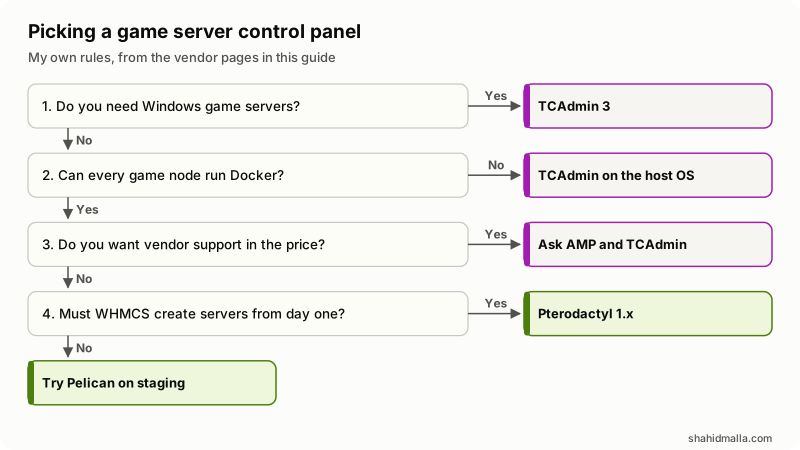
In words: Windows game servers point at TCAdmin, the only panel here whose own site lists Windows nodes. Nodes that cannot run Docker rule out Pterodactyl and Pelican, because both run every game server in a container, which leaves TCAdmin on the host operating system. If you want vendor support in the license rather than a community Discord, ask CubeCoders and TCAdmin for a quote. Otherwise it is timing: Pterodactyl 1.x if WHMCS has to create servers from day one, Pelican on a staging node if you can wait for its module. A panel is also the screen your customers see every day. TCAdmin publishes a public demo you can click through; for Pterodactyl and Pelican, put one on a spare node before you commit.
What does this comparison not tell you?
It compares published facts, not performance, and published facts have gaps. Here is what I could not confirm and where the risk sits.
- AMP's price. CubeCoders publishes no Enterprise figure. The editions sheet I read carries prices for non-commercial editions, but it was posted in 2022, so I will not quote them as current. Ask CubeCoders which edition a host needs.
- Performance. I ran no benchmarks. No panel here will fix an oversold node.
- Pelican's readiness. A release candidate panel plus a module its own README calls non-functional is fine on staging and expensive on a live order form.
- Pterodactyl 2.0. It is a pre-release. If you try it, update the WHMCS module before the panel, or orders will fail.
- Per-machine cost. TCAdmin's price grows with machines, not customers, so many small nodes cost more in licenses than a few large ones.
- Support. Pterodactyl and Pelican both send configuration questions to Discord rather than GitHub issues, so your own time is the support budget.
Switching panels later moves customer data, allocations and billing links, so a wrong pick is not free. The one documented shortcut I read today is Pelican's migration from Pterodactyl.
What else do people ask about game server control panels?
Is Pelican the same as Pterodactyl?
They share a design and the egg format, and Pelican's documentation offers Pterodactyl users a migration that keeps their data instead of a fresh install. They are separate projects with separate repositories and different licenses: Pterodactyl's panel is MIT, Pelican's panel is AGPL-3.0 with a MIT Wings.
Which game server control panel works with WHMCS?
All four publish a module. Pterodactyl's is free, MIT and current, with its last code push on 11 October 2026. TCAdmin includes a WHMCS module and billing API with every license. AMP's module is public but last changed on 15 November 2024, and Pelican's README says it is not functional yet.
How much does a game server control panel cost?
Pterodactyl and Pelican are free to license. TCAdmin is $7.95 a server a month for Community, up to four services, and $15.95 for Professional with unlimited services, read on its pricing page on 8 November 2026. AMP Enterprise is a subscription priced by instance count, and CubeCoders does not publish the figure.
Do I need Docker to run a game server panel?
For Pterodactyl and Pelican, yes: both run each game server in its own Docker container, so a node that cannot run Docker cannot host games for them. TCAdmin runs game and voice services on Windows or Linux directly, and also offers a Docker image that packages the panel itself.
Is Pterodactyl still maintained?
Yes, on the evidence I could read today. Stable 1.15.2 shipped on 21 October 2026 as a security release, the panel repository had code pushed on 5 November 2026, and a 2.0 line is in pre-release.
If you need a panel wired into billing in a way the free modules do not cover, I do that as custom WHMCS module development, and the wider build is on my hosting business page, with a free scoping call of about 30 minutes and a written quote within one business day.
Last reviewed 8 November 2026. Disclosure: I sell WHMCS and hosting development work, including provisioning modules for panels named here, so I am not neutral. I am CTO at ElySpace, a freelance developer for Marmaids LLC, and founder of WHMCSPilot and MagizAI. Prices, licenses, release dates and module states come from the vendor pages, license files and repository data linked above, read on 8 November 2026.