
To start an IPTV business legally, you need written distribution rights for every channel and title you sell, from the rights holder or a distributor it has authorized. Then you pick a model those rights allow (your own content, licensed niche channels, hotel and hospital TV, or private corporate TV), build encoding, delivery, middleware and apps, and connect billing that opens and suspends accounts.
An IPTV business delivers live TV channels and on-demand video over internet protocol networks to paying subscribers, hotel guests, patients or staff. It is legal when a license from the rights owner covers every stream it sends, for the territory, devices and audience it serves. Panels, apps and billing systems are tools: none of them supplies or licenses content.
This guide is for people who hold the rights or can get them. Law, enforcement and prices come from the linked pages, read on 5 November 2026. It is not legal advice: have a media or copyright lawyer in your country read your license agreements.
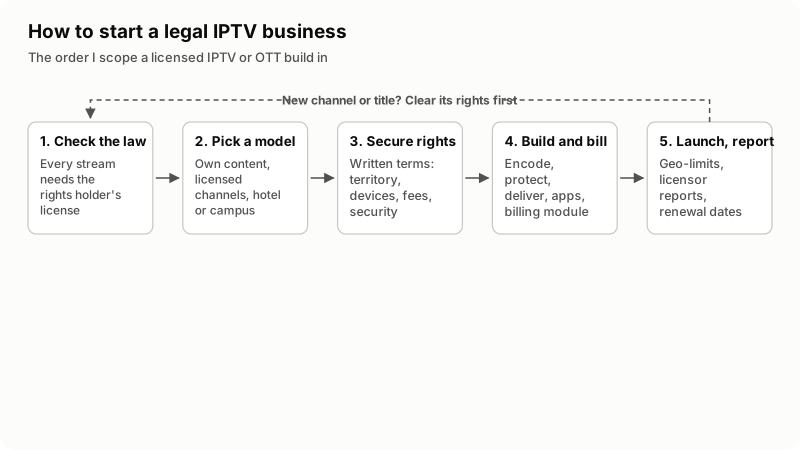
In words: check the law, pick a model, get rights in writing, build and bill, then launch and report.
What makes an IPTV business legal?
A license for every stream. Under US law, section 106 of the Copyright Act gives the owner of copyright in a motion picture or other audiovisual work the exclusive rights "to do and to authorize" its public performance, subject to the exceptions in sections 107 through 122. Section 101 says performing a work publicly includes transmitting a performance of it to the public "by means of any device or process," in the same place or separate places, at the same time or different times. In the Department of Justice case below, a jury convicted one operator of a paid streaming service of "criminal copyright infringement by public performance."
Selling streams you have no license for is not only a risk for whoever runs the servers. In that case a jury convicted five men of conspiracy to commit copyright infringement, and the roles the DOJ lists for the defendants include subscriptions and revenue and customer support. The record:
| Source | What it shows |
|---|---|
| U.S. Department of Justice, 22 July 2025 | Five men convicted over an illegal paid TV show streaming service were sentenced to terms of up to 84 months in prison. The government conservatively estimated the value of the copyright infringement at $37.5 million. |
| 17 U.S.C. 504(c) | A copyright owner may elect statutory damages of $750 to $30,000 per work, as the court considers just, instead of actual damages and profits. If the court finds the infringement willful, it may increase the award to up to $150,000 per work. |
| Alliance for Creativity and Entertainment press release, 3 October 2025 | Thailand's Department of Special Investigation, supported by ACE, searched six locations and seized 46 servers among other evidence, and shut down an illegal IPTV service. ACE says it works through criminal referrals, civil litigation and cease-and-desist operations. |
| European Commission Recommendation, 2023 | Its stated purpose is to combat online piracy of sports and other live events. It encourages Member States and all relevant stakeholders to take effective measures against unauthorized retransmission of live sports events. |
| EUIPO study, 28 November 2024 | Has IPTV piracy data for the first time. Actual consumption through IPTV remains unknown, but the study's simulations show this type of piracy growing. |
| Stripe, updated 22 September 2026 | Lists sales or distribution of music, films, software or other licensed materials without appropriate authorization among its prohibited businesses. |
If the business depends on a channel you cannot license, the business is the problem.
Which legal IPTV business model fits you?
Four models work legally; they differ in who pays and who grants the license.
| Model | Who pays | Licensing | Stack |
|---|---|---|---|
| Own or licensed content: OTT and VOD for a creator, church, school, gym or club | Viewers, members, or the organization | You own each video or license each title; music inside needs clearance | Video platform, CDN, player and apps, subscription billing |
| Niche and ethnic channels | Subscribers, monthly | Written license from each channel owner or an authorized aggregator | Live encoding, stream protection, CDN, middleware, apps, billing |
| Hotel and hospital IPTV | The property; guests sometimes pay for extras | Channels through a provider licensed for guest rooms | Middleware, in-room TVs or boxes, property system link |
| Private corporate or campus IPTV | The organization | Internal channels owned; outside channels from a licensed provider | Encoder, internal network, single sign-on, signage |
Own or licensed content: OTT for creators, churches, schools, gyms and clubs
The simplest model: a creator's courses, a gym's classes, a club's youth matches. The licensing work is inside the video: music, clips and footage you did not make. For US churches, CCLI's Streaming License extends its Church Copyright License to online worship and covers more than 450,000 songs performed live; the Streaming Plus License adds recorded backing tracks and multitracks. A gym should check its class music license covers streaming; a club should confirm in writing that its league lets it stream its matches.
Niche and ethnic channels with distribution rights
Channels for an audience the big platforms serve poorly, such as a language community abroad. It is legal when each channel's owner, or an aggregator that owner has authorized, licenses you in writing. Before any build, ask for the chain of rights from the channel owner to you, and read the security terms.
Hotel and hospital IPTV
The customer is the property. In the US, 17 U.S.C. 111(a)(1) says a secondary transmission of a work embodied in a primary transmission is not an infringement of copyright if it "is not made by a cable system, and consists entirely of the relaying, by the management of a hotel, apartment house, or similar establishment, of signals transmitted by a broadcast station licensed by the Federal Communications Commission, within the local service area of such station, to the private lodgings of guests or residents of such establishment, and no direct charge is made to see or hear the secondary transmission." I do not interpret how that text applies to a given property: ask a media or copyright lawyer in your country which channels the property may relay and which need a license for guest rooms. As the builder you integrate middleware, the in-room interface, the property system link and hardware; your contract should say the channel license stays with the property and its provider.
Private IPTV for corporate or campus use
Town halls to offices, channels to dorms, a factory's signage. What you produce is yours; outside channels come from a provider that sells to institutions. Access stays behind the network or single sign-on.
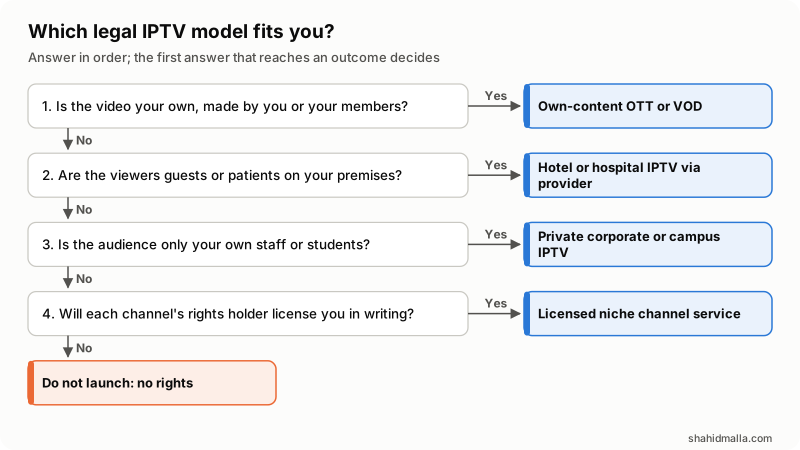
In words: own video means OTT; on-site guests mean hotel IPTV; staff or students only means private IPTV; otherwise you need each channel's written license, or you do not launch.
How do you get distribution rights for channels and titles?
You ask the rights holder for a written license before you spend money on the build. These are the terms I make sure a client has read before I scope anything:
| License term | What to confirm |
|---|---|
| Territory | The countries where you may sell. Geo-restriction must match it. |
| Platforms and devices | Set-top boxes, smart TV apps, mobile and web, each included or excluded. |
| Rights type | Live, catch-up, start-over or on demand: confirm which ones the license grants. |
| Fees and reporting | How you pay, and which subscriber reports the licensor expects. |
| Security | Encryption or DRM, simultaneous-stream limits, watermarking. |
| Term and exit | Dates, renewal, and what happens to subscribers if a channel leaves. |
| Resale | Whether you may appoint resellers, and on what terms. |
Keep a rights register from day one: one row per channel or title, with contract, territory, devices and expiry. It tells your team which channel to switch off the day a license ends.
What drives the cost of a legal IPTV business?
Content licenses and delivery for a channel business; delivery and apps for own content. License fees are negotiated privately, so I cannot quote them. Delivery has public prices, so model it first.
Cloudflare Stream's pricing page, read on 5 November 2026, is one example. Storage is prepaid in blocks of $5 a month for each 1,000 minutes of capacity, delivery is billed at $1 per 1,000 minutes delivered, ingest and encoding are free, and bandwidth is included in delivery. On-demand and live video are billed the same way. The rows below are worked examples, my own arithmetic on those list prices, not quotes:
| Worked example | Minutes per month | Cost at list price |
|---|---|---|
| Church: four 90-minute services, 150 viewers watching all of each, recordings kept (first month) | 54,000 delivered, 360 stored | $54 plus one $5 storage block: $59 |
| Gym: twenty 45-minute classes, 40 members watching each, recordings kept (first month) | 36,000 delivered, 900 stored | $36 plus one $5 storage block: $41 |
| Channels: 10,000 subscribers, two hours a day for 30 days | 36,000,000 delivered | $36,000 for delivery alone |
Kept recordings add up: each further 1,000 stored minutes adds $5 a month. For millions of minutes a month, as in the last row, Cloudflare's page points to its sales team for volume pricing. Music adds a fee too: CCLI's page says streaming license prices start from $84 a year for churches already licensed with CCLI, or $108 for an average church of 100 to 199 people.
Other drivers have no single public price: apps for each platform you support, middleware, DRM when a license requires it, live support, and a media lawyer.
What tech stack does a legal IPTV service need?
Six layers, whichever model you pick:
| Layer | What it does | What to decide |
|---|---|---|
| Intake and encoding | Turns the licensor's feed or your camera into streams at several quality levels, for example in HLS or DASH format | Cloud or your own encoders; how many quality levels |
| Protection | DRM or signed, expiring links; geo-restriction; simultaneous-stream limits | What each license requires; Widevine, Microsoft PlayReady and Apple FairPlay Streaming are DRM systems a license may name |
| Delivery | A CDN or video platform serves stream segments to viewers | Per-minute or per-gigabyte pricing; regions served |
| Middleware or panel | Subscribers, channel packages, program guide, devices, catch-up | An existing panel, an OTT platform or custom software |
| Apps | Web player, mobile, smart TV and set-top apps | Which platforms first; white-label or custom |
| Billing | Takes payment and turns access on and off | Platform billing, WHMCS with a provisioning module, or custom |
Hotel projects add device management for hundreds of identical TVs; campus projects add single sign-on. When the apps are the product, I build them as mobile app development work on your chosen delivery platform.
How do you bill subscribers and switch access on and off?
Billing must open access when someone pays and close it when they stop. Three routes work:
- The OTT platform's own billing. If you use a hosted video platform, check whether its own subscriptions and paywalls cover your plans before you add a separate billing system.
- WHMCS with a provisioning module. The WHMCS provisioning module documentation describes the core functions:
CreateAccountruns on checkout or payment of a new order,SuspendAccountwhen the cron finds a product overdue,UnsuspendAccounton payment of the overdue invoice, andTerminateAccountwhen the cron handles a long-overdue product (if enabled in Automation Settings) or an admin requests it. For IPTV those calls create, suspend, restore and remove a subscriber on the panel. - Custom billing. Worth it when licenses need reports no standard system produces. My WHMCS or custom billing comparison covers that trade-off.
I sell WHMCS modules for three panels, XUI, Xtream UI and NXT, listed with my other WHMCS modules, so weigh my view of the WHMCS route with that in mind. They are billing and provisioning software for licensed operators. They supply no streams, channels or content, and no billing module makes an unlicensed service legal. Middleware with an API but no module needs custom WHMCS module development; my provisioning module guide shows how one is built.
Expect payment processors to look closely: apply in your own business name, describe the service plainly, and keep the rights register ready.
What should you check before you launch?
That every stream on day one is covered by a license you can produce, and that the system enforces its terms:
- A signed license for every channel and title, filed in the rights register.
- Geo-restriction set to the licensed territories, tested from outside them.
- Stream protection and device limits that match each license.
- Music, clips and match footage in your own content cleared for streaming.
- Terms of service, a privacy policy and a contact for rights notices.
- Billing tested end to end: payment, overdue suspension, restore, termination.
- Subscriber reports in the format each licensor's contract asks for.
- License expiry dates in a shared calendar, with a plan to remove a channel on time.
Stop here if any line fails. Do not launch when the lineup needs channels nobody will license to you, or when a supplier bundles channels with software and cannot show the license chain.
What else do people ask about starting an IPTV business?
Is IPTV legal in the US?
IPTV is a way to deliver video; the law turns on what you stream. Under sections 101 and 106 of the Copyright Act, transmitting a film or show to the public is a public performance, which only the copyright owner may do or authorize, subject to the exceptions in sections 107 through 122. Ask a copyright lawyer whether an exception covers your plan.
Is IPTV reselling legal?
Only with authorization that traces back to the copyright owner, because section 106 reserves to the owner the right "to do and to authorize" a public performance. Get the operator's resale rights in writing and sign with that operator directly; a service with no rights has none to pass on.
Can you go to jail for IPTV?
For running an unlicensed streaming service, yes. In July 2025 the Department of Justice announced prison terms of up to 84 months for five men convicted over an illegal paid TV show streaming service.
How much does it cost to start an IPTV service?
There is no single number, because channel license fees are private. In my worked examples at Cloudflare Stream's list prices, a weekly church stream to 150 viewers is about $59 for the first month, and 10,000 subscribers watching two hours a day about $36,000 a month for delivery alone.
How do IPTV providers get their channels?
Licensed providers sign a distribution agreement with each channel owner, or with an aggregator the owner has authorized, for named territories and devices. A supplier that cannot show that agreement has nothing to license to you.
If you hold the rights and need the website, apps or billing built, I scope it on a free call of about 30 minutes and send a written quote within one business day; my IPTV website and billing packages show fixed-price options.
Last reviewed 5 November 2026. Disclosure: I build IPTV and OTT websites, apps and billing, and I sell WHMCS billing modules for XUI, Xtream UI and NXT panels for licensed operators; those modules supply no content. So I am not neutral. I am CTO at ElySpace, a freelance developer for Marmaids LLC, and founder of WHMCSPilot and MagizAI. This guide is not legal advice; ask a media or copyright lawyer in your country.