No, not as whole professions. In the peer-reviewed study that measures this on Upwork data, writing-related freelancers took 2% fewer jobs and earned 5.2% less per month after ChatGPT than freelancers in less exposed categories. Design freelancers showed the same pattern after image models. Demand for AI work grew at the same time. Tasks moved, trades did not end.
Replacement, in labor economics, is substitution at the level of tasks, not job titles. A freelance service is replaced when the client can get an acceptable result from a tool instead of a person, at a price the person cannot match. Most freelance jobs are bundles of tasks, so what actually happens is that a bundle loses some paid tasks and keeps the rest.
I sell AI work, so treat me as an interested party and check the sources yourself. I read every figure below at its own source on 6 November 2026, and I quote no earnings I cannot link. For the practical version, my guide on AI for freelancers covers tools, platform rules and client data. This one is about the evidence behind the headline.
What does the research actually show about AI and freelance work?
It shows a measurable fall in freelance jobs and earnings in the categories closest to what the models do, in the months right after each model launched. The study is The Short-Term Effects of Generative Artificial Intelligence on Employment: Evidence from an Online Labor Market by Xiang Hui, Oren Reshef and Luofeng Zhou, published in Organization Science, volume 35, issue 6, pages 1977 to 1989. I read the figures in the authors' CESifo working paper version, which is a free PDF.
The design matters more than the headline. The authors pulled the public work histories of about 92,000 Upwork freelancers who offer a single occupation, from January 2022 to April 2023, and compared writing-related freelancers with freelancers in categories ChatGPT touched less. Both groups lived through the same platform changes and the same economy, so the gap that opens after 30 November 2022 is attributed to the model release.
| What was measured | Change for writing-related freelancers | How confident |
|---|---|---|
| Monthly number of jobs | Down 2.0% | Error 0.004, significant at 1% |
| Monthly earnings | Down 5.2% | Error 0.016, significant at 1% |
| Chance of any job in a month | Down 1.2 percentage points | About a 10% fall from baseline |
| Jobs taken in months they worked | Down 4.7% | Error 0.011 |
| Earnings in months they worked | Down 5.1% | Error 0.037, which the paper calls much noisier |
Two things make those percentages smaller than they sound. The sample baseline is modest: the paper's summary table puts the average freelancer at 0.36 jobs a month, a job roughly once a quarter, and average monthly earnings of $171. And the falls are relative to the control group, not to zero. Freelance writing did not stop. It got measurably harder to win and measurably less well paid, in a matter of months.
Which freelance tasks shrank after generative AI arrived?
The ones where the client buys an output that a model can now produce at acceptable quality: content writing, editing and proofreading first, then design and image editing.
The authors ran the same test twice. The main analysis uses the ChatGPT release and writing-related occupations. The second uses the April 2022 release of image-based models such as DALL-E 2 and Midjourney, with design and image-editing freelancers as the affected group. The result was the same shape: fewer jobs and lower earnings for the exposed group, on both measures.
The finding that surprised me is about quality. The authors tested whether past jobs, past income, skill level of past work, a Top Rated badge, job success rate or hourly rate protected anyone. None of them did. The point estimates mostly run the other way, though in the ChatGPT analysis they are often not statistically significant. In the image-based analysis they are: freelancers with above-median prior earnings lost an extra 7% of jobs and 14% of income, both significant at the 1% level. Being good at producing the output did not shield anybody when the output itself got cheap.
Marketplace data since then points the same way on price. Upwork's Future Workforce Index, written by Jennifer Brett and Teng Liu, reports that generative AI and creative production work grew 90% year over year in contract starts while earnings per contract fell 13%, and that earnings on AI-based execution tasks fell 28% year over year. More work, less money per piece.
Which freelance work grew at the same time?
Work that puts AI inside somebody's business, and work that takes responsibility for the result. The same Upwork report gives the other half of the picture.
| Signal | Source and period | Figure |
|---|---|---|
| Hourly pay, AI work against no AI work | Upwork Future Workforce Index | 34% higher, across every category |
| Generative AI and creative production | Upwork, year over year | Contract starts up 90%, earnings per contract down 13% |
| AI-augmented professional services | Upwork, year over year | Up 72%, earnings up 22% |
| More complex work done with AI | Upwork, first quarter of this year | Earnings up 45% |
| Searches for AI automation | Fiverr, six months from May 2025 | Up 136% |
| Searches for prompt engineering | Fiverr, same period | Up 76% |
| Searches for AI video creators | Fiverr, same period | Up 66% |
The Fiverr numbers come from the marketplace's own Business Trends Index announcement, dated 10 December 2025 and drawn from millions of searches on the platform. Read them as demand signals, not as earnings: a search is a client looking, not a contract signed. The same release shows demand growing for plainly human services in the same months, including book publishing up 38%, book editing up 24% and social media managers up 33%.
Upwork's survey half says the supply side moved too. Skilled freelancing rose from 28% of skilled knowledge workers last year to 38% this year, and 58% of full-time employees say they are considering freelancing, up from 36%. More competition arrives at the same time as more demand, which is why the price of generic output keeps falling.
What held up in the official employment data?
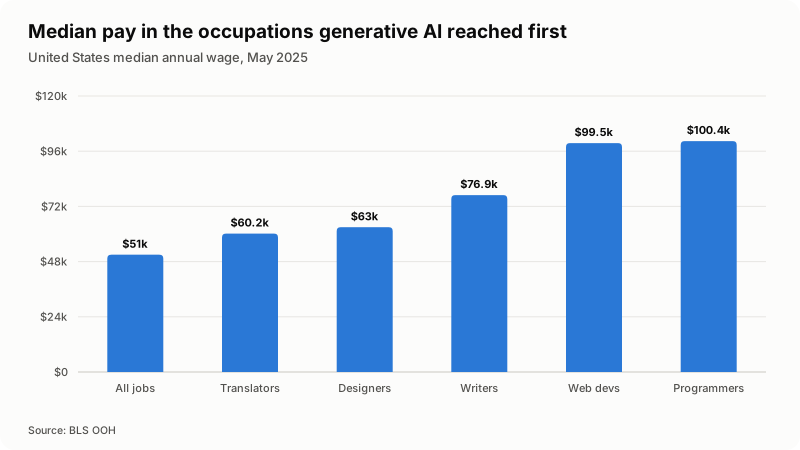
The occupations themselves held up better than the freelance gig counts did, but with no growth where AI bites hardest. The US Bureau of Labor Statistics publishes a ten-year outlook per occupation in its Occupational Outlook Handbook, and the pages I read were last modified on 27 August 2026.
| Occupation | Median annual pay, May 2025 | What the Handbook says |
|---|---|---|
| Writers and authors | $76,910 | 140,300 jobs, little or no change over the decade, a net fall of 500, about 11,900 openings a year, 65% self-employed |
| Editors | $77,920 | Media and communication group, projected to show little or no change |
| Interpreters and translators | $60,170 | Same group, about 88,500 openings a year across it |
| Graphic designers | $62,960 | Arts and design, projected to grow slower than the average for all occupations |
| Web developers and digital designers | $99,520 | Computer and IT, projected to grow faster than average, about 280,000 openings a year |
| Computer programmers | $100,390 | Same group, median wage $109,470 against $50,980 for all occupations |
The group statements come from the media and communication, arts and design and computer and information technology landing pages. The Handbook does not attribute its projections to AI, and I will not pretend it does. The split still matches the freelance evidence: text and image trades flat or slow, software trades still growing, and openings appearing in all of them as people retire and move on.
How do you test your own services against this evidence?
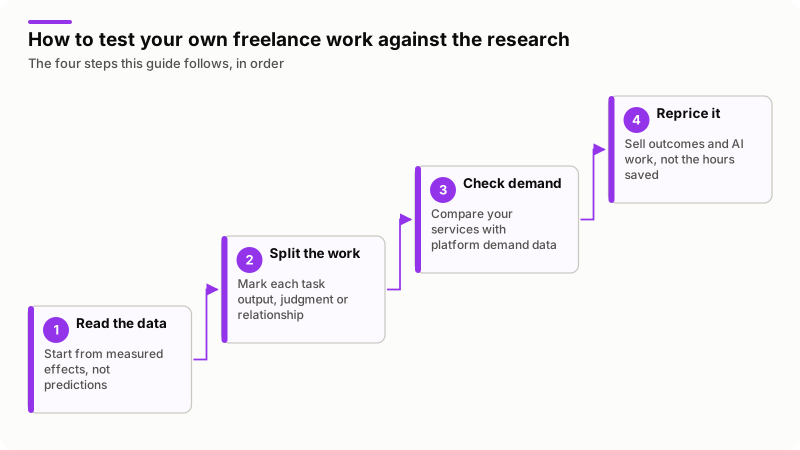
Take one service at a time and ask what the client is really buying. The research separates work by whether the paid output can be produced by a model, not by job title, so your own list has to be split the same way.
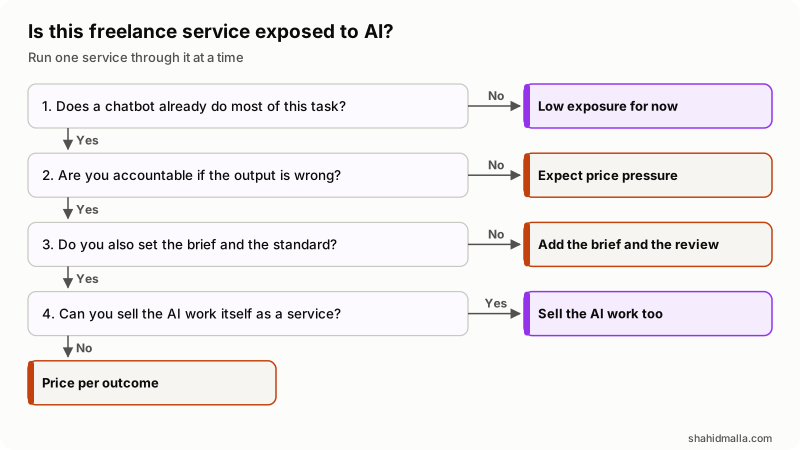
In words: if a chatbot does not already do most of the task, exposure is low for now. If it does, and you are not accountable for the result, expect price pressure. If you are accountable but somebody else writes the brief and sets the standard, add those two things to your offer. If you do all of it, the open question is whether you can sell the AI work itself as a service or price the outcome instead of the hour.
The checklist I run through for each service:
- Write the service as a list of tasks, then mark each one output, judgment or relationship.
- Count what share of your fee comes from output tasks. That share is the exposed part.
- Try the output task yourself in a current model, at the quality your client accepts, and time it.
- Check whether your platform's own demand data shows that service rising or falling.
- Check what your last five clients actually complained about. It is rarely the first draft.
- Decide for each service: drop it, bundle it into a bigger outcome, or sell the AI version of it.
How should you reprice what is left?
Stop selling the hours the model saved, because the evidence says the market takes that saving back quickly. Both halves of the Upwork data point the same way: the per-contract price of AI-assisted output work is falling while the volume rises, and the earnings premium sits with complex, accountable work.
Three moves follow from that, and I use all three in my own work.
- Price the outcome, not the time. A fixed price for a defined result keeps the productivity gain with you instead of handing it to the client as a smaller invoice. My comparison of retainer, hourly and fixed price sets out who carries the risk in each.
- Sell the accountable layer. Review, testing, security, compliance and handover are what a model cannot sign for. The Hui, Reshef and Zhou result says being excellent at output did not protect anyone, which is an argument for moving your fee onto the parts a client cannot take to a chatbot.
- Sell AI work as its own service. That is the fastest-growing line in both marketplaces' data: AI-augmented professional services grew 72% year over year on Upwork, and AI automation was among the fastest-rising searches on Fiverr.
If you are starting from nothing rather than repricing an existing book of work, my guide on how to make money with AI covers the routes in order of how hard they are to start.
What does this research not tell you?
More than most summaries admit. The authors are explicit about their own limits, and I would rather repeat them than oversell the paper.
- It is short-term only. The sample ends in April 2023, and the authors write that long-term implications may be significantly different.
- It is one platform. A freelancer who moved clients to direct contracts looks, in this data, like one who lost work.
- It is a snapshot of profiles. Attributes were collected once, in April 2023, and terminated accounts are not in the data.
- It measures relative change. Every figure is the exposed group against the less exposed group, not against last year.
- Marketplace reports are not peer reviewed. Upwork and Fiverr both sell freelance work, and their numbers describe their own platforms only.
- The BLS outlook is not an AI forecast. The Handbook projects occupations, not tools.
One more gap: nobody I read has a clean measure of freelancers who kept their income by changing what they sell. That is the group this guide is about, and the data does not see them.
What else do people ask about AI replacing freelancers?
Which freelance jobs are most at risk from AI?
On the measured evidence, the ones where the paid deliverable is generic text or a generic image. Hui, Reshef and Zhou treat content writing, editing and proofreading as the writing-related work ChatGPT hit, and design and image-editing work as what the image models hit. Both groups lost jobs and earnings. Risk follows the task, so a writer who also runs research, interviews and publishing is far less exposed than one who only supplies drafts.
Will AI replace graphic designers?
The evidence shows design work being repriced, not removed. Freelancers offering design and image-editing services saw fewer jobs and lower earnings after the image models arrived, and the effect was larger for those with above-median prior earnings. At the occupational level, the BLS projects arts and design occupations to grow slower than the average for all occupations over the decade, with about 76,400 openings a year.
Will AI replace web developers?
Nothing I read measures that the way the Upwork study measures writing. The BLS projects computer and information technology occupations to grow faster than the average for all occupations through the decade, with about 280,000 openings a year, and web developers and digital designers had a median wage of $99,520 in May 2025. That is the official outlook, not a claim that AI will leave coding alone.
Do Top Rated badges protect a freelancer from AI?
Not in this data. The authors tested the Top Rated badge, job success rate, hourly rate, past earnings, past job count and the skill level of past work. None of them softened the effect, and several results point the other way, with top freelancers hit harder in the image-based analysis. If you rely on marketplace status, read my Fiverr and Upwork comparison for what those badges do and do not buy.
Is it still worth starting freelancing now?
The people best placed to answer with numbers say yes, and they are selling you something, so weigh it accordingly. Upwork's survey puts skilled freelancing at 38% of skilled knowledge workers this year against 28% last year. The research adds a warning about what to start with: an output-only service walks straight into the part of the market where prices are falling.
Does using AI mean I should charge less?
No, and the data is the argument. Upwork reports that freelancers doing AI work earn 34% more per hour than those who do not, while earnings on simple AI execution tasks fell 28% year over year. Charge for the result and the responsibility, not for the minutes a model saved you.
If you want the AI part built rather than researched, hire me as an AI developer or for AI integration, with a free scoping call of about 30 minutes and a written quote within one business day at $55 to $65 per hour.
Last reviewed 6 November 2026. Disclosure: I sell AI development and integration work, so I am not neutral on this question. I am CTO at ElySpace, a freelance developer for Marmaids LLC, and founder of WHMCSPilot and MagizAI. Every figure here was read at its own source on 6 November 2026: the Organization Science paper and its CESifo working paper version, Upwork's Future Workforce Index, Fiverr's Business Trends Index announcement, and the US Bureau of Labor Statistics Occupational Outlook Handbook.